

Most ecommerce brands running a Klaviyo account have both flows and campaigns turned on. That part is not usually the problem. The problem is that they rarely understand – with any real precision – what each one is supposed to be doing, how they differ structurally, and how the balance between them should shift as the program matures.
The flows vs campaigns question isn’t a technical distinction. It’s a strategic one. And getting it wrong – by over-relying on campaigns while underbuilding automation, or treating flows as a set-and-forget box to check – is one of the most common reasons email programs plateau despite clean deliverability and a growing list.
This article breaks down both sides of that equation: what flows and campaigns each are, what they’re each responsible for across the customer lifecycle, and how a program that uses both well actually looks in practice.
Key takeaways
- Flows are triggered by customer behavior and run automatically. Campaigns are manually written, segmented, and sent. They solve different problems – and neither replaces the other.
- A program that’s heavily campaign-dependent is fragile. Revenue stops the moment someone stops hitting send. A program with strong flow coverage generates returns continuously, regardless of what’s happening on the campaign side.
- The most consistently underbuilt flow categories are post-purchase, cross-sell/up-sell, and win-back – not abandoned cart. Most brands have the obvious flows; the gaps are in the retention-side sequences.
- Campaigns are not a fallback for missing flows. A campaign calendar that fills in for absent automation is doing twice the work for half the compounding.
- Flows and campaigns require different management rhythms. Flows need architecture and continuous optimization. Campaigns need strategy, creative, and send discipline.
- The business metric that ties both together is repeat customer rate. If that number isn’t moving, neither flows nor campaigns are doing their real job.
What we’ll cover
- How flows and campaigns differ – mechanically and strategically
- What flows are actually trying to accomplish across the customer lifecycle
- The core flows every serious ecommerce brand needs
- What campaigns are responsible for that flows cannot do
- How to build a campaign strategy that doesn’t burn your list
- How revenue should split between flows and campaigns in a mature program
- The metrics that tell you whether both sides are working
- Where flows and campaigns fit within the wider retention system
How flows and campaigns differ
The mechanical difference is simple. Flows are automated email sequences triggered by specific customer actions or time-based conditions. No one hits send. A customer adds to cart and leaves – the abandoned cart flow fires. A subscriber makes their first purchase – the post-purchase flow activates. A customer goes quiet past their expected repurchase window – the win-back flow starts. The logic runs continuously, around the clock, without manual input.
Campaigns are the opposite. Someone on your team writes them, segments the audience, reviews the creative, and schedules the send. They can be planned in advance and managed against a calendar, but they require human decisions at each step.
That mechanical difference points to something more important: the jobs each one is built to do.
Flows are designed to respond to individual customer behavior at scale. The premise is that a customer who just abandoned a $200 cart is in a fundamentally different state than a customer who hasn’t engaged with your emails in 60 days. Flows address each of those states automatically, with messaging calibrated to the specific moment. That personalization – triggered by real intent signals rather than a calendar date – is what makes flows disproportionately effective in retention contexts. According to Omnisend’s 2026 Ecommerce Marketing Report, which analyzed over 470 million automated email sends across 27,000+ brands, automated emails generate 22x more revenue per send than standard campaign emails – a gap that compounds directly from the behavioral precision of the trigger.
Campaigns are designed to create moments. Urgency around a sale event. A new product introduction. Seasonal relevance. A piece of educational content that builds brand credibility. Campaigns reach a defined segment on a specific date because something worth saying is happening, or because maintaining consistent brand presence matters even when there’s no behavioral trigger to work from.
Neither model makes the other redundant. Brands that only run flows have a behavioral layer but no broadcast voice – no way to create urgency, announce launches, or communicate things that don’t fit into an automated sequence. Brands that only run campaigns have a broadcast voice but no behavioral layer – every customer gets the same calendar regardless of where they are in their journey, whether they bought yesterday or haven’t engaged in months.
The goal is a program where both parts are working at the same time, covering different dimensions of the customer relationship.
What flows are actually trying to accomplish
The right way to evaluate a flow is not “does it send emails?” It’s “does it address a real moment in the customer journey, and does it do useful work at that moment?”
Every ecommerce customer moves through a recognizable sequence of stages: discovery and subscription, pre-purchase consideration, checkout-stage drop-off, first purchase, post-purchase engagement, second purchase, repeat buying, at-risk lapsing, and eventual disengagement. Flows exist to address the natural drop-off points in that sequence – to be present at exactly the moments where customers are most likely to either advance or fall away.
This is what makes flow architecture different from campaign planning. A campaign might reach a subscriber on a Tuesday because that’s when the send was scheduled. A flow reaches them when they’re actually doing something – browsing, hesitating, buying, or going quiet – because the trigger is their behavior, not your calendar.
That behavioral precision is the source of flows’ leverage. And it’s also why a poorly built flow architecture is so costly. If a customer makes their first purchase and nothing happens beyond a transactional shipping notification – no welcome into the brand relationship, no cross-sell, no path toward a second order – that’s not a neutral outcome. It’s a missed opportunity at the highest-engagement moment in the lifecycle.
The core flows every serious ecommerce brand needs
For a complete breakdown of how these flows fit together as a system – including sequencing logic, zero-party data integration, and customer journey mapping – our guide to Klaviyo flows for ecommerce brands covers the full architecture.
Welcome series
The welcome series is the first conversation you have with someone who’s expressed interest but hasn’t committed to buying yet. Its job is to convert that interest into a first purchase – but it also sets the tone for everything that follows.
The welcome window (roughly the first 7-14 days after sign-up) is the highest-engagement period in the subscriber lifecycle. New contacts are more receptive to your brand story than they’ll be at almost any later point. A well-built welcome series uses that window deliberately: delivering on any sign-up promise, building credibility through product education and social proof, and creating a reason to act before the incentive window closes. For a deeper look at how to structure each email in the sequence – including incentive logic and zero-party data collection – our welcome email series guide for ecommerce brands covers the architecture in full.
The strategic detail that most brands miss: subscribers who convert during the welcome series should exit the flow and enter the post-purchase sequence. Continuing to send welcome emails to a paying customer signals that your system doesn’t know who it’s talking to – and that breaks trust in a very basic way.
Abandoned cart flow
Abandoned cart is the most visible flow in Klaviyo and the most commonly built. The trigger is clear: someone started checkout and didn’t finish. The flow’s job is to bring them back.
But framing it purely as “recovery” understates what’s happening. Cart abandonment almost always has a reason. Baymard Institute’s aggregated checkout research documents an average abandonment rate of around 70% across industries, with the most common causes ranging from unexpected shipping costs to second-guessing and distraction. A well-sequenced abandoned cart flow doesn’t just remind someone they left items behind. It addresses the friction point.
A basic sequence runs 2-3 emails: a clean reminder within an hour or two (when intent is still warm), a trust-building second email 12-24 hours later (reviews, returns policy, product-specific reassurance), and an optional third with a modest incentive for subscribers who haven’t responded to the first two. Segmenting by cart value, whether the customer is a first-time or returning buyer, and what’s in the cart produces meaningfully better results than a single generic sequence. Our Shopify abandoned cart email guide goes deeper on the structural decisions that separate a functional recovery sequence from one that compounds over time.
Browse abandonment
Browse abandonment is the most commonly missing flow in underperforming programs. The trigger fires when a subscriber views a product page but doesn’t add anything to cart. Lower intent than cart abandonment – but still a deliberate buying signal, particularly when someone returns to the same page multiple times.
The flow typically runs 1-3 emails, personalized to the specific product viewed. It should include a filter to suppress subscribers who already triggered an abandoned cart event in the same session – redundant touchpoints from two parallel sequences feel aggressive and damage trust.
This flow operates against a much larger pool than abandoned cart (many more people browse than reach checkout), and at brands generating $300K+/month, that volume makes the revenue contribution real even at lower individual conversion rates.
Post-purchase sequence
If there’s one area where ecommerce brands consistently underinvest, it’s post-purchase. Most treat the order confirmation and shipping notification as the full post-purchase experience. Those are transactional emails – they confirm logistics. They are not a retention strategy.
The marketing post-purchase sequence starts after delivery, when the customer has the product in hand and the logistics phase is complete. Its job is to do several distinct things:
Product onboarding. For any brand in health, beauty, supplements, or a category with a learning curve, helping the customer get actual results from the product directly affects whether they come back. A customer who uses a product correctly and sees results is far more likely to buy again than one who fumbled through it and felt vaguely disappointed.
Review request. Timed to 1-2 weeks post-delivery, when the experience is fresh. Not buried in a multi-purpose email – a dedicated request that makes the process frictionless.
Cross-sell introduction. Once the customer has had time to experience the product, an email introducing a complementary item – with a clear rationale for why they pair well – converts far better than a generic product recommendation block.
Path to second purchase. The second purchase is the most predictive indicator of long-term customer retention. A post-purchase flow that actively guides a first-time buyer toward that second order – through product recommendations, a relevant nudge based on your repurchase window, or a loyalty program invitation – is one of the highest-leverage investments in customer lifetime value the entire email program offers. Smile.io’s 2025 State of Ecommerce Customer Loyalty report, drawing on 585 million orders across 100,000+ merchants, found that repeat customer rates increased year-over-year across every major industry vertical – underscoring how much retention opportunity exists once the first purchase is made.
First-time vs. repeat buyer branching. These two audiences need different sequences. A customer buying for the third time doesn’t need product education. They need acknowledgement, a contextually relevant cross-sell, and potentially an introduction to a VIP tier. Serving both with the same emails is a personalization miss at the most valuable moment in the lifecycle. For a full breakdown of how to build this sequence email by email – including the first-time vs. returning buyer split – our post-purchase email flow guide covers the architecture in detail.
Cross-sell and up-sell flows
Cross-sell and up-sell logic is frequently collapsed into the post-purchase sequence as a few product recommendation emails. That works at a basic level but misses the real opportunity. A dedicated cross-sell or up-sell flow – triggered by a specific product purchase – can be timed to the natural product cycle, personalized to what the customer actually bought, and structured around the logic of how your customers actually progress through your catalog.
The trigger is a specific purchase event. The timing depends on the product: a cross-sell for a complementary skincare product makes more sense two to three weeks after purchase than the same day. An up-sell toward a premium tier makes sense once the customer has had enough experience with the base product to understand the value gap.
The underlying principle: a recommendation that genuinely fits the customer’s purchase history lands as helpful. A generic product push reads as broadcast. That difference is why these flows deserve their own sequence rather than being appended to an already-busy post-purchase stack.
Win-back flow
A win-back flow is triggered when a customer who has previously purchased goes longer than expected without buying again. The operative phrase is “longer than expected” – and the expected window should be based on your brand’s actual average repurchase frequency, not a generic 90-day or 180-day default.
If your average order frequency is 45 days, a customer who hasn’t purchased in 65 days is statistically lapsing. Triggering a win-back at that point – when there’s still a residual connection to the brand – is very different from a 180-day trigger, when most customers who were going to return have already done so, and those who haven’t have largely moved on. A 180-day win-back is rarely a retention tool. In most categories, it’s a Hail Mary.
The sequence typically runs 2-4 emails, starting with a relevant reason to return (a new product, a seasonal moment, a reminder of what the original purchase delivered) rather than an immediate discount. The discount, if used, should be the last push – not the opening move.
VIP and loyalty escalation flow
The customers who’ve bought four or five times, who have the highest lifetime value, and who are most likely to refer new customers often receive the same automated experience as someone who bought once six months ago. That’s a structural gap in how most programs think about their best customers. According to Smile.io’s loyalty research, the top 5% of customers generate an estimated 35% of an ecommerce store’s revenue – making the incremental investment in a VIP escalation sequence one of the highest-return plays in retention email.
A VIP escalation flow triggers when a customer crosses a threshold you define based on your AOV and customer data. Its job is to acknowledge loyalty in a way that feels meaningful – early access, exclusive product offers, a personal tone, or a formal loyalty tier entry – and give the customer structural reasons to stay. The economics are straightforward: the incremental cost of this sequence is small relative to the revenue contribution of a retained top-tier customer.
Sunset flow
The sunset flow is distinct from every other flow listed here because its purpose is not revenue – it’s list hygiene and deliverability protection.
It triggers for subscribers who haven’t engaged with any email over an extended window (typically 90-120 days depending on your send frequency). It makes a final, transparent re-engagement attempt: “We haven’t heard from you – do you still want to hear from us?” If they engage, they stay. If they don’t respond after two or three attempts, they get suppressed.
Why this matters: inbox providers use engagement signals as the primary input for placement decisions. Sending consistently to a list with a high proportion of chronically unengaged subscribers drags down sender reputation and gradually routes more of your emails into spam. The sunset flow removes that drag. It does not drive revenue – but it protects the channel that does. Keep it clearly separated from your revenue-driving automation architecture.
What campaigns are responsible for that flows cannot do
Flows handle behavioral moments. Campaigns handle the broadcast layer – everything that’s relevant to a segment at a specific point in time, regardless of what individual customers are doing in their journey.
The things campaigns do that flows can’t replace:
Creating commercial urgency. A sale event, a limited-time offer, a flash drop – these are time-bound moments that require reaching your audience at a specific point. Flows are triggered by behavior; they can’t create urgency around an external deadline. Campaigns can.
Launching new products. A new product introduction needs to go to your audience when the launch happens – not when a behavioral trigger fires weeks later. Campaign sends are how product news reaches the list while it’s still news.
Building brand depth between purchases. Not every email a customer receives should be asking them to buy something. Educational content, behind-the-scenes brand storytelling, use-case inspiration, and values-driven communication build the kind of relationship that makes customers receptive to the commercial sends they’ll also receive. Campaigns are the channel for this kind of relationship maintenance.
Responding to external moments. Seasonal relevance, cultural moments, market events – these don’t wait for a behavioral trigger. Campaign sends are how brands stay contextually present in the inbox.
Maintaining presence with engaged non-purchasers. Subscribers who haven’t bought but are still engaging with your emails represent warm interest. Flows respond to them only when they take specific actions. Campaigns keep the brand relationship alive in the gap between those actions.
The thing campaigns cannot do is replace missing flows. A campaign to recently lapsed customers every quarter is not the same as a properly timed win-back flow. A campaign to recent purchasers with cross-sell suggestions is not the same as a trigger-based cross-sell flow with product-specific timing. Campaigns operate on a calendar. Flows operate on customer behavior. Trying to use one to compensate for the absence of the other means you’re spending more effort for fundamentally worse output.
How to build a campaign strategy that doesn’t burn your list
The pattern that degrades most campaign programs is consistent: a brand discovers that promotional sends drive attributable revenue, starts sending more of them, gradually trains subscribers to expect discounts, and then watches full-price conversion decline over time. Subscribers stop opening non-promotional emails because they’ve learned that discounts come around often enough to wait.
Avoiding that cycle requires intentional content balance.
A healthy campaign calendar balances four content types:
Promotional. Sale events, limited-time offers, clearance, seasonal pricing. These should have a commercial rationale and shouldn’t overlap with discount flows that are already running for the same segment.
Product-led. New arrivals, bestseller spotlights, restocks. Commercial intent without relying on price reduction as the mechanism.
Educational and value-driven. How-to content, ingredient or material breakdowns, usage guides, brand stories. These build credibility and genuine engagement – and protect deliverability by generating real opens and clicks from interested subscribers, not just conditional responses to offers.
Social proof. Customer stories, review compilations, user-generated content. Particularly effective for building trust with first-time buyers who are still deciding whether this is a brand worth repeat purchasing from.
If your last eight campaign sends were promotional, the calendar needs rebalancing. Subscribers who only hear from your brand during discount periods learn to tune out everything else – and when you need that engagement for a high-stakes commercial moment, it isn’t there.
Segmentation is not optional for campaigns. Sending the same message to your entire list is both a deliverability risk and a conversion drag. A returning customer with four previous purchases responds differently to a promotional email than a one-time buyer from eight months ago. VIP customers shouldn’t receive the same message as subscribers who’ve never converted.
A functional segmentation framework for campaign sends:
- Active engaged subscribers (opened or clicked within 60-90 days)
- Recent purchasers (bought in the last 60-90 days) – highest commercial intent
- Lapsed subscribers (haven’t engaged recently but haven’t been suppressed) – lower frequency, re-engagement focus
- Historical purchasers beyond the active window – win-back eligible, different message frame
That framework is enough to make every campaign more targeted and more relevant than a list-wide blast.
How revenue should split between flows and campaigns
In a well-built email program, revenue distributes meaningfully between flows and campaigns. In a mature program, that split approaches 50/50. In an underdeveloped one, campaigns dominate – often accounting for 70-85% of all email-attributed revenue.
That imbalance is a signal, not a success metric. A program where campaigns generate the vast majority of email revenue is a program where automation isn’t doing its job. It also has a hidden vulnerability: revenue stops when someone stops hitting send. Flows generate returns whether or not your team touches the program on any given week.
The practical implication when auditing your own program: if your Klaviyo reports show that most revenue is consistently coming from manual campaign sends, that’s the indicator that flow coverage – not campaign creative – is where the leverage is.
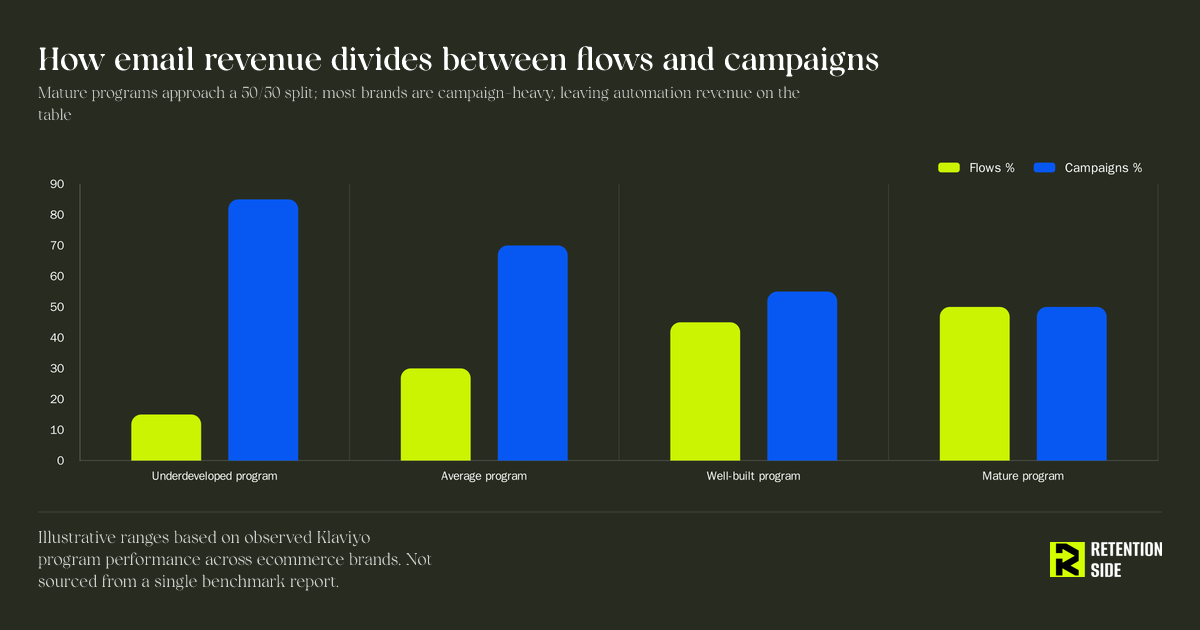
The chart above illustrates a pattern we see across ecommerce accounts at different stages of program maturity. Brands in the early stages lean heavily on campaigns because campaigns are visible and easy to attribute. As the flow architecture gets built out – post-purchase, cross-sell, win-back, VIP – the automation share grows, and the program becomes less dependent on weekly campaign effort for its baseline revenue.
Getting to an even split doesn’t happen all at once. It happens as individual flow gaps get closed: a missing post-purchase sequence gets built and starts converting, a cross-sell flow gets added and compounds over time, a win-back trigger gets adjusted to a more accurate repurchase window and starts catching customers before they fully disengage.
The metrics that tell you whether both sides are working
The metrics worth tracking for flows and campaigns are the same metrics worth tracking for the overall email program – because both formats ultimately exist to move the same business outcomes.
Repeat customer rate (returning customer rate). This is the single most important retention metric. It measures what percentage of customers in a given period placed more than one order. If flows are working and the campaign calendar is doing its job, this number should trend upward over time. Smile.io’s research across 585 million orders found that repeat customer rates increased year-over-year across all major ecommerce industries in 2024 – an encouraging signal that systematic retention investment does compound. If it isn’t moving despite strong email activity, the issue may be upstream of email – product, post-purchase experience, pricing, or acquisition quality.
Revenue attributed to retention channels. What share of total store revenue is coming from email, SMS, and related channels? The specific percentage that represents “good” varies significantly by category and business model – be skeptical of universal benchmarks. The question that matters is whether the number is growing in proportion to your investment in the program.
Flow-specific conversion metrics. For each core flow, what’s the conversion rate? What revenue is it generating per trigger? These numbers tell you where the automation layer is performing and where it needs work. They’re also the baseline against which A/B tests are measured.
Deliverability metrics. Inbox placement rate, spam complaint rate, bounce rate. These are leading indicators – they tell you about problems before those problems appear in revenue data. An email that doesn’t reach the inbox has a zero percent conversion rate regardless of how good the creative is.
List growth rate (with quality lens). Not just whether the list is growing, but whether the new subscribers eventually buy. The real KPI for list growth is lead-to-customer conversion rate, not subscriber count. A growing list with a declining lead-to-customer rate is a deliverability risk and a sign that the acquisition strategy is attracting the wrong audience.
What to deprioritize: open rate, click rate, and revenue per recipient. Open rates have been materially inflated by Apple Mail Privacy Protection‘s pixel pre-fetching since 2021. Click rates are diagnostic, not strategic. Revenue per recipient treats every email as if its purpose is immediate conversion – which ignores the educational and relationship-building emails that make commercial sends work when it counts. These metrics might be useful for diagnosing specific anomalies, but they don’t tell you whether your program is actually building the business.
Where flows and campaigns fit within the wider retention system
Email – flows and campaigns combined – is the foundation of most ecommerce retention systems. It has the largest addressable audience on any given list, the deepest behavioral data integration (particularly through Klaviyo), the most content flexibility, and the most reliable direct attribution of any retention channel.
But email alone leaves gaps. Some customers don’t engage with email consistently. Some segments respond better to SMS in the moments that matter. High-value customers at certain price points benefit from a physical touchpoint that digital channels can’t replicate – and that’s where direct mail becomes a distinct retention channel worth considering. Customers with meaningful purchase history and the right category economics benefit from a structured loyalty program that gives them structural reasons to stay, not just promotions that condition them to wait for deals.
The structure of a well-built retention system isn’t “email first, then everything else.” It’s: build the email infrastructure properly – deliverability clean, flows covering the full lifecycle, campaigns strategic and disciplined – and then expand into additional channels based on where the behavioral gaps are. SMS for customers who don’t open email but respond to mobile messages. Push notifications for re-engagement at high-intent browsing moments. Loyalty programs for customers whose purchase history justifies a structured relationship. Direct mail for high-AOV segments where a physical touchpoint meaningfully outperforms a digital one.
WhatsApp and Viber are increasingly relevant in markets where those channels dominate consumer messaging behavior. The logic is the same: meet customers on the channel they actually use, with communication that fits that channel’s format and expectations.
What makes this work is not adding channels for its own sake. It’s understanding that flows and campaigns in email are the starting point – and that the same principle driving good email strategy (meet the customer where they are, with a message calibrated to their moment) applies across every channel in the retention stack.
At Retention Side, email via Klaviyo is where retention work starts. It’s where the behavioral infrastructure gets built, where the customer lifecycle gets mapped, where the automation runs first. Everything else extends from that foundation – not as an add-on, but as a deliberate expansion of the same system. If you’re evaluating whether your current Shopify email marketing strategy has the right flow architecture in place before expanding to other channels, that’s the right sequencing question to be asking.
Flows and campaigns: a few operational principles worth keeping
Flows are never finished
The most important operating principle for flow management: a flow goes live and then gets improved continuously. A welcome series built two years ago and left untouched is almost certainly underperforming relative to what it could be doing. Every flow has testable variables – subject lines, timing, email count, incentive structure, branching logic – and every test produces learnings that sharpen the sequence.
A/B testing should be continuous, not occasional. The brands that compound flow performance over time are the ones running at least one active test on each major flow in any given quarter.
Filters and smart sending prevent overlap
Multiple flows running simultaneously create the risk of sending too many emails in a short window, or reaching a subscriber with a message from a sequence that’s no longer relevant. A subscriber who just completed a purchase should be filtered out of the abandoned cart flow. Someone mid-welcome series shouldn’t be pulled into a browse abandonment sequence triggered by a product view from within that email. These filter conditions are not edge cases in a mature account – they’re the mechanics that keep the subscriber experience coherent rather than chaotic.
Campaign frequency and incentive discipline go together
A campaign strategy that sends discounts frequently enough trains subscribers to wait for them. An incentive in a welcome series that’s visible in email one gives subscribers no reason to act before the final nudge. Both situations create the same problem: subscribers learn when to expect the deal and disengage with everything else in the meantime.
The discipline is the same in both contexts: position incentives where they do the most work (later in a sequence, for subscribers who haven’t responded to non-incentive touches), not as a default opener because it’s easier.
Coverage before optimization
There’s a sequencing priority worth applying to flow architecture: building coverage across the full customer lifecycle is more valuable than deeply optimizing a single flow in isolation. A brand with a perfectly tuned abandoned cart flow but no post-purchase sequence is investing heavily at one stage of the journey while leaving major stages unaddressed.
The audit question to ask regularly isn’t “how can we improve this flow?” – it’s “are there stages in the customer lifecycle where we have no automated coverage at all?” The answer to that second question usually points to higher-leverage work than another round of subject line testing.
Conclusion
Flows and campaigns are not in competition with each other. They’re solving different problems at different layers of the same email program. Flows address behavioral moments across the customer lifecycle – automatically, at scale, at exactly the right time. Campaigns create commercial moments, maintain brand presence, and do the broadcast work that no automated sequence can replicate.
A program that’s strong on campaigns but weak on flow architecture is working harder than it needs to for its baseline revenue. A program that’s strong on flows but treats campaigns as an afterthought is leaving relationship depth and commercial urgency off the table.
What a genuinely mature program looks like: full lifecycle flow coverage that runs continuously and improves over time, a campaign calendar disciplined enough in its content balance to build engagement rather than erode it, and the metrics in place to tell you which side needs attention at any given point.
The single metric that ties both together is repeat customer rate. If that number isn’t trending upward, something in the system – the flow architecture, the campaign strategy, the list quality, or something upstream of email entirely – needs attention.
Getting both sides right isn’t a one-sprint project. It’s the ongoing operational work of a serious retention program. Brands that treat it that way are the ones whose email programs keep compounding year after year – not plateauing after the first good quarter.