


Most ecommerce brands find themselves stuck in the same loop: paid acquisition is working, revenue is growing, but the numbers never quite compound the way they should. Every month feels like starting over because the majority of customers bought once and disappeared. CAC keeps creeping up. Margins thin. The growth looks impressive on a revenue chart but fragile underneath.
This article is about the choice that sits at the center of that problem – how to think about customer retention vs acquisition as an ecommerce brand, when to push harder on each, and why the real answer is more nuanced than most marketing content makes it sound.
Key takeaways
- Acquisition brings customers in. Retention determines whether the business compounds or resets every month. You need both, but most brands underinvest heavily in one.
- Repeat purchase rates vary dramatically by category. There is no single universal benchmark that tells you whether your retention is healthy.
- The second purchase is the highest-leverage moment in any customer relationship. Brands that win it build something durable. Brands that miss it pay acquisition cost again.
- Retention is a system, not a single campaign or channel. Email is usually where it starts, but sustainable retention runs across the full customer lifecycle.
- Throwing discounts at a retention problem does not solve the underlying issue. It defers it while eating margin.
The way most brands frame this question is wrong
When ecommerce operators ask whether they should focus on retention or acquisition, they usually mean where should the next dollar go. That is a budget allocation question, and it is the wrong frame.
The better question is: at what point does acquisition become the constraint, and at what point does retention become the constraint?
Every ecommerce business has both problems simultaneously – you need new customers, and you need to keep them. The question is which one is the active bottleneck on growth right now. For most brands doing $300K or more per month in revenue with a working paid channel, the bottleneck is almost never more acquisition. It is the return rate on the customers they have already paid to acquire.
Here is a simple way to see this. If your repeat purchase rate is 20% and your average CAC is $65, you are effectively paying $65 for every customer who brings you one sale and then disappears. For the 20% who come back, the economics are transformed – the cost to reach them through email or SMS is a fraction of a dollar, and they spend significantly more per order than first-timers do. The brands that grow profitably are the ones who increase the size of that 20%, not just the total volume of the 80%.
That said, you cannot retain your way out of a broken acquisition funnel, and you cannot acquire your way out of a product or experience problem. The relationship between retention and acquisition is not a tradeoff. It is a system. Acquisition feeds the top. Retention determines what stays.
What the economics actually look like
The gap between retention and acquisition economics is well established. Acquiring a new customer costs five to twenty-five times more than retaining an existing one, depending on category and channel. Repeat customers spend roughly three times more per visit than first-time buyers. And after a customer makes a second purchase, the probability of a third jumps from 27% to 45%.
That compounding effect is what makes retention investment disproportionately valuable over time – not any single email campaign or loyalty point.
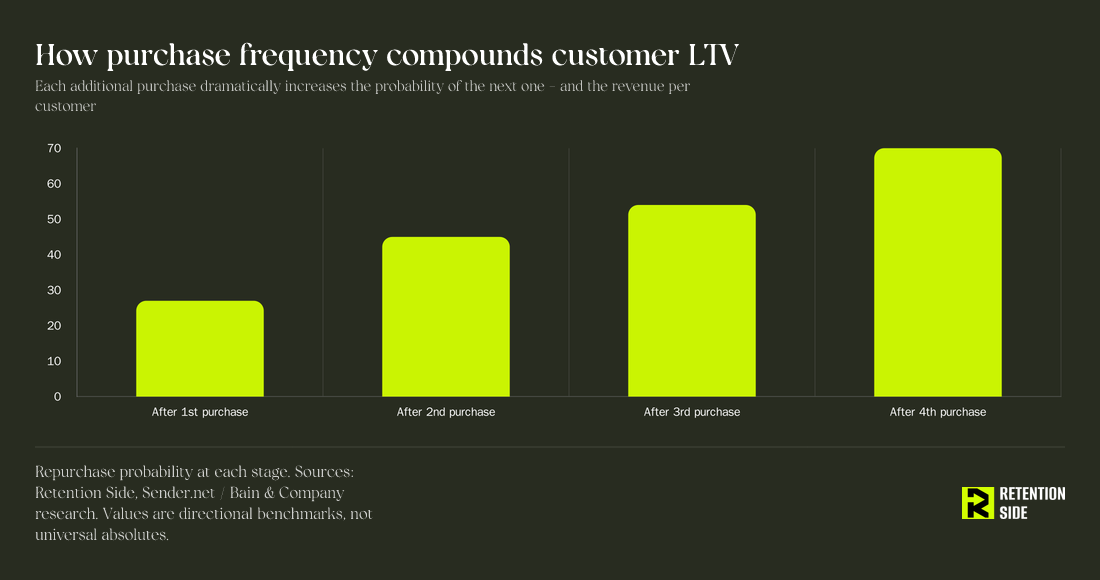
A 5% improvement in retention rate can boost profits by anywhere from 25% to nearly 100%, depending on the business model. This finding traces back to Bain & Company’s foundational research on customer defections, originally published in Harvard Business Review, which established that the longer a customer relationship holds, the more disproportionately profitable it becomes. The range is wide because the impact is highly sensitive to margin structure – a high-margin supplement brand gets more from the same percentage improvement than a thin-margin apparel brand. But the direction is consistent across categories: better retention compounds, worse retention bleeds.
The flip side is what happens when acquisition-heavy brands ignore this. CAC has risen roughly 40% between 2023 and 2025 for ecommerce brands on average. Most ecommerce businesses now lose money on the first customer order – the average net loss per acquired customer is around $29 after returns and acquisition costs, up from $9 in 2013. The model only works if the customer comes back. If they do not, every ad dollar spent is a subsidy for a single transaction.
Why repeat purchase rates vary so widely by category
The conversation about retention benchmarks gets confused because people apply universal averages to highly variable categories. The median ecommerce repeat purchase rate across a 471-store Shopify sample sits around 27% at the 365-day window – which sounds like a useful reference point until you realize it spans a grocery delivery app at over 44% and an electronics retailer at 11% in the same number.
The nature of the product drives repurchase behavior more than almost any marketing tactic. A daily supplement with a 30-day supply has a structural reason to create repeat purchases. A luxury watch does not. Trying to hold both to the same retention standard is analytically meaningless.
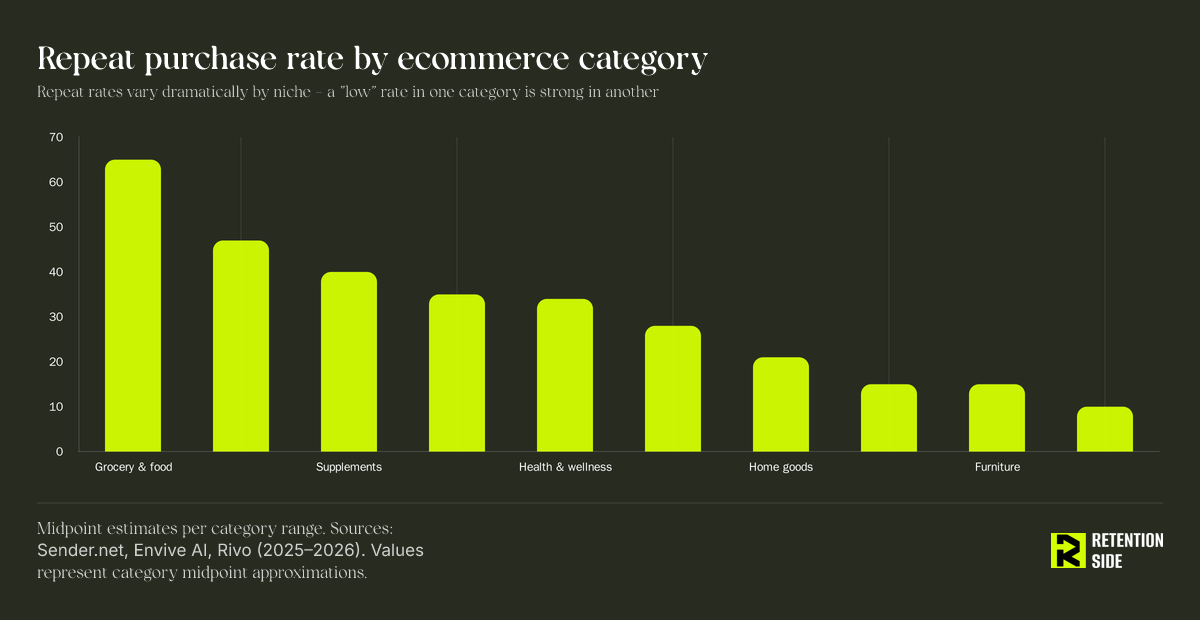
Before you label your retention rate as good or bad, anchor it to your category. According to Shopify repeat purchase rate benchmarks by industry, food and beverage brands median at 44%, supplements and wellness at 42%, pet products at 40%, and beauty and personal care at 38% – all driven by consumable, habit-based replenishment. On the other end, home goods sits at 18% and electronics at 11%, reflecting replacement cycles that stretch years. A 15% repeat purchase rate in furniture reflects normal purchase cycles. The same number in health and wellness supplements signals that something is breaking in the post-purchase experience, product quality, or communication strategy.
The categories with structurally high repeat rates – supplements, food and grocery, pet supplies, beauty and skincare – share a few traits: the product is consumable, usage is habitual, and replenishment creates a natural re-entry point. Categories with structurally lower rates – luxury goods, furniture, electronics – have longer consideration cycles and fewer natural touchpoints.
This matters for budget allocation because a supplement brand can build an aggressive retention system and expect meaningful returns within 60 to 90 days. A furniture brand needs a different approach – focusing on catalog expansion, cross-sell into adjacent categories, and building a long-term brand relationship that keeps them relevant even during long gaps between purchases.
Worth noting: the 27% blended benchmark is also window-dependent. The same store that shows 27% at 365 days typically sits at 11% at 30 days. The 30-day repeat rate is actually the more predictive signal – it correlates with 12-month LTV at around 0.78, stronger than AOV or site conversion rate. If your 30-day repeat rate is below 6%, the fix is almost always in the first post-purchase email or the unboxing experience, not in the broader retention strategy.
The second purchase: where retention is actually won or lost
If there is one moment in the customer lifecycle that deserves disproportionate strategic attention, it is the window between the first and second purchase.
After a customer places their first order, they have roughly a 27% chance of buying again. That is a meaningful opportunity but it is fragile. Most brands do very little with this window beyond a generic order confirmation and a shipping notification. They have paid to acquire the customer, and then they go quiet at exactly the moment when attention is highest and intent is still warm.
What happens in the 7 to 30 days after a first purchase shapes the trajectory of that customer’s entire relationship with the brand. Brands that use this window well – with post-purchase education, onboarding, product guidance, and the right follow-up – see meaningful lifts in second-purchase rates. Brands that ignore it watch the same customers end up on a competitor’s email list.
The post-purchase flow in Klaviyo is one of the most consistently underbuilt elements in ecommerce email programs. Welcome flows get attention because they are visible. Abandoned cart flows get attention because the lift is obvious. Post-purchase – the sequence that covers the critical window after money has already changed hands – is usually either a bare-minimum transactional series or completely missing. For a deeper look at how these flows fit into a complete Klaviyo setup, the Klaviyo email marketing setup guide for ecommerce brands covers the full lifecycle architecture.
Getting this right is not about discounting. It is about education, timing, and relevance. Show the customer how to get more value from what they just bought. Introduce the next logical product at the right moment based on their category and purchase history. Ask for a review when the product has had time to work. Make the experience feel intentional, not automated.
Research from the COREPPC Shopify benchmark study shows that a well-timed order 1 to order 2 flow adds 6 to 12 points to 90-day repeat rate. The mechanics matter: a welcome on day 1, use-case education around day 5 to 7, and a replenishment or cross-sell trigger at roughly 70% of the median first-to-second window for that category. The common mistake – sending a generic 10% off at day 14 regardless of product type – actually trains customers to wait for discounts and drops repeat rate 2 to 4 points over six months.
That is how you turn a 27% probability into something higher – and that lift directly determines whether your acquisition spend is building something durable or funding a transaction machine.
Why discounting your way to retention does not work
The instinct is understandable. Customers have not come back. Put a 15% discount in an email. Some will use it. Revenue spikes. Problem solved.
Except it is not. What that approach actually trains your customer base to do is wait. If a brand consistently re-engages lapsed customers with discounts, it teaches the most price-sensitive customers to time their purchases around offers and trains everyone else to expect them. Over time, full-price purchasing behavior erodes, promotional periods become the norm, and the discount has to get bigger to generate the same response.
There is a version of discounting that does work in retention – targeted incentives in specific flows, used sparingly and with careful unit economics behind them. A 10% offer in a win-back flow after a long lapse period is defensible because only a small segment of your list will ever trigger that flow, and you are spending margin to recover a customer you might otherwise lose permanently. That math is different from blanket promotional blasting to your whole list every time revenue looks soft.
The key distinction: an incentive used to recover a specific customer situation is a precision tool. An incentive used to prop up revenue is a crutch, and it compounds over time in the wrong direction.
Real retention requires building conditions where customers want to come back without needing a coupon. Those conditions are a product experience worth repeating, communication that adds genuine value rather than extracting it, and a purchase journey that creates real satisfaction rather than just completing a transaction.
What retention actually requires – and what marketing cannot fix
Email, SMS, push notifications, loyalty programs – none of these can retain a customer who has no real reason to come back. If your product is a one-time purchase, if the post-purchase experience was forgettable, if the quality did not match the expectation, or if there is nothing in your catalog that creates a natural next step – then marketing more aggressively to that customer will generate noise, not revenue.
Sustainable retention requires some foundational conditions to be in place before the marketing system can do its job.
A product ecosystem with repurchase logic. Either the product itself is consumable, or you have complementary products that create natural next steps. A brand with one hero product and nothing adjacent will always struggle with repeat purchase rates regardless of how well the email program runs.
A purchase experience worth remembering. The window between placing an order and receiving it shapes the customer’s emotional relationship with the brand. Packaging, unboxing, the small details that signal care – these do not need to be extravagant, but they do need to exist. Brands that treat fulfilment as purely a logistics function are leaving retention leverage on the table.
Timing that matches real usage behavior. Replenishment reminders only work if they arrive when the customer is actually running low. That requires knowing your product’s actual consumption patterns – which means customer research, repeat purchase data analysis, and communication cadence that reflects reality rather than assumptions. The gap between firing an email at day 30 vs day 42 for a 45-day product can move replenishment conversion from 3-5% to 9-14%.
A cross-sell strategy based on behavioral data, not catalog logic. The obvious next product to recommend is rarely the one that actually performs. Look at what customers frequently buy in combination, what the most common second purchase is, and which product sequences correlate with the highest long-term repeat rates. The data usually tells a different story than intuition.
When these conditions are in place, a well-built retention system can meaningfully accelerate the return rates that already want to happen. When they are not, adding more marketing channels just generates more noise at higher cost.
How retention channels layer into a system
The channels that make up a complete retention strategy each serve a different role in the customer lifecycle. They are not interchangeable, and they work better as a coordinated system than as parallel silos.
Email marketing is the foundation. It has the widest addressable audience on your list, the most flexibility for content and personalization, and the lowest cost per reach of any owned channel. A properly built Klaviyo setup covers the entire customer lifecycle: welcome and onboarding flows for new subscribers, behavioral flows for cart and browse abandonment, post-purchase sequences, cross-sell and up-sell flows triggered by purchase history, win-back flows timed to each brand’s specific repurchase window, and campaigns that balance promotional sends with genuine editorial and educational value.
The four pillars that hold an email program together are deliverability, list growth, automated flows, and campaigns. If any one is weak, the others underperform. Deliverability in particular is upstream of everything – an email that lands in spam has no conversion value regardless of how well it is written or timed.
SMS marketing excels at urgency. Flash sales, back-in-stock alerts, limited-time replenishment reminders, and cart recovery in the final hours before an offer expires. The near-instant read rate makes it valuable for time-sensitive moments, but that same characteristic makes it easy to overuse. Frequency discipline matters more in SMS than in any other channel.
Push notifications fill the space between email and SMS – low friction, no personal contact information required, and useful for lightweight nudges that would feel intrusive as a text. Restock reminders, price drops, and light re-engagement prompts fit well here.
Loyalty programs are a retention structure, not a communication channel. A well-built tiered loyalty program creates psychological investment in the brand relationship: once a customer has built status or accumulated points, leaving means walking away from something they already earned. The programs that actually move retention metrics are built around behavior, not just transactions, and they integrate meaningfully with every communication channel.
Direct mail occupies the high-impact end of the physical touchpoint spectrum. A well-designed piece sitting on a customer’s counter for two weeks operates in a completely different attention environment from an inbox. For VIP reactivation, high-LTV customer acknowledgment, and moments where a brand wants to signal genuine investment in the relationship, direct mail creates impact that digital channels cannot match – at higher per-unit cost, which means it works best as a precision tool for specific segments rather than broad sends.
WhatsApp and Viber matter more depending on geography. For brands with meaningful customer bases in Europe, the Middle East, Latin America, or Southeast Asia, these platforms are not optional extras – they are the primary communication channel for a significant portion of the audience.
The coordination question is as important as the channel selection. Brands that run all of these channels independently, with no shared logic about what a customer just did or received, create fatigue and confusion. The system works when each channel knows its role, and when a customer’s action in one channel suppresses or adjusts their experience in another.
When acquisition is the right priority
Nothing in this article should be read as an argument against acquisition. You need new customers. Retention cannot survive without new entrants into the lifecycle.
Acquisition is the right primary investment when your list is too small for retention economics to generate meaningful scale, when your repeat purchase rate is already strong for your category and the constraint is genuinely top-of-funnel volume, when you are launching a new product into a new category and need proof of demand, or when your product is a genuinely one-time purchase where repeat rate will always be structurally low.
The problem is not brands investing in acquisition. The problem is brands treating acquisition as the only lever and treating retention as something they will get to eventually. For any brand doing meaningful revenue with a reasonable product-market fit, “eventually” is a very expensive delay.
How to read your own retention data
The most useful metric for understanding where retention stands in your business is returning customer rate and its direction over time.
Returning customer rate measures the percentage of your buyers in a given period who have purchased from you before. If it is below 20%, you are functionally acquisition-dependent. If it is above 30%, you have a compounding retention engine. The goal is not to hit a number once, but to move it in the right direction over time.
One important nuance: a single blended repeat rate number is almost always misleading. The honest diagnostic is to break it into three windows – 30, 90, and 365 days – and read each against your category median. The 30-day rate tells you if the post-purchase experience is working. The 90-day rate tells you if your flows are doing their job. The 365-day rate tells you if the full retention engine is running. The gap between each window is where the real diagnosis lives.
Cohort analysis adds another important dimension. An overall returning customer rate of 28% is a snapshot. Cohort data – how did customers acquired in Q3 2025 perform compared to those acquired in Q1 2025? – tells you whether your retention efforts are actually changing behavior. If cohort repeat rates are improving quarter over quarter, the system is working. Shopify’s native cohort report surfaces this directly.
Customer lifetime value is the companion metric. LTV growth is the long-term outcome of successful retention work. The CLV to CAC ratio, ideally 3:1 or better, tells you whether your acquisition cost is being validated by the long-term value of the customers you are bringing in.
Building the right budget allocation
There is no formula for the right split between retention and acquisition spend, but there is a useful framework for thinking about it.
Ask three questions. What is my current CAC trend? If CAC is rising faster than LTV, the acquisition model is deteriorating. That is not a signal to spend more on acquisition – it is a signal that retention needs to improve the long-term value delivered for each acquired customer.
What does my returning customer rate trend look like? If it is flat or declining despite growing revenue, you are replacing lost customers with new ones rather than building on a base. That is a treadmill, not a growth model.
Where are the structural constraints? A brand with a broken onboarding flow and a 5% second-purchase rate has a retention problem that no amount of acquisition spend will solve. A brand with strong retention but a slow-growing list has an acquisition problem. Honest diagnosis determines where the next dollar has higher expected return.
For most brands doing $300K or more per month with a working acquisition engine, the answer will usually be that retention is underfunded relative to its expected return. Not because acquisition is the wrong investment, but because the infrastructure required to extract value from the customers already being acquired has not been built.
Conclusion
The retention vs acquisition debate is not really a debate. Both matter, and both need resources. The question is which one has the higher marginal return on the next dollar given where you are right now.
For most ecommerce brands at meaningful scale, the answer is retention – not because acquisition is unimportant, but because the gap between what the existing customer base could generate and what it actually generates tends to be substantial. The customers are already there. The purchase history already exists. The data on what they bought, when they bought it, and what they might buy next is already in Klaviyo or Shopify. What is usually missing is the system to act on it.
That system starts with email – not because email is the only channel, but because it has the highest addressable audience, the lowest cost to operate, and the most flexibility to cover every stage of the customer lifecycle. The channels that make a complete retention strategy extend well beyond email into SMS, loyalty programs, push notifications, direct mail, and conversational channels where the audience warrants it.
At Retention Side, we start with email because that is where the foundation gets built. But the work is always in service of a broader goal: building the system that makes your existing customer base worth more over time, so that every acquisition dollar you spend compounds rather than resets.
If your acquisition is working and your returning customer rate is not where it should be for your category, that is the gap. And it is very solvable.