


Most brands ask for a Klaviyo audit after something has already gone wrong. Revenue from email flattened, a new hire inherited an account nobody documented, or a deliverability warning showed up right before a big promotional push. That’s a fine reason to start one, but it’s the wrong mindset to finish one with. A Klaviyo audit isn’t a one-time cleanup. It’s the mechanism that tells you whether your retention system is actually built the way you think it is.
We run these audits constantly at Retention Side, usually for brands doing well past $300,000 a month who assume their Klaviyo account is “fine” because revenue is still coming in. It usually is fine, on the surface. Underneath, we typically find flows that were built two strategies ago, segments that haven’t been touched since the account was set up, and deliverability issues quietly capping how much of that revenue is even possible. This guide walks through how to actually audit a Klaviyo account, not just check boxes inside it.
Key takeaways
- A Klaviyo audit is a diagnostic process across deliverability, flows, campaigns, segmentation, list health, and data integrity, not a single deliverability check or a template checklist.
- Delivery and deliverability are different things. An audit that only looks at whether emails sent, without checking where they landed, will miss the most expensive problems.
- Flow revenue share is one of the clearest signals of account health. When campaigns are carrying almost all of the revenue, the automation layer is underbuilt or outdated.
- Audit findings need a structure to be useful. Borrowing from classic audit methodology (criteria, condition, cause, consequence, corrective action) turns a list of observations into a prioritized roadmap.
- Klaviyo itself is more relevant than ever for ecommerce brands, but a tool being relevant doesn’t mean your specific setup inside it still is.
- Audits should happen on a schedule, not only when something breaks. Quarterly is a reasonable baseline for growth-stage brands; more frequent checks make sense around major sends or list changes.
What we’ll cover
This guide walks through what a Klaviyo audit actually means for a brand generating meaningful revenue, the areas every audit needs to cover, the red flags that show up most often, how to structure findings into action, and direct answers to the most common questions brands ask before starting one.
What a Klaviyo audit actually means for a growth-stage brand
A Klaviyo audit is a structured review of how your account is set up, sending, and performing, measured against what your customer journey and revenue goals actually require. That’s different from opening the dashboard and glancing at flow revenue for the month.
At the revenue level most of our clients operate at, the stakes of an unaudited account are higher than people assume. A brand doing $50,000 a month in email revenue and a brand doing $400,000 a month can have the exact same structural problems: a welcome flow that hasn’t been touched in a year, a winback flow with the wrong incentive logic, a sunset segment that’s never actually been suppressed. The difference is that at scale, those same gaps cost real money every single month, and they compound because the list keeps growing around a broken foundation.
The other mistake brands make is treating an audit like a scorecard instead of a diagnostic. A scorecard tells you your open rate is “good” or “below average.” A diagnostic tells you why your open rate is where it is, whether that’s a deliverability issue, a list quality issue, or a content and relevance issue, and what to actually do about it. Retention Side treats retention as a system, not a single channel lever, and a Klaviyo audit only earns its value when it’s read the same way: as a check on the whole system, not just the platform.
The areas every Klaviyo audit needs to cover
A proper audit doesn’t start inside Klaviyo. It starts with the customer journey and works backward into the platform. Here’s the structure we use.
Deliverability
This comes first because nothing else in the audit matters if emails aren’t reaching inboxes. Deliverability is not the same as delivery. Delivery means Klaviyo successfully handed the email off and it wasn’t bounced or rejected outright. Deliverability means it actually landed somewhere useful, the inbox, not spam, not a promotions tab nobody checks. An audit needs to look at authentication (SPF, DKIM, DMARC), sending domain reputation, spam complaint rates, bounce rates by domain (Gmail, Yahoo, Outlook behave differently), and inbox placement trends over time, not just a single snapshot. Despite these being baseline requirements since Google and Yahoo tightened enforcement in 2024, Mailgun’s State of Email Deliverability report found that only 66% of senders confirm they’re using both SPF and DKIM, and just over half have DMARC in place at all.
List growth and list health
This isn’t about subscriber count. It’s about where subscribers came from, how engaged they still are, and whether the list is being maintained or just accumulated. An audit checks form conversion rates, but more importantly it checks lead-to-customer rate, since that’s the number that actually reflects list quality. It also looks at list hygiene: how long has it been since unengaged profiles were suppressed or moved into a re-engagement path, and is the account still emailing people who haven’t opened anything in a year.
Flows
Flows are behavior-based automations that should map directly to where customers actually drop off in their journey, not a generic template someone installed at setup. An audit checks whether the core flows exist (welcome, abandoned cart, abandoned checkout, post-purchase, winback, browse abandonment) and, just as important, whether they’ve been updated to reflect current offers, current brand voice, and current customer behavior. Flows are never “done”. An audit should flag any flow that hasn’t been touched or tested in the last two to three months as stale by default.
Campaigns
Campaign strategy lives and dies on segmentation. An audit looks at send frequency, the mix of promotional versus educational or value-driven content, and whether campaigns are going out to broad, undifferentiated segments or to groups built around actual behavior and lifecycle stage. A brand that only emails during discounts trains its list to wait for discounts, and that shows up in declining full-price purchase rates over time. That pattern is one of the most common things we flag in campaign audits — and it’s exactly why the balance between flows and campaigns matters more than most brands realize.
Segmentation
This sits underneath both flows and campaigns, so it gets its own line item. An audit checks how segments are built (are they static, one-time exports, or dynamic and behavior-based), how many segments actually get used versus sitting unused in the account, and whether engagement, purchase recency, and predicted lifetime value are factored in anywhere. For a deeper framework on building segments that hold up over time, our Klaviyo segmentation strategy guide breaks down how to structure segments around lifecycle stage, purchase behavior, and engagement signals.
Data and integrations
Klaviyo is only as good as the data feeding it. An audit checks the ecommerce platform integration, whether custom events and properties are firing correctly, whether SMS and other channels are properly synced if the brand is running a multichannel retention strategy, and whether there are any broken triggers quietly costing revenue in the background.
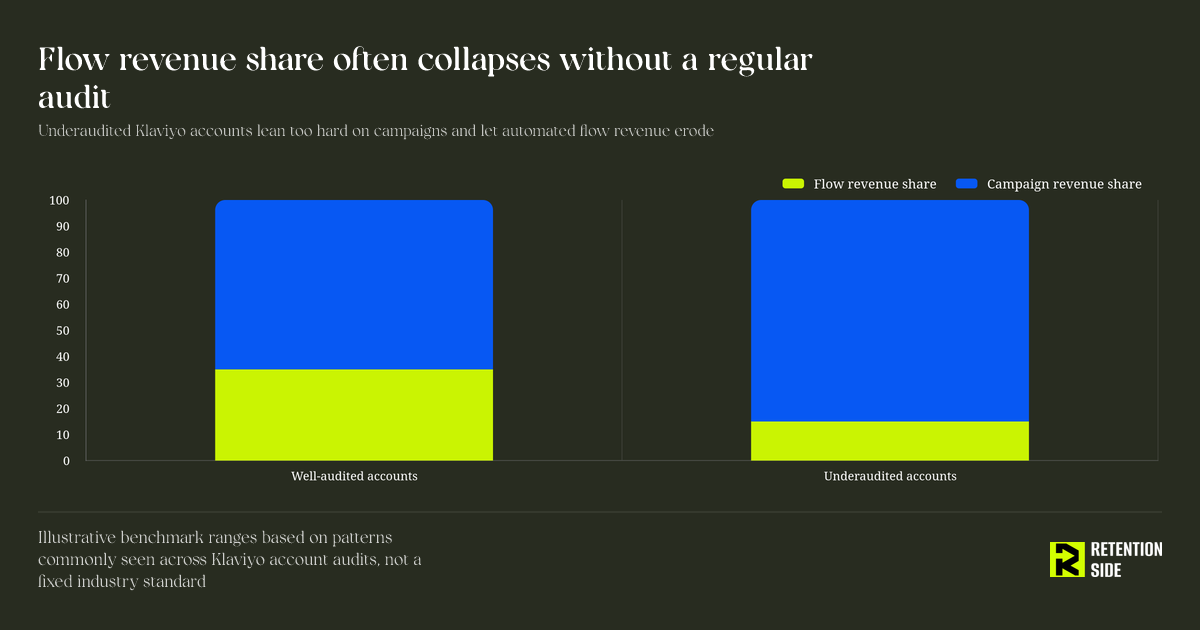
That flow-to-campaign split is one of the fastest health checks in any audit. When flows are carrying only 10 to 15 percent of email revenue instead of closer to a third, it almost always means the automation layer hasn’t kept pace with the brand, even if campaigns are propping up the topline number. According to Klaviyo’s own benchmark data across more than 183,000 brands, flows generate roughly 41% of total email revenue despite accounting for just over 5% of send volume — a gap that makes a low flow-revenue share immediately diagnostic.
Red flags a Klaviyo audit typically uncovers
Some patterns show up often enough that we treat them as near-universal warning signs during an audit.
- Campaign-heavy revenue mix. When campaigns account for the overwhelming majority of email revenue, it usually means flows were set up once and forgotten, not that campaigns are exceptionally strong.
- Flat or declining flow revenue despite list growth. If the list is growing but flow revenue isn’t moving with it, something in the automation logic, timing, or offer structure has gone stale.
- No suppression strategy. Sending to fully unengaged profiles drags down deliverability for the whole account, not just those individual sends.
- Segments built once and never revisited. Static segments from a year ago don’t reflect current customer behavior, and campaigns sent to them underperform quietly without anyone noticing why. Our ecommerce email segmentation guide covers how to audit and rebuild stale segments.
- Missing or shallow post-purchase flows. Brands over-invest in acquisition-stage flows and under-invest in the post-purchase and retention-stage flows that actually drive repeat revenue.
- No testing cadence. A/B testing across subject lines, send times, incentives, and flow logic should be continuous. An account with zero active tests is an account that’s guessing.
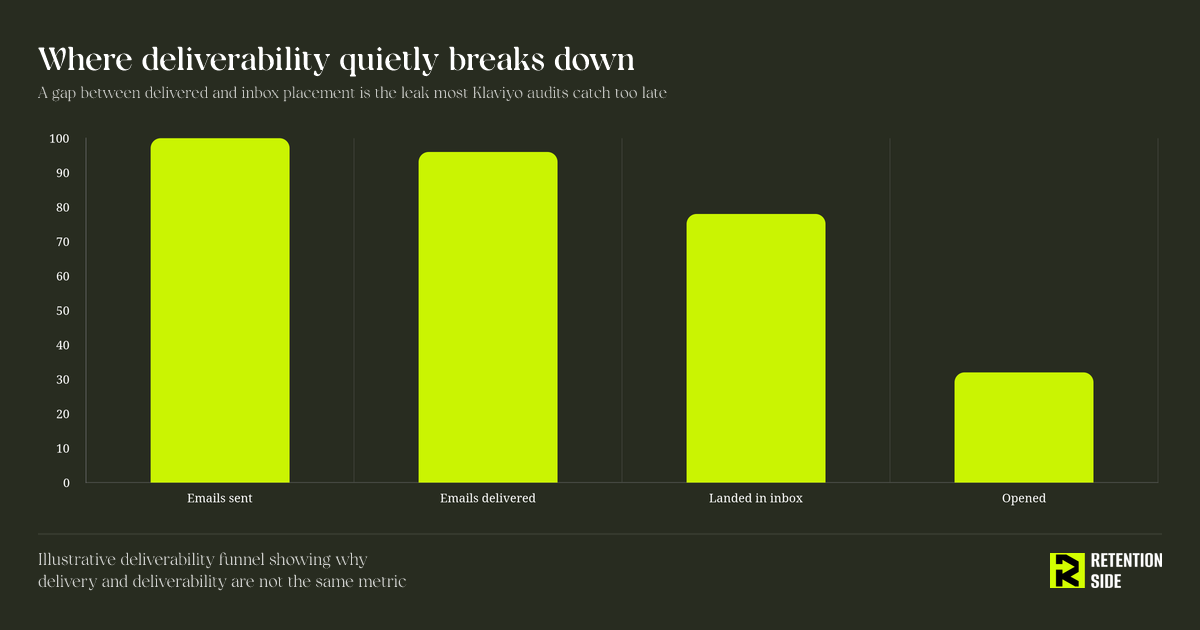
This is the gap that gets missed most often. A brand can have a 96 percent delivery rate and still have a serious deliverability problem, because delivery only confirms the email wasn’t bounced. It says nothing about whether it landed in the inbox or the spam folder. Since Google and Yahoo began enforcing bulk sender requirements in February 2024, the cost of ignoring this gap has gone up sharply — non-compliant senders now face outright rejection or spam foldering. An audit that stops at delivery rate and doesn’t dig into inbox placement is an incomplete audit.
Turning audit findings into a roadmap
An audit that produces a list of problems without a way to prioritize them isn’t finished. This is where a structured findings framework earns its keep. It’s borrowed from traditional internal audit methodology, but it maps cleanly onto Klaviyo work:
- Criteria – what should be happening. This is the benchmark: a welcome flow should convert new subscribers within the first 30 days, a winback flow should re-engage lapsed customers before they’re suppressed, deliverability should sit above a specific inbox placement threshold.
- Condition – what’s actually happening. This is the observed state during the audit: the welcome flow hasn’t been updated in 14 months, the winback flow doesn’t exist, inbox placement has quietly dropped on Gmail sends over the last quarter.
- Cause – why the gap exists. Sometimes it’s neglect. Sometimes it’s a platform migration that broke an integration. Sometimes strategy changed and nobody updated the automation to match.
- Consequence – what it’s costing. This is where findings get translated into revenue terms, because “the flow is outdated” doesn’t move a decision-maker the way “this flow is likely leaving five figures a month on the table” does.
- Corrective action – what to actually do about it, in priority order.
Every finding in a Klaviyo audit should be able to answer all five of those. If it can’t, it’s an observation, not a finding, and it doesn’t belong in the roadmap yet.
How to audit a Klaviyo account: a step-by-step process
Start by setting clear goals for the audit before opening a single flow or report. An audit without a defined goal turns into an unfocused tour of the dashboard. Are you auditing because revenue plateaued, because you’re inheriting an account from a previous team or agency, because deliverability dropped, or because you want a baseline before scaling ad spend and list growth? The goal shapes where you look first and how deep you go in each area.
From there, the process generally follows this order:
- Define the goal and the timeframe. Decide what “healthy” looks like for this specific brand and pick a comparison window, usually the trailing 90 days against the same period a year prior if seasonality matters.
- Pull deliverability data first. Check authentication, bounce rates by domain, spam complaints, and inbox placement trends before anything else. If deliverability is broken, every other number in the account is unreliable.
- Map the customer journey against existing flows. List every stage a customer moves through, from first visit to repeat purchase to lapse, and check which stages have a flow and which don’t.
- Review flow performance individually, not just in aggregate. Aggregate flow revenue can hide one strong flow masking three weak ones. Klaviyo publishes flow-specific benchmarks by revenue band that are useful for setting realistic expectations here.
- Audit segmentation logic. Check whether segments are dynamic, current, and actually used in recent campaigns and flows.
- Review the last 90 days of campaigns. Look at frequency, promotional-to-value ratio, and performance by segment, not just blended account-wide averages.
- Check integrations and data flow. Confirm ecommerce, SMS, and any other connected channels are syncing correctly and that custom properties are populating as expected.
- Document findings using the criteria-condition-cause-consequence-corrective action structure, then prioritize by revenue impact and effort to fix.
That process works whether the audit is being run internally by a marketing director or externally by a retention agency. What matters is that every step gets documented, not just reviewed and mentally filed away. For a companion resource that operationalizes this process, our Klaviyo audit checklist covers the specific items to verify at each stage.
How often to audit, and who should do it
Quarterly is a reasonable baseline for most growth-stage ecommerce brands. That cadence catches drift before it compounds: a segment that’s slowly gone stale, a flow whose offer no longer matches current pricing, deliverability trends that are heading in the wrong direction but haven’t triggered an obvious crisis yet. Brands running frequent promotions, launching new product lines, or scaling paid acquisition aggressively should audit more often, since list composition and customer behavior shift faster under those conditions.
On who should run it: an internal marketing team can absolutely audit its own account, but there’s a real bias risk in reviewing work you built yourself. It’s easy to explain away a stale flow as “still fine” when you’re the one who built it. This is part of why brands bring in outside eyes, whether that’s a dedicated retention agency, a Klaviyo-focused shop, or a broader lifecycle marketing agency. Retention Side runs these audits specifically because Klaviyo is usually the starting point of a much larger retention system that includes SMS, push, direct mail, loyalty, WhatsApp, and Viber depending on the audience, and it’s hard to see whether that broader system is missing something from inside the account itself.
Whoever runs it, the output should be a prioritized, revenue-weighted roadmap, not a slide deck of metrics with no clear next step attached.
Frequently asked questions
How to audit a Klaviyo account?
Start by setting clear goals for the audit. Decide whether you’re auditing because of a revenue plateau, a deliverability concern, an account handoff, or a planned scale-up, since the goal determines where to focus first and how deep to go. From there, work through deliverability data (authentication, bounce rates, spam complaints, inbox placement), map flows against the actual customer journey, review flow and campaign performance individually rather than in aggregate, audit segmentation logic for whether segments are dynamic and current, check integrations and data flow, and document every finding with a clear cause and revenue consequence attached. Skipping the goal-setting step is the most common reason audits turn into unfocused metric-browsing instead of a usable diagnostic. Our Klaviyo audit checklist walks through each step in more detail.
Is Klaviyo still relevant?
Yes, and arguably more relevant for ecommerce brands than it was a few years ago, because it’s continued to expand beyond email into SMS, mobile push, reviews, and richer segmentation and predictive analytics, positioning itself as a broader customer data and marketing platform rather than just an email service provider. For DTC and ecommerce brands specifically, it remains the dominant platform because of how deeply it integrates with ecommerce data (order history, product catalogs, customer lifetime value) in ways that generic email tools don’t match. Klaviyo’s benchmark reports, based on data from over 183,000 brands, continue to show email and automation as primary revenue drivers for ecommerce. That said, relevance of the platform and health of your specific account are two different questions. Klaviyo being the right tool doesn’t mean your flows, segments, and deliverability setup inside it are still doing their job. That’s exactly the gap a Klaviyo audit is meant to close: confirming not just that you’re on the right platform, but that you’re actually using it the way your current customer base and revenue goals require.
What are the 5 C’s of audit findings?
The “5 C’s” come from traditional internal audit methodology, and they translate cleanly to a Klaviyo audit: criteria (what should be happening, the benchmark or expected standard), condition (what’s actually happening, based on what the audit observed), cause (why the gap between criteria and condition exists), consequence (what that gap is actually costing in revenue, engagement, or deliverability terms), and corrective action (the specific, prioritized fix). Structuring findings this way turns a Klaviyo audit from a list of loosely connected observations into a roadmap a team can actually execute against, because every issue gets tied to a clear “why it matters” and a clear “what to do next.”
What are the top 5 SEO audit tools?
While an SEO audit and a Klaviyo audit are different disciplines, the tools worth knowing are Google Search Console (free, direct data from Google on indexing, crawl errors, and search performance), Screaming Frog SEO Spider (technical crawling for broken links, redirects, metadata, and site structure issues), Ahrefs (backlink analysis, keyword research, and site health scoring at scale), Semrush (an all-in-one suite covering technical audits, keyword tracking, and competitor analysis), and Sitebulb (visual, prioritized technical audit reports that are easier to hand off to non-technical stakeholders). The reason this question matters alongside a Klaviyo audit is that retention doesn’t operate in isolation. If acquisition and organic traffic quality are declining, email and lifecycle performance will look worse even when the Klaviyo account itself is healthy, so it’s worth knowing whether a performance dip traces back to the list and flows or further upstream to traffic and site issues.
Conclusion
A Klaviyo audit is worth the time when it’s treated as a system-level diagnostic, not a metrics review. The brands that get the most value from one go in with a clear goal, look at deliverability before anything else, check flows and campaigns individually instead of trusting blended averages, and walk out with findings that are tied to cause and revenue impact, not just a list of things that look off.
Klaviyo isn’t the problem for most brands we audit. The problem is a setup that hasn’t kept pace with how the brand, its customers, and its offers have changed since the account was first built. That’s a fixable gap, but only if someone actually goes looking for it on a regular basis instead of waiting for revenue to make the case first.