

Most Shopify brands have a welcome email. Very few have a welcome email flow – a deliberate, sequenced automation that actually engineers the journey from new subscriber to first-time buyer.
The difference is not cosmetic. A single welcome email delivers a discount code and hopes for the best. A properly built welcome flow uses the highest-engagement window in the entire subscriber relationship to establish brand credibility, answer purchase objections, surface the right products, collect preference data, and create a coherent experience that makes buying feel like the obvious next step.
This article covers how to build that flow from scratch: the architecture, the sequence logic, the subject lines that work, and the strategic thinking that separates a flow that compounds from one that just sits there.
Key takeaways
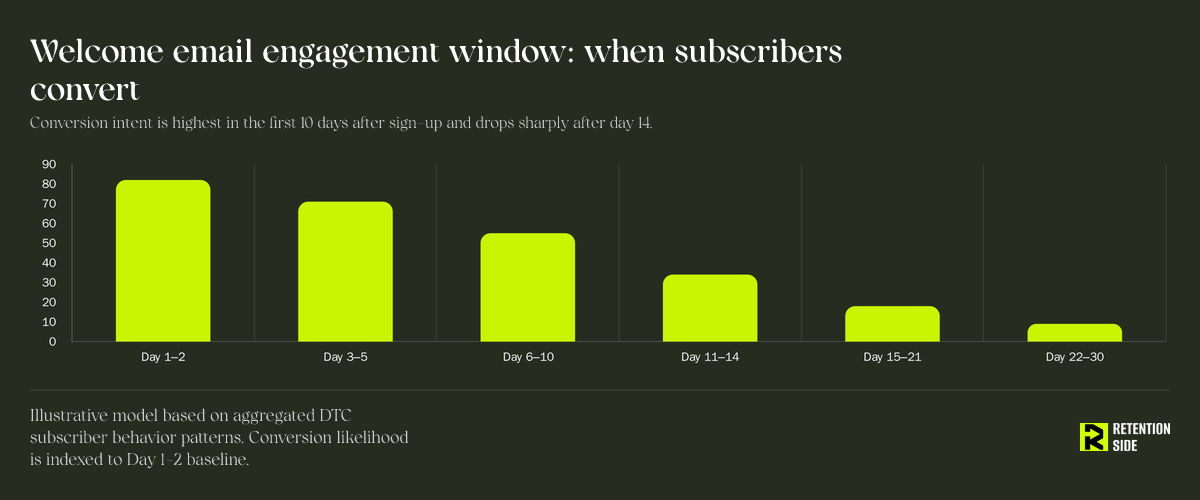
- The welcome flow is your highest-leverage automation – not because of raw volume, but because subscriber engagement is at its absolute peak in the first 7-14 days after sign-up.
- The job of the welcome series is not to deliver a discount code. It is to build enough trust and relevance that buying feels like the obvious next step.
- A well-built welcome flow runs 3-5 emails across 5-10 days, with each email serving a distinct purpose in the subscriber’s decision journey.
- Zero-party data collected at sign-up is the foundation for personalization across the entire sequence – and should be built into the flow architecture from the start.
- Subject lines in the welcome series carry more weight than anywhere else in your program because this is when subscribers are most likely to open.
- Shopify Flow is a native automation tool, but for welcome email sequences at any serious scale, Klaviyo’s trigger-based flows are the right infrastructure.
- A/B testing in the welcome flow is not optional – it is the mechanism by which performance improves over time.
What we’ll cover
- What a Shopify welcome email flow actually is and what it needs to accomplish
- How to create the flow – Shopify native vs. Klaviyo
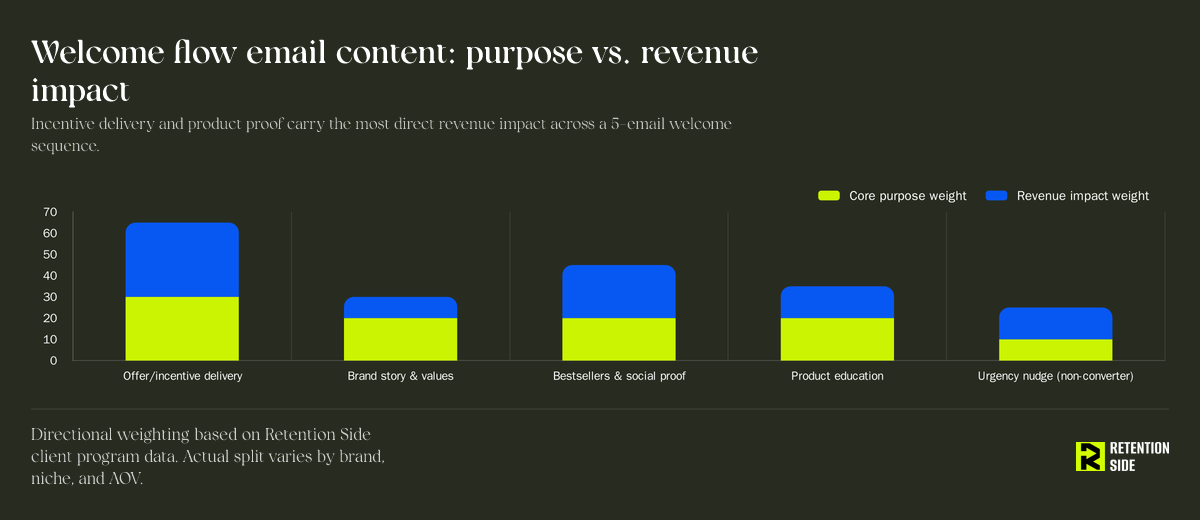
- The 5-email sequence architecture, email by email
- Welcome email subject line examples that work
- Zero-party data and personalization within the flow
- Common mistakes that kill welcome flow performance
- How to measure whether the flow is working
What a welcome email flow actually is – and what it needs to do
A welcome email flow is a behavior-triggered automation that fires when a new subscriber joins your list. Unlike a campaign – which you manually send to a selected segment – a flow runs continuously and automatically, responding to the specific moment of sign-up without requiring any input from your team.
The trigger is simple: someone submits a signup form, enters their email at checkout, or opts in through a lead magnet or pop-up. From that moment forward, they enter a predefined sequence of emails, spaced across several days, each designed to move them closer to a first purchase.
What makes this flow disproportionately important relative to every other automation in your program is timing. The moment after someone signs up is the only moment in the subscriber relationship where you have their full attention by default. They just chose to give you their email address. They are thinking about your brand right now. That level of active interest is never as high again – not after the first purchase, not during a sale event, not in a win-back sequence months later.
Research consistently backs this up: welcome emails achieve average open rates around 83% – roughly double the average for standard promotional sends. A multi-email welcome series also generates up to 90% more orders than a single welcome email. That engagement gap is the entire reason the welcome window deserves disproportionate investment.
The strategic goal of the welcome flow is to use that window deliberately. Not just to deliver whatever incentive was promised on the sign-up form, but to establish credibility, surface your best products, answer the questions that create purchase hesitation, and give the subscriber enough reasons to buy from you before their attention moves on.
A flow that does only the first of those things – delivers the discount code – is leaving the rest of the window unused.
How to create a welcome email on Shopify
Shopify gives you two routes for creating a welcome email: native Shopify Email and a third-party platform like Klaviyo. Understanding what each one actually does is important before choosing.
Shopify’s native email tools
Shopify has a built-in email marketing tool called Shopify Email, and it also has Shopify Flow – a workflow automation builder available on mid-tier and higher plans. These are separate tools that solve different problems.
Shopify Email lets you design and send email campaigns directly from the Shopify admin. It includes basic templates, a drag-and-drop editor, and built-in analytics. For brands just starting out or sending occasional newsletters, it works.
Shopify Flow is a conditional logic automation builder, primarily designed for internal store operations: tagging orders, triggering fulfillment actions, updating customer segments, and connecting third-party apps through event triggers. Can Shopify Flow send emails? Technically, yes – through integrations with supported apps. But Shopify Flow is not designed as an email marketing platform. It lacks the behavioral segmentation depth, A/B testing infrastructure, conditional logic within sequences, and profile data layer that make a welcome series genuinely effective.
For any Shopify brand doing meaningful volume – or building toward it – Shopify Email and Shopify Flow are not the right infrastructure for a welcome series. They are tools for different jobs. Our full breakdown of Shopify Email vs. Klaviyo covers exactly where the native tool runs out of road and why the platform decision matters before you build anything.
The right infrastructure: Klaviyo on Shopify
Klaviyo is the platform that serious Shopify brands use for welcome flows, and the reason is architectural. Klaviyo connects to Shopify’s data layer in real time, which means every behavioral event – a product view, an add-to-cart, a checkout start, a purchase, a return visit – populates the subscriber’s profile the moment it happens. That data is what powers the conditional logic that makes a welcome series intelligent rather than just automated. Our Klaviyo setup guide for ecommerce brands covers this integration layer in detail, including the onsite tracking configuration that makes everything downstream more accurate.
Within Klaviyo, the welcome series is built as a flow triggered by a list subscription event (or a specific sign-up form submission). The flow builder lets you:
- Set time delays between emails
- Add conditional splits based on subscriber behavior (did they purchase? did they click a specific link?)
- Branch the sequence based on zero-party data collected at sign-up
- Suppress subscribers who have already purchased from receiving remaining emails
- A/B test subject lines, content, send times, and incentive structures within the sequence
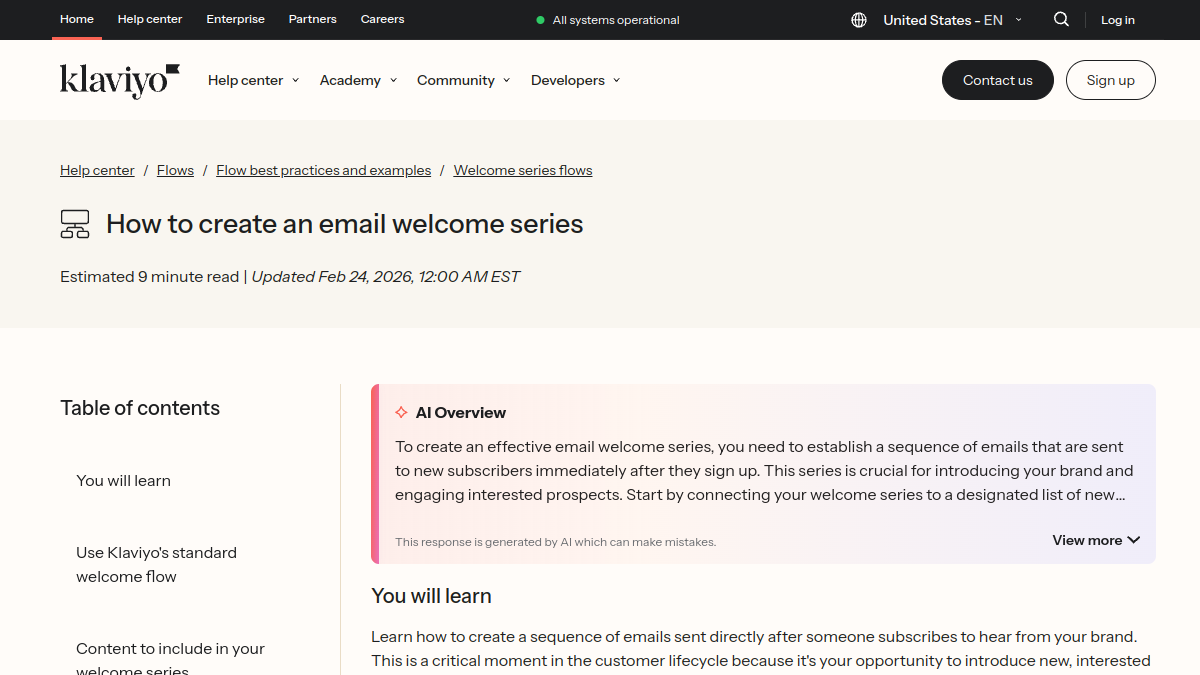
Setting up the flow itself takes three core steps in Klaviyo. Klaviyo’s own welcome series setup documentation is a useful reference for the technical mechanics:
- Define the trigger. The most common trigger is “Subscribed to List” – the moment someone submits any form connected to your main email list. You can also use form-specific triggers if you want to branch different subscriber sources into different welcome paths.
- Build the sequence. Add email steps, set time delays between them, and configure any conditional logic that splits the path based on subscriber behavior.
- Configure flow filters and suppression logic. Ensure subscribers who convert early exit the flow or skip discount-heavy steps. Also suppress current subscribers from receiving the welcome series if they return and re-enter somehow.
One critical configuration detail: new subscribers should be suppressed from your campaign sends while they are active in the welcome series. They are in a distinct stage of the relationship. Loading them with promotional campaigns while the welcome sequence is still running creates a disjointed experience and can actually interrupt the trust-building the welcome series is trying to do.
The welcome email sequence: structure, timing, and intent
The architecture of the welcome flow is where most Shopify brands make the biggest mistakes. They either send a single email, run a generic three-email sequence with no conditional logic, or build a sequence that talks entirely about the brand without ever addressing what the subscriber actually needs to hear to buy.
A well-built welcome flow for a Shopify brand typically runs 3-5 emails across 5-10 days. Here is the logic behind each position in that sequence.
Email 1 – The delivery email (immediate send)
Send within minutes of sign-up. The only job of this email is to deliver on the promise made in the signup form – whether that is a discount code, a free guide, early access, or another incentive.
Do not bury the incentive. Do not make the subscriber hunt for the code. And do not use this email to dump your entire brand story on them before they have asked for it.
What makes a strong first email beyond code delivery:
- A clear acknowledgment of what they signed up for
- A brief, one or two sentence introduction to what your brand does – framed around the customer benefit, not the company description
- A single CTA that moves them toward the next action (shop the collection, take the quiz, explore bestsellers)
Subject line guidance: this email should feel like fulfillment, not marketing. Keep it plain and clear. “Your 15% off code is here” outperforms clever alternatives for delivery emails because subscribers are actively looking for it.
Email 2 – Brand credibility and proof (24-48 hours)
By day 2, the subscriber has had the code for at least a day and has not yet converted. This email does not push harder on the offer. Instead, it builds the foundation of trust that makes the offer worth using.
The frame: why does this brand exist, and why should someone trust it? Not a founding story essay – a tight, customer-centric articulation of what makes you worth buying from. Social proof is your most powerful tool here. Customer reviews for your bestseller, a UGC shot that shows the product in real use, a specific testimonial that speaks to the exact hesitation your target customer has before buying.
This email is also a good place to introduce your top-selling product or collection – not by listing products, but by showing the purchase in context. What does life look like after buying? What problem does it solve?
Email 3 – Product education or category value (day 4-5)
This email earns attention by being genuinely useful rather than promotional. Depending on your category, this might look like:
- A skincare brand walking through how to build a morning routine with their hero product
- A supplement brand explaining the specific mechanism behind their formulation
- A home goods brand showing three ways customers style the product in real spaces
The purpose is to close the information gap that exists between someone being interested and someone being confident enough to purchase. Many subscribers do not convert in the first two days not because they are not interested, but because they have unanswered questions. This email answers those questions without requiring the subscriber to go find information themselves.
Email 4 – Urgency or upgrade nudge (day 6-8, non-converters only)
By day 6, subscribers who have not yet purchased need a different kind of message. Not another reminder that the offer exists. Not more brand storytelling. A reason to act now specifically.
This email should only be sent to subscribers who have not converted – use a conditional split in Klaviyo’s flow builder to exclude purchasers. The message can be:
- A time reminder if the original offer has an expiration (“Your code expires in 48 hours”)
- An upgrade offer for genuinely persistent non-converters (“Because you haven’t found the right fit yet, here’s an improved offer”)
- A “letter from the founder” style email that acknowledges the inaction and adds personal warmth to the pitch
The tone here should feel human. This is not another promotional blast. It is a genuine follow-up that treats the subscriber like someone who almost bought and might just need one more piece of the puzzle.
Email 5 – Final push or transition (day 9-10)
The final email in the sequence serves two purposes depending on the subscriber’s behavior. For non-converters: this is the last structured attempt to convert them within the welcome window. Keep the message simple – acknowledge that the window is closing, make the final CTA clear, and let them decide. There is no value in a sixth or seventh email that says the same things again.
For converters who did not complete additional actions (like joining your SMS list or following on social), this email can serve as a soft invitation to deepen the relationship – not with another purchase push, but with a next step that expands the communication channel or gathers preference data.
After this point, active subscribers who have not purchased should flow into your standard campaign cadence. Converters should have already entered your post-purchase flow, triggered by the Shopify purchase event in Klaviyo. The transition matters: a well-built post-purchase sequence picks up exactly where the welcome flow leaves off, turning first-time buyers into repeat customers before the relationship cools.
Welcome email subject line examples
Subject lines in the welcome series carry more consequence than anywhere else in your program. This is the one moment when subscribers are actively expecting to hear from you – which means the ceiling for engagement is higher, but so is the risk of a poor first impression.
A few principles before the examples:
Clarity beats cleverness for delivery emails. When someone is looking for their code or their free resource, an unclear subject line creates friction at the worst possible moment. Save creative wordplay for emails further down the sequence.
Length matters less than relevance. Seven words is a rough average. But the most effective subject lines are as long as they need to be and no longer.
Preview text is the extension of your subject line. The two characters that appear after the subject in the inbox should function as a single unit – subject line sets the hook, preview text completes the thought or adds the reason to open.
Examples by email position
Email 1 – Incentive delivery:
- “Your [X]% off code is inside”
- “Here’s your exclusive discount code, [first name]”
- “You’re in – here’s what you get”
- “Welcome to [Brand]. Your code: [CODE]”
Email 2 – Brand credibility and social proof:
- “Why 14,000+ customers chose [Brand] first”
- “What makes [Product] different (from people who’ve tried both)”
- “Real results from real customers”
- “[First name], here’s why people keep coming back”
Email 3 – Education and value:
- “How to get the most from your first [product type]”
- “The [Brand] guide to [specific outcome]”
- “Three ways our customers use [hero product]”
- “Before you decide – read this first”
Email 4 – Urgency nudge:
- “Your code expires in 48 hours”
- “[First name], still thinking it over?”
- “We made the offer a little better”
- “A note before your discount disappears”
Email 5 – Final close or transition:
- “Last chance to use your welcome offer”
- “This is the last email in your welcome series”
- “One more thing before we go back to normal”
- “Your offer ends tonight”
One note on personalization in subject lines: first name personalization is widely used and produces diminishing returns. The more meaningful personalization is contextual – referencing what the subscriber signed up through, a preference they shared in a quiz, or a product category they browsed before signing up. That kind of contextual subject line is only possible when zero-party and behavioral data is wired into the flow correctly from the start.
Zero-party data and personalization inside the welcome flow
Zero-party data is information a subscriber actively and voluntarily shares with you – a preference question answered on the sign-up form, a quiz result, a stated goal. It is different from behavioral inference, which is probabilistic. Zero-party data is explicit.
The welcome flow is where zero-party data creates its highest return. If a subscriber told you at sign-up that they are shopping for skincare for dry skin, email 3 does not send a generic product education email. It sends a dry skin-specific guide featuring the products most relevant to that subscriber’s stated need. That specificity is what separates a welcome series that feels genuinely helpful from one that feels like automated broadcasting.
This is not a minor optimization. McKinsey’s research on personalization has consistently shown that personalization leaders drive 5-15% revenue increases compared to brands that rely on broad, untargeted communication. The welcome series is the earliest and most natural place to put that principle into practice – because the subscriber has just chosen to tell you something about themselves.
The practical setup in Klaviyo:
- Embed a preference question into the sign-up form (Klaviyo’s multi-step form builder makes this relatively straightforward)
- Store the response as a custom profile property on the subscriber’s Klaviyo profile
- Add conditional splits in the welcome flow that branch based on that property
- Create email variants for each branch – the content differs, the structure stays the same
This does not need to be elaborate. A single well-chosen question – “What are you shopping for?” or “What’s your primary goal?” with 3-4 options – is enough to create meaningful branches. The payoff is a welcome sequence that feels personalized to the subscriber’s actual context, not just to their first name.
For brands that use quizzes as their primary sign-up mechanism, this data is already being collected. The work is ensuring it flows into Klaviyo correctly as custom profile properties so the flow logic can access it. Our broader Klaviyo email marketing setup guide covers zero-party data collection as part of the full program architecture, including how it connects list growth mechanics to flow personalization downstream.
The most common welcome flow mistakes
These patterns appear consistently in brand audits across categories and revenue tiers. Many of them also surface in our Klaviyo audit checklist, which covers the full program – not just the welcome series.
Single email and done. A one-email welcome sequence uses roughly 15-20% of the engagement window. The other 80% – the days when the subscriber is still thinking about your brand, still considering the purchase – goes uncaptured. This is the most common mistake and the simplest to fix.
Incentive delivered late. Burying the discount code in the second paragraph, or making subscribers click through to find it, creates immediate friction at the moment they most need to feel rewarded for signing up. Deliver the incentive clearly in the first email, above the fold.
No conditional logic for converters. Sending an urgency email about a code expiration to a subscriber who bought three days ago damages trust and looks unprofessional. Klaviyo’s flow filters make it simple to exclude purchasers from discount-reminder emails – but this must be configured deliberately. It is not the default.
Brand-centric copy without customer focus. Welcome series that spend two or three emails talking about the company’s founding story, values, and mission without connecting any of it to a concrete customer benefit lose subscribers during the sequence. Every email in the sequence needs a clear “what’s in it for me” for the reader – even the brand story email.
No A/B testing. The welcome series is the highest-leverage flow to test. Subject lines, incentive structure (percentage off vs. dollar off vs. gift with purchase), sequence length, and timing all affect conversion – and the only way to know what works for your specific audience is to test systematically. A welcome series built once and never touched again will plateau. Klaviyo’s flow A/B testing documentation outlines exactly how to set up split tests within a live flow without disrupting the subscriber experience.
Ignoring the mobile experience. Over 41% of all email opens now occur on mobile devices, and 50% of recipients will delete or skip an email that is not optimized for mobile viewing. A template that looks great on desktop but renders poorly on a 375px screen creates friction immediately after sign-up. Every email in the welcome sequence should be QA’d on mobile before the flow goes live – and after any template change.
Campaign suppression not configured. Subscribers in an active welcome series receiving your general promotional campaigns simultaneously creates a confusing, over-communicated experience. Suppress welcome-series subscribers from campaign sends until the sequence completes.
What is a welcome email sequence – a note on structure
The phrase “welcome email sequence” and “welcome email flow” are often used interchangeably, and for practical purposes they mean the same thing: a series of automated, time-spaced emails sent to new subscribers in response to their sign-up.
The word “sequence” emphasizes the ordered structure. The word “flow” is Klaviyo’s terminology for behavior-triggered automation – and specifically for a sequence that can branch, filter, and respond to subscriber behavior between steps, rather than just sending emails on a fixed schedule regardless of what the subscriber does.
The distinction matters operationally. A true welcome flow in Klaviyo is not a static sequence. It responds dynamically – skipping emails when a subscriber converts, branching based on zero-party data, holding sends during peak campaign moments if needed, and connecting to other flows (like a post-purchase sequence) when the conversion event fires.
A welcome sequence without conditional logic is essentially a static drip – the same emails, in the same order, to every subscriber, regardless of behavior. That is better than a single email. But it is not the full capability of what Klaviyo can do with the welcome window. Understanding flow triggers and filters in Klaviyo is the place to start if the technical distinction between a static sequence and a true conditional flow is new territory.
How to measure whether the welcome flow is working
The instinct is to look at open rates. Resist it. Welcome emails have structurally elevated open rates because subscribers are actively expecting to hear from you immediately after sign-up. That elevated engagement is the baseline condition of the welcome window – not a signal of flow quality.
The metrics that actually tell you whether the welcome flow is building your business:
Welcome-to-first-purchase conversion rate. What percentage of subscribers who enter the welcome flow make a first purchase within a defined window (30 days is a reasonable benchmark)? This is the primary performance metric for the flow. If it is low, the flow is not doing its job – regardless of what engagement signals look like.
Time-to-first-purchase. Of the subscribers who do convert, how quickly are they buying? A welcome series that is doing its job should be compressing the time between sign-up and first purchase. If the average time-to-purchase is 18 days and most of your emails are frontloaded in the first 5 days, the sequence timing likely needs adjusting.
Exit rate by email position. Which email in the sequence drives the most unsubscribes? Which email drives the most conversions? Klaviyo’s flow analytics show you the conversion and unsubscribe rate at each step – this data tells you precisely where the sequence is working and where it breaks down.
Lead-to-customer rate by sign-up source. If you track where subscribers are coming from (paid social, organic search, referral, pop-up vs. embedded form), you can compare conversion rates across sources. This tells you which acquisition channels are bringing subscribers who actually buy – not just subscribers who collect codes.
Repeat customer rate downstream. This is a longer-horizon signal, but a meaningful one. Subscribers who had a strong welcome experience – who received a coherent, brand-building sequence before their first purchase – tend to have better long-term retention metrics than subscribers who were acquired purely through a discount. A well-built welcome flow is not only a first-purchase conversion tool. It shapes the quality of the customer relationship that follows. For a full view of the metrics that actually matter in a retention program, our ecommerce email marketing strategy guide covers how to connect flow-level performance to business-level outcomes like repeat customer rate and revenue attribution.
The welcome flow in the context of your broader retention system
The welcome flow does not operate in isolation. It is the entry point into a larger automated system that covers the full customer lifecycle – from first interest to repeat buyer to brand advocate.
Understanding where the welcome flow ends and where other flows begin is important for keeping the customer experience coherent:
- A subscriber who converts during the welcome series should exit the welcome flow and enter the post-purchase sequence automatically – triggered by the Shopify purchase event in Klaviyo.
- A subscriber who does not convert and completes the full welcome series transitions into your standard campaign cadence – not into silence.
- A subscriber who purchases once and then goes quiet will eventually become a candidate for your win-back flow, timed to your brand’s actual repurchase frequency data. Our guide on increasing repeat purchases covers how to time and structure that win-back trigger based on real order frequency data rather than generic 90-day defaults.
The welcome flow is also where the foundation for every future personalization decision gets laid. The zero-party data you collect at sign-up, the behavioral signals you observe during the sequence (which links they clicked, which emails they opened, what products they browsed between sends), all of this populates the Klaviyo profile that drives every future flow and campaign that subscriber receives.
A shallow welcome series is not just a missed conversion opportunity. It is a missed data collection opportunity that weakens every subsequent automation in the program. This is why the welcome flow deserves more investment, more testing, and more strategic attention than most Shopify brands give it.
At Retention Side, the welcome series is typically one of the first things we build or rebuild when working with a new client – not because it is the most glamorous part of the program, but because it is the most leverage-dense window in the entire subscriber relationship. Getting it right from the start compounds forward into every other retention metric that matters. If you want to see how the welcome flow fits into a complete Shopify email program, our Shopify email marketing strategy guide covers the full architecture – deliverability, list growth, flows, and campaigns – and how they work together.
Conclusion
A Shopify welcome email flow is not a nice-to-have automation that runs in the background. It is your one opportunity to convert maximum subscriber attention into a first purchase – using a window that is only at its peak once.
The brands that build this flow properly – with the right sequence structure, conditional logic for converters, zero-party data collected and used, and continuous A/B testing across subject lines and incentive design – see meaningfully higher first-purchase conversion rates and, downstream, better retention metrics across the board.
The ones that treat it as a discount delivery mechanism are using roughly 20% of the opportunity and leaving the rest to chance.
The architecture is not complicated. The flow does not need to be elaborate to perform well. What it needs is a clear strategy behind each email, conditional logic that responds to what subscribers actually do, and a commitment to treating the welcome window as the highest-leverage moment in the subscriber relationship – because it is.
FAQs
How do I create a welcome email on Shopify?
Shopify offers Shopify Email for basic campaign sending and Shopify Flow for workflow automation. While both can be used for simple welcome messages, neither provides the depth needed for a properly built welcome series. For a welcome flow with behavioral segmentation, conditional logic, A/B testing, and real personalization, Klaviyo is the right tool. Once connected to your Shopify store, Klaviyo tracks all subscriber and purchase events in real time. You set up the flow by defining a list subscription trigger, building your email sequence with time delays and conditional splits, and configuring suppression logic for subscribers who convert before the sequence ends. Klaviyo’s welcome series setup guide walks through the technical steps in detail.
What is a welcome email sequence?
A welcome email sequence (also called a welcome flow) is a series of automated emails sent to new subscribers in a defined order after they sign up to your list. In Klaviyo, a welcome flow is more powerful than a static sequence – it responds dynamically to subscriber behavior between sends, branching for converters vs. non-converters, personalizing content based on zero-party data, and connecting to other automated flows (like post-purchase) when a purchase event fires. A well-built welcome sequence typically runs 3-5 emails across 5-10 days, with each email serving a distinct purpose: incentive delivery, brand credibility, product education, urgency nudge, and final close.
Can Shopify Flow send emails?
Shopify Flow can trigger email sends through supported app integrations – but it is not designed as an email marketing platform. It lacks the behavioral segmentation infrastructure, A/B testing capability, conditional sequence logic, and unified subscriber data layer that email marketing requires at any meaningful scale. Shopify Flow is built for internal operational workflows: order tagging, fulfillment triggers, customer segment updates, and third-party app connections. For welcome email flows and any other retention-focused automation, Klaviyo running natively on Shopify is the appropriate infrastructure.
What are good subject lines for a welcome email?
Subject lines in the welcome series should be calibrated to the specific email’s purpose. For the delivery email (email 1), clarity outperforms cleverness – “Your 15% off code is inside” works better than something cryptic because subscribers are actively looking for what you promised. For later emails in the sequence, subject lines can lean into curiosity, social proof, or urgency depending on the email’s goal. Examples: “Why 14,000+ customers chose [Brand] first” (social proof), “Before you decide – read this first” (curiosity), “Your code expires in 48 hours” (urgency). The most effective personalization is not first name insertion – it is contextual relevance based on what the subscriber browsed or shared in a preference question at sign-up.