

Most email advice is calibrated to repurchase cycles of 30 to 90 days. Furniture breaks every one of those defaults. A customer who buys a sofa is not "dormant" at day 91. They are doing exactly what a sofa buyer does.
That is why furniture email marketing case studies are hard to use. A result from a supplements brand with a 45-day reorder window tells you almost nothing about a home brand where the next order may be 18 months away. The useful question is not "what lift did they get?" It is "what did email have to do in a category where the long middle of the lifecycle is mostly non-transactional?"
This article starts with two named furniture implementations, then explains what an operator can take from them and from broader retention work.
The named furniture examples below come from Klaviyo’s Bay Gallery Furniture case and Grow Pronto’s LuxeDecor case. They are external implementations, not Retention Side clients. The later cross-category lessons are evidence of method, not furniture results. Read each reported outcome with its attribution and measurement limits.
Key takeaways
- Furniture repeat rates look low by standard benchmarks and can still represent strong performance.
- Win-back timing, not subject lines, is where long-cycle programs most often go wrong.
- The post-purchase window carries the retention work when the next order is far away.
- A case study is only credible if it shows the before state, the actions, and the after state in business metrics.
- List quality and non-transactional flows matter more here than campaign volume.
Two named furniture email case studies
Bay Gallery Furniture: connect education with the next useful purchase
Klaviyo's Bay Gallery Furniture case study describes a migration from Mailchimp with SOUP Agency. The team connected Shopify purchase data, built welcome and abandonment journeys, and combined post-purchase care guidance with complementary recommendations. One example pairs an outdoor-furniture purchase with an educational email and relevant weather covers.
Klaviyo reports 147x ROI in 2024, 29% quarter-over-quarter growth in attributed revenue and roughly five hours of weekly sales-team time saved. Those are platform-published results with their stated periods, not proof of a causal retention lift or a target every furniture brand should expect.
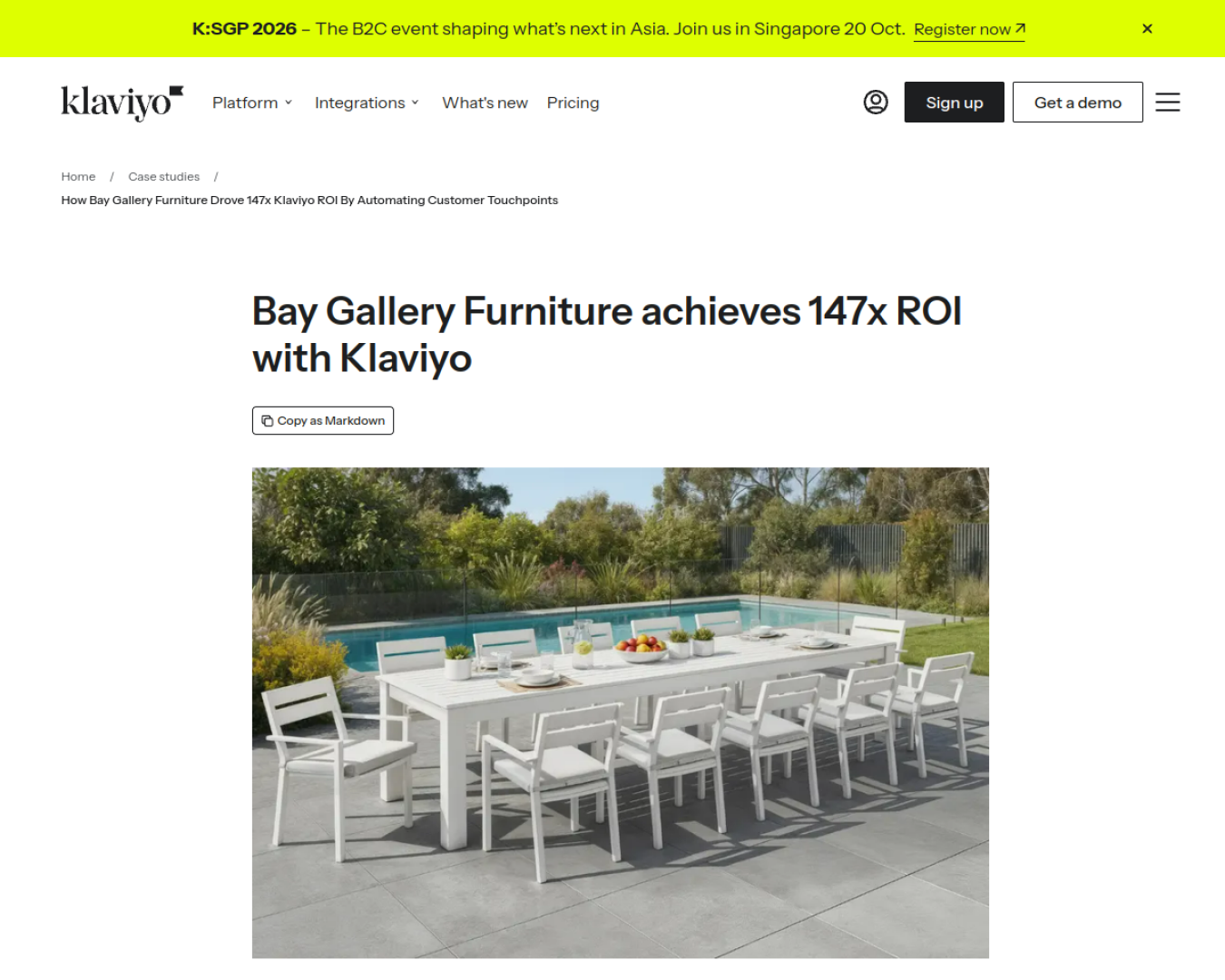
Source: Klaviyo's Bay Gallery Furniture case study. Screenshot of the source page, not a sample campaign.
What to apply: make care guidance useful on its own, then recommend a complementary item justified by the original purchase. Measure those flows separately from discount campaigns.
LuxeDecor: improve an existing program before adding more volume
Grow Pronto's LuxeDecor case study describes a furniture brand already generating substantial Klaviyo revenue. The agency reports lengthening flows from one or two emails to three to seven, improving stage-specific messaging and increasing pop-up conversion from about 2% to 4%.
Pronto reports approximately $1.5 million in monthly Klaviyo revenue and an approximately 58% contribution from email and SMS. These are agency-reported attribution figures; the public page does not provide an independent audit, a comparable measurement window for every claim, or a holdout-based estimate of incremental revenue.
What to apply: audit missing answers and handoffs inside existing flows before increasing send volume. Compare form quality, flow conversion and unsubscribe behavior with a consistent measurement window.
These examples describe work for external brands. Retention Side does not claim them as its own clients, and the two results should not be combined in a ranking chart.
The benchmark problem: what "good" means in furniture
Furniture has structurally long repurchase cycles because of the product itself. A repeat rate of roughly 10-15% can represent genuinely strong lifecycle performance. Our own published material gives slightly different figures (10-15% in some articles, 12-15% in others), so treat it as a range. Directional movement matters more than the absolute figure, because the exact number depends on your price point, assortment, and how far back you measure.
The error to avoid is applying standard benchmarks to this category. If you hold a furniture brand to the repeat rate of a beauty or supplements brand, you will conclude the program is failing and start pushing discounts to fix a problem that does not exist.
Operator takeaway: before you read any case study, ask what the repurchase cycle was. If the study does not say, its numbers are not comparable to yours.
Lesson 1: win-back timing is the real differentiator
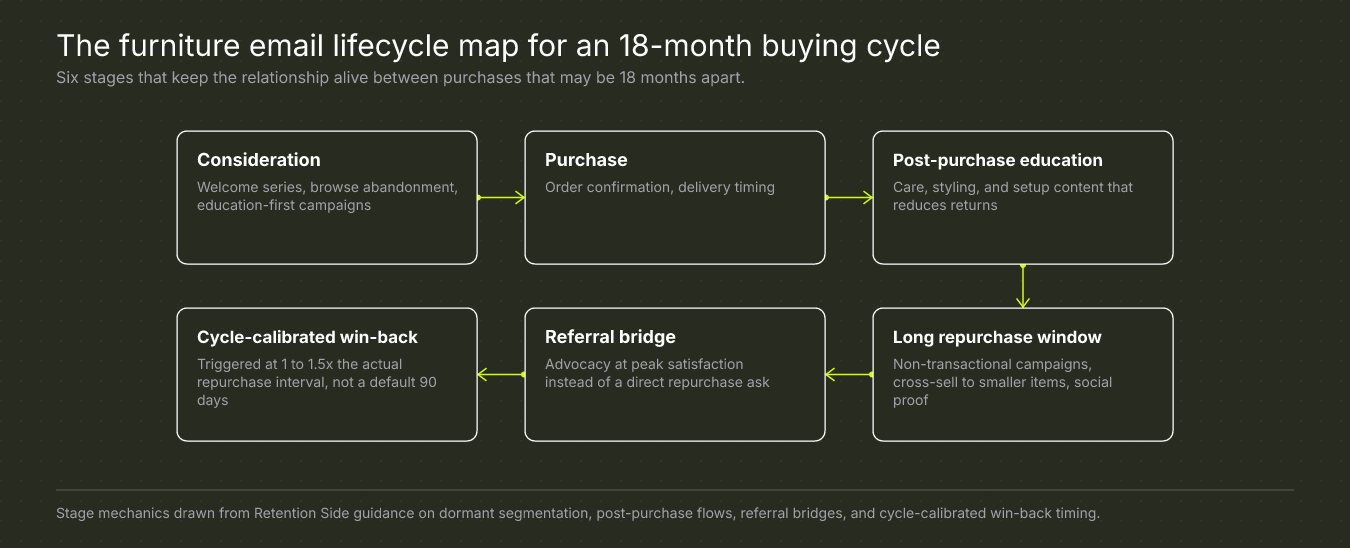
The standard dormant-customer rule is 90 days without a purchase. A furniture brand with an 18-month cycle that uses that rule sends win-back messaging to perfectly healthy customers. It trains them to expect discounts and wastes sends on people who are not at risk.
Categories with very long natural buying cycles, such as furniture, high-end electronics, and specialty outdoor equipment, are the exception to the standard window. The fix is to tie the trigger to your own data. Look at the actual time between first and second orders for customers who did repurchase, then set the win-back trigger relative to that interval, at roughly 1 to 1.5 times the typical gap, rather than a default.
Message content changes too. Acknowledge the gap and reconnect with the customer's original reason for buying, not just an offer. The sequence logic we use for win-back applies well here:
- Email one re-opens the relationship with relevance and no incentive.
- Email two deepens the value case with social proof.
- Email three is where an incentive appears, if it appears at all.
Operator takeaway: if a furniture case study reports win-back success without stating how the trigger was set, be skeptical.
Lesson 2: the post-purchase window does the retention work
When the next order is a year or more away, the weeks after delivery are where email can still change outcomes. Two mechanisms are documented in our work.
The first is returns. Customers who know what to expect do not send products back over misaligned expectations. Retention Side documented this in a case study on cutting return rates with email for a women's fashion brand. It is not a furniture result, but the mechanism is arguably stronger in furniture, where size, finish, assembly, and delivery all create room for surprise. Care, setup, and styling content belong in this window.
The second is the second-purchase bridge. For considered purchases with long cycles, that bridge may work best as a referral rather than a direct repurchase. A satisfied customer at peak satisfaction becomes an advocate, and the acquisition that follows comes in below paid CAC.
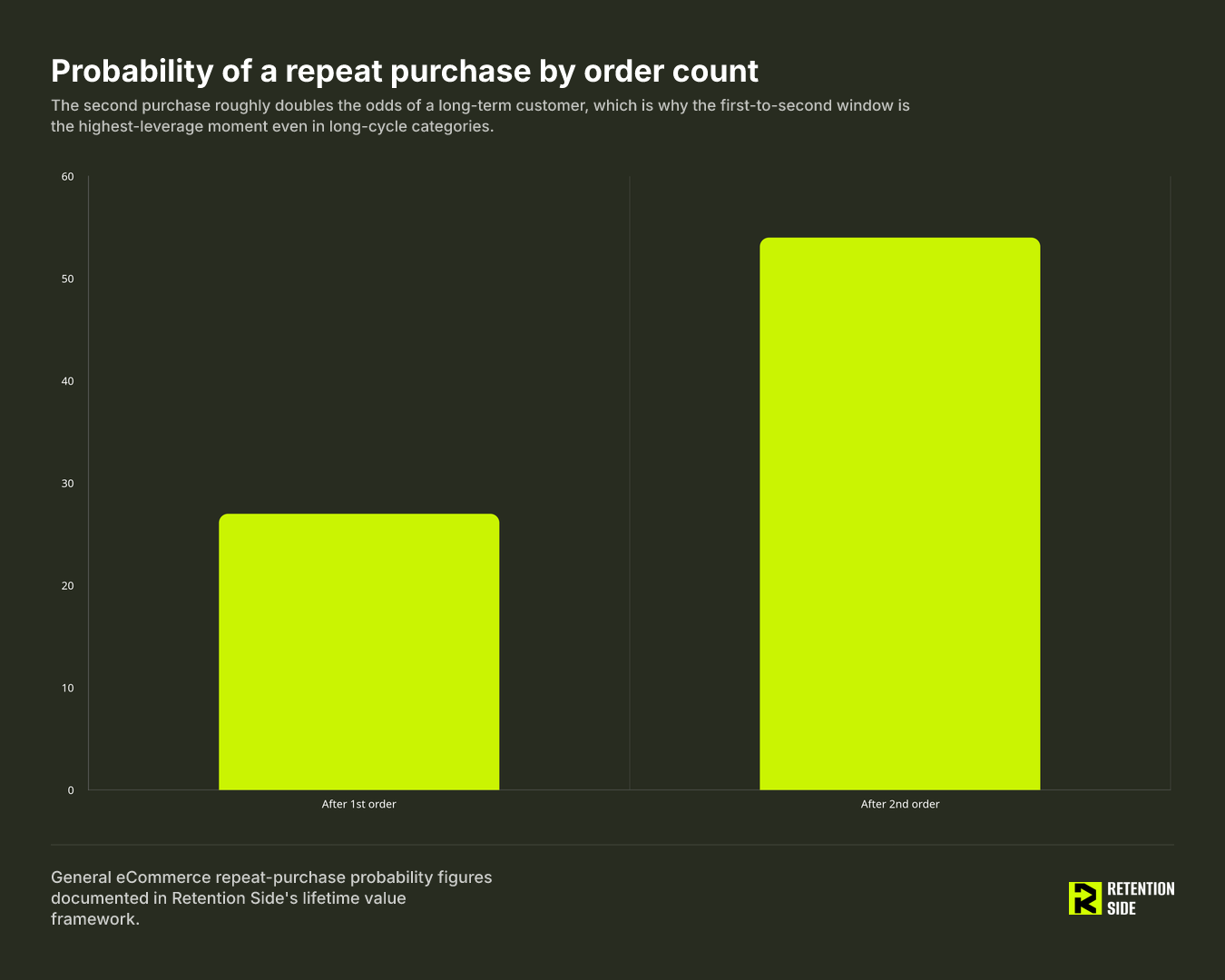
Second orders still matter when they happen. The probability of a customer buying again sits around 27% after a first order and roughly doubles to 54% after a second. In furniture, a smaller add-on item can be that second order, even when the big-ticket piece will not repeat for years.
Operator takeaway: measure post-purchase flows on returns, reviews, referrals, and add-on orders, not only on direct revenue.
Lesson 3: judge a case study by what it measures
A real case study specifies the before state, the actions taken, and the after state in business metrics: returning customer rate, revenue attributed to retention channels, list growth. A study that leads with "increased open rate by 40%" is optimizing for optics. Open rate says little about whether anyone bought, and it is especially unreliable as a proof point in a category where purchase is rare.
Here is what that standard looks like applied to results Retention Side has documented in other categories:
- A returning customer rate that moved from 21.4% to 29.8% in six months. This reports a business metric, a start point, an end point, and a timeframe.
- Email-attributed revenue that grew 800% in the first 60 days without increasing campaign volume. The "without more volume" detail matters, because it points to better targeting and flows rather than more sends.
- A 35% reactivation rate on dormant lists using proper segmentation.
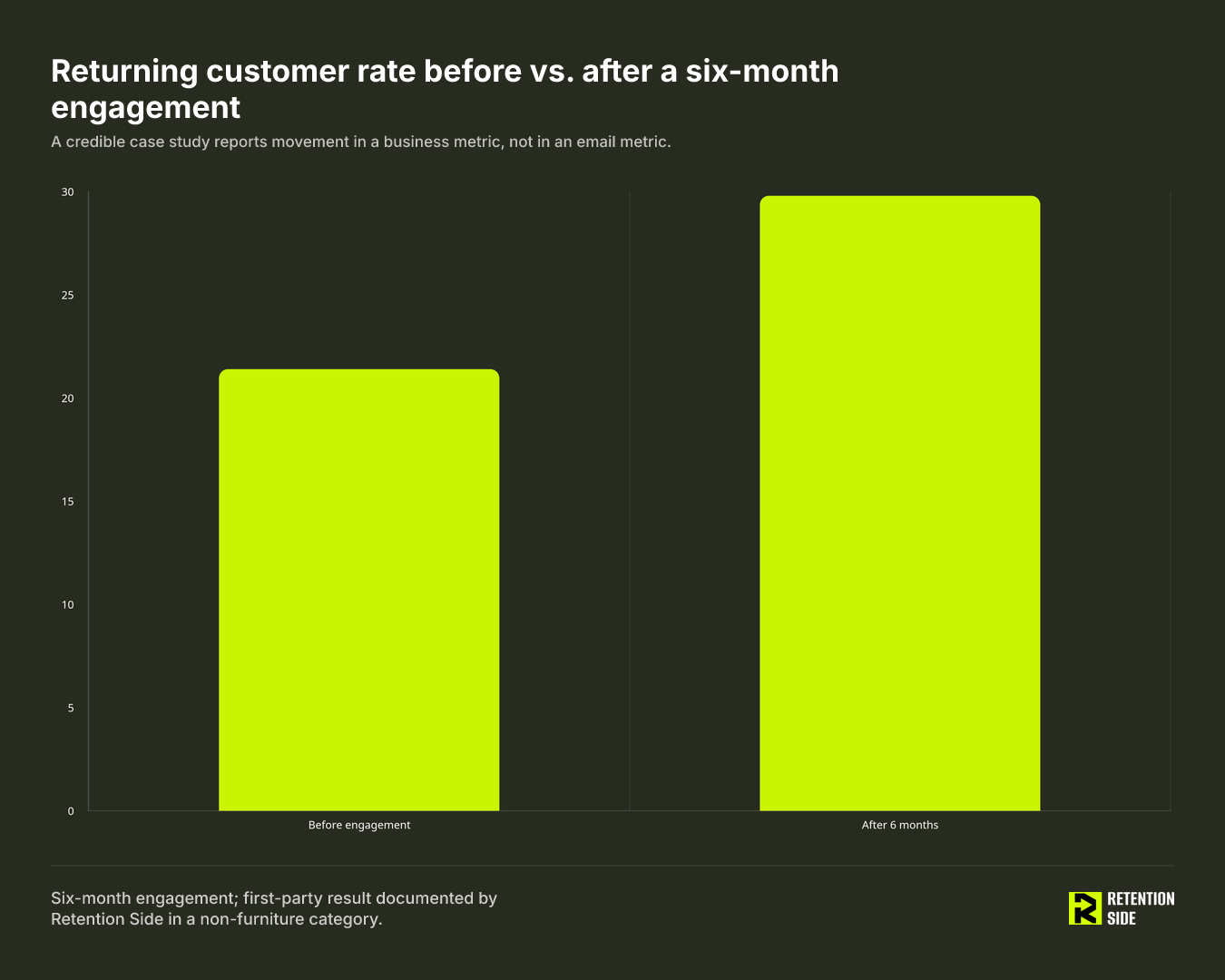
Even these should be read with care. They are first-party claims, and none is a furniture result. What you can take from them is the shape of a credible claim. When you evaluate any furniture case study, including ones from agencies, ask for the same three things: starting point, specific changes, and outcome in revenue or customer-behavior terms. Then check that the cycle length, average order value, and starting list quality are comparable to yours. Results from a brand with a very different cycle or a much healthier starting point will not transfer.
Operator takeaway: a case study that cannot state its baseline is a marketing asset, not evidence.
Lesson 4: list quality beats list size
High-AOV categories tempt brands to chase subscriber volume, since each converted subscriber is worth a lot. The Hedonism Wines engagement shows why that backfires. The brand had a list of more than 100,000 subscribers that sat underperforming for years. It only began converting once list hygiene and segmentation were applied together.
That case is a wine brand, not a furniture one, but the diagnosis is the same one furniture brands need. Form submission rate is not the KPI. Lead-to-customer rate is. A long consideration window makes this more important, because many furniture subscribers are researching a purchase months ahead and will go quiet. Without hygiene and segmentation, that quiet drags down engagement signals across the whole list.
Deliverability sits underneath this. Delivery and deliverability are not the same thing: a 99% delivery rate can coexist with 40% of sends landing in spam. A large, stale list sending unsegmented campaigns is how that happens.
Operator takeaway: audit lead-to-customer rate and list engagement before you spend more on acquisition forms or incentives.
Lesson 5: non-transactional flows carry the long middle of the cycle
In furniture, most of the lifecycle is not a buying moment. If every flow and campaign is built to produce direct revenue, the program has nothing useful to say for most of the year.
Not every flow exists to generate revenue. Some educate, onboard, collect information, or support the customer experience. For a furniture brand, that means material and care guidance, room-planning content, styling ideas, and social proof from real homes. These keep the brand present without training customers to wait for a discount, and they give you behavior signals (clicks, browsing, replies) that help you segment who is moving toward a next purchase.
There is also a balance issue on the campaign side. If subscribers only hear from you during sales, engagement and full-price purchasing decline over time. Mixing educational and value-driven sends with promotions is how you protect margin across an 18-month cycle.
Operator takeaway: assign each flow a job, whether education, information capture, reminder, or revenue, and measure it against that job.
How to use external case studies without being misled
Published case studies from platforms, apps, and agencies are worth reading, but treat each one as unverified until you confirm the brand, timeframe, before and after metrics, and the program details on the primary page. Then compare four things against your own business: repurchase cycle, average order value, list size and quality, and the channels involved. A result earned by a brand with a 6-month cycle and a heavy SMS program may not apply to you.
Also remember that retention does not operate in isolation. A change in email performance can come from traffic quality, acquisition changes, website issues, or shifts in customer behavior. A case study that credits email alone for a result, without addressing those factors, is telling only part of the story.
What this means for your furniture program
Furniture email programs rarely fail because of one campaign. They fail at the system level: deliverability that was never checked, a list that grew faster than its quality, win-back triggers copied from a different category, and flows built only for revenue. Fixing a subject line does not touch any of those.
That is the case for working with a partner that treats retention as a system. Retention Side starts with Klaviyo email and extends into SMS, push notifications, direct mail, loyalty, WhatsApp, and Viber where behavior and cost justify it. If you run an established furniture or home brand and want the lifecycle diagnosed against your actual repurchase interval, contact Retention Side and start with a review of your deliverability, list quality, and flow structure.