

Most retention advice is written for brands that sell something customers run out of. Coffee, supplements, skincare, pet food. The playbook is simple: predict the replenishment date, send the reminder, reward the habit. Furniture has no replenishment date. Nobody finishes a sofa.
That is why furniture customer retention goes wrong so often. Operators import the consumable playbook, watch the numbers underperform, and conclude that email “doesn’t work” for their category. The problem is not execution. The problem is that the playbook was built for a different purchase pattern.
This article lays out how to think about retention when your best customer might buy once every one to three years, and what a system built for that reality looks like.
Key takeaways
- Furniture’s repeat economics are structural. Weak repeat rates are mostly a function of the category, not a sign your flows are broken.
- The growth lever is catalog geography. A sofa buyer is rarely in-market for another sofa, but they may well be in-market for the dining room, the bedroom, or the outdoor set.
- Post-purchase education protects the first order, and a good first experience is the precondition for any second one.
- Loyalty, win-back, and nurture all need to run on multi-year clocks, not 12-month windows.
- Metrics need category context. Consumable benchmarks will make a healthy furniture program look like a failing one.
Why the replenishment playbook does not transfer
Retention Side’s published benchmarks, citing Eightx 2026 data, put the cross-vertical average 365-day repeat purchase rate at 28.2%. Consumables sit at 45-55%. Home and electronics trail at 20-25%.
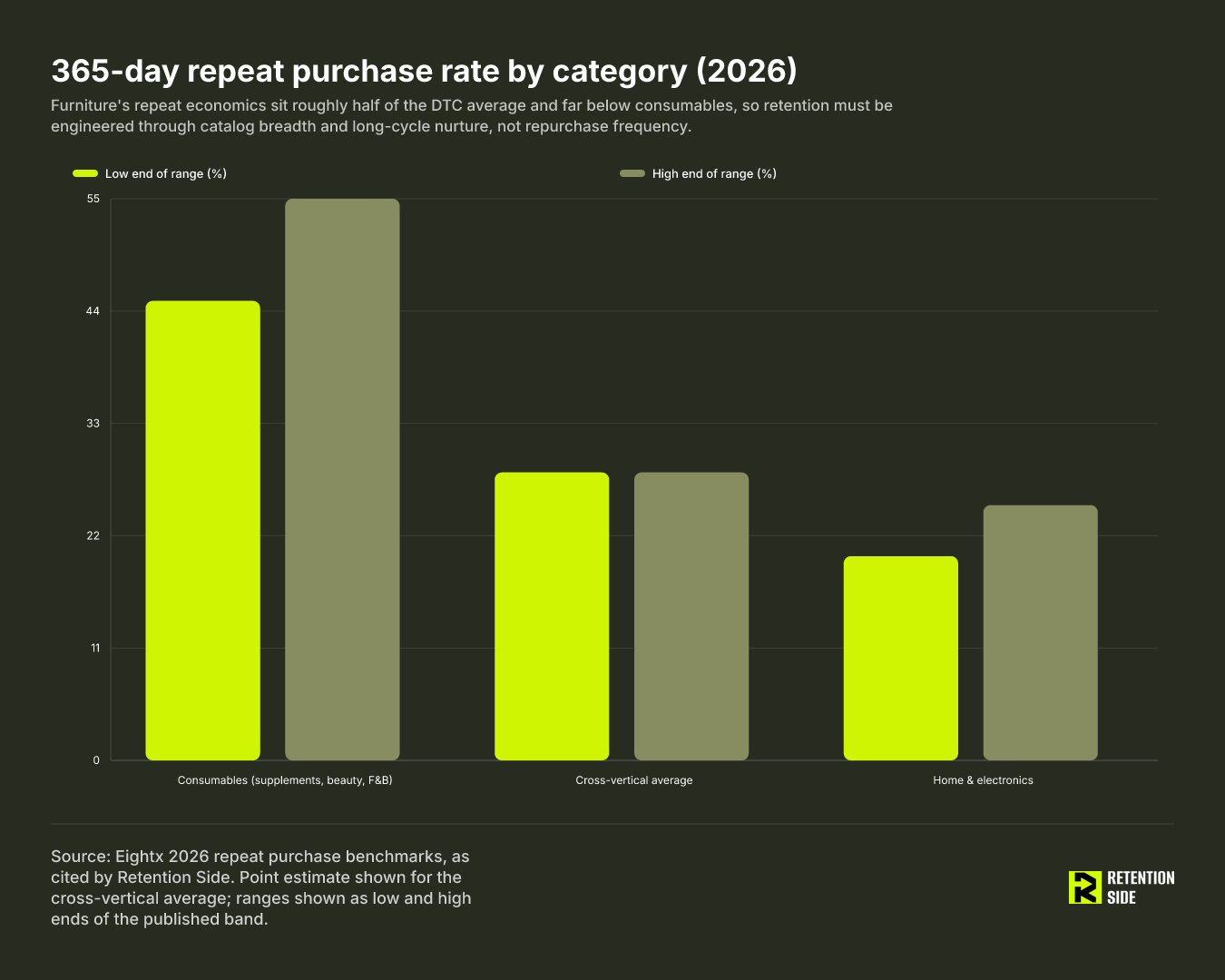
Read that chart as a description of the category, not a target you are missing. A consumable brand can build a retention system on frequency: more orders from the same customer, same product, tighter intervals. A furniture brand has a structurally lower repeat ceiling, so the same tactics produce a smaller return per send.
The same logic applies to short-window metrics. The 2026 DTC average for 90-day repeat purchase rate sits around 25-30%, but that number is almost useless without category context, and furniture is one of the categories where consumable-style benchmarks actively mislead. A furniture customer who has not reordered at day 90 is not churned. They are furnished.
The economics still favor retention. Bain’s research, widely cited through Harvard Business Review, found that a 5% increase in retention can raise profits by 25-95%, and that acquiring a customer can cost 5-25x more than keeping one. In a category with expensive acquisition and high order values, that gap is wide. What changes is where the retained revenue comes from.
The next room thesis
If frequency is capped, breadth has to carry the load. Think of every first order as an entry point into a home, not a transaction in a product category.
A customer who bought a sofa has told you several useful things: they are in the middle of a room project, they trust your quality enough to spend real money, and they probably have adjacent rooms that are not finished. The goal is the next room, not the next sofa.
This is where the durable-goods logic of cross-sell matters. For categories like home goods, recommendations in the sequence should be natural complements to what was purchased, not replenishment prompts. In furniture, I’d go one step further and make them room-adjacent rather than category-adjacent:
- Sofa buyer: coffee table, side tables, rug, lighting, then the dining room.
- Bed buyer: nightstands, dresser, bedding-adjacent accessories, then the guest room or kids’ room.
- Dining set buyer: storage, seating additions, then the living room.
Segment by what was bought and which room it belongs to, then build recommendation logic around the rooms that typically follow. A generic “you might also like” block fails here because it recommends similar sofas to someone who just ended a sofa search.
Protecting the first purchase
Furniture is a considered purchase. Customers research for weeks, compare options, and carry real anxiety about size, fit, assembly, and whether it will look right in the room. Retention starts by resolving that anxiety, because a customer who regrets the first order will not place a second.
Retention Side’s post-purchase approach for considered categories like home goods and electronics treats the education email as a core asset. It focuses on setup, advanced use cases, and lesser-known features that justify the price. For furniture, that translates to:
- Delivery-window expectations and what to do on arrival.
- Assembly and placement guidance.
- Care and maintenance for the specific material, whether that is fabric, leather, or solid wood.
- Styling ideas that show the piece in a finished room.
This content does two jobs. It lowers return probability, and it raises perceived value, which makes the customer more receptive when a complementary offer arrives later. This is retention work that never shows up as a discount code, yet it protects margin directly.
Flow architecture for a long-cycle category
A standard post-purchase flow runs from confirmation through education, cross-sell, review request, and a second-purchase bridge. The timing in Retention Side’s published structure is Day 0-1 for confirmation, Day 2-5 for post-delivery education, Day 7-10 for cross-sell, Day 14-21 for the review request, and Day 18-25 for the second-purchase bridge.
For furniture, the order holds but the dates need adjusting to delivery rather than order date. Large items can arrive weeks after purchase, so anchoring education and review timing to the order date means a customer gets “how are you enjoying it?” before the box is open.
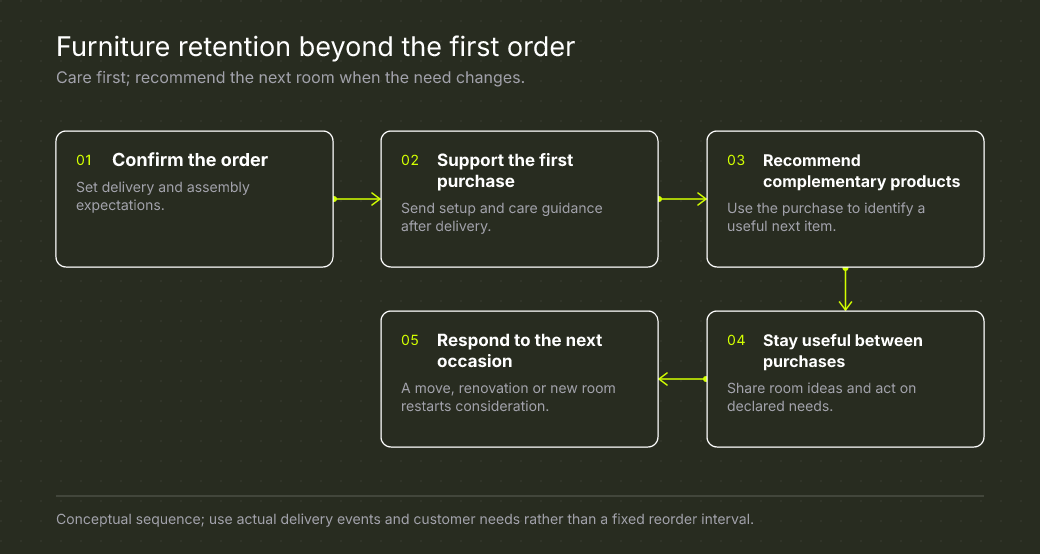
Here is how I’d adapt the sequence:
- Order confirmed. Set expectations on delivery and assembly.
- Post-delivery education. Setup, care, and styling, triggered by delivery status where your data allows it.
- Room-adjacent cross-sell. Complements to the room, not duplicates of the item.
- Review request. Once the customer has actually lived with the piece.
- Second-purchase bridge. A soft step toward the next room, such as a styling guide or a saved-room collection.
- Long-cycle nurture. Twelve to thirty-six months of lower-frequency, higher-value contact.
The last step is the one most furniture brands skip. Flows should hand off to the next lifecycle stage rather than end. When the post-purchase sequence finishes and nothing replaces it, the customer goes quiet for exactly the period in which the next purchase is being planned. And when a customer reaches a new purchase occasion, such as a move, a renovation, or a new child, they should re-enter the cross-sell logic at step three, not start from zero.
Loyalty and win-back on a multi-year clock
Retention Side’s loyalty guidance is blunt about this category. For furniture, electronics, and luxury goods, customers might buy once every one to three years, so a points system with a 12-month expiration is functionally useless. Customers lose their points before they have a reason to return, and the program becomes a source of irritation instead of value.
What works better follows the purchase cycle:
- Referral mechanics. Furniture buyers are often asked “where did you get that?” by guests. A referral offer turns a high-satisfaction moment into acquisition.
- VIP status for high-AOV buyers. Recognition tied to lifetime spend, with perks like early access to new collections, suits a customer who buys rarely but spends heavily.
- Long-cycle nurture. Content and collection launches that keep the brand present until the next purchase occasion arrives.
Win-back needs the same recalibration. Define lapsed against time between orders in your own data, not against a 90-day or 180-day default. If your repeat buyers typically return at 14 months, flagging a customer as at-risk at month four wastes sends and trains the list to ignore you.

Metrics that mean something in furniture
Because short-window benchmarks mislead, measure on horizons that match the category. The metrics worth watching for promotion and loyalty decisions are repeat customer rate, revenue attributed to retention channels, lead-to-customer rate, and average time between orders.
For furniture specifically:
- Repeat customer rate over 12 months or longer, compared against the 20-25% home and electronics range rather than the 45-55% consumable range.
- Average time between orders, which should set your nurture cadence and win-back thresholds.
- Second-purchase AOV, since a customer who returns for a room set may spend differently from the first order.
- Lead-to-customer rate, because list growth only matters if subscribers become buyers. Raw sign-up volume tells you very little in a category where research phases are long.
One caution. When performance dips, do not assume email is the cause. Traffic quality, audience mix, website experience, and acquisition changes all affect retention results. Furniture brands that lean heavily on promotional traffic often see this: the list fills with discount seekers, and the retention program is blamed for what is really an acquisition issue.
Common furniture retention mistakes
- Running consumable logic. Replenishment reminders, short-window winbacks, and points that expire in a year all assume a purchase pattern furniture does not have.
- Training the list to wait for discounts. If subscribers only hear from you during sales, engagement and full-price purchasing decline over time. Furniture margins and brand perception make this especially costly, so balance promotions with education, styling, and collection stories.
- Declaring one-time buyers churned too early. In a one-to-three-year category, a quiet customer is often just between projects.
- Ending the flow at the review request. The handoff to long-cycle nurture is where retention revenue is actually created.
Building it as a system
Furniture retention is not a single flow or a better discount. It depends on deliverability that keeps long-cycle emails reaching the inbox, list growth that brings in buyers instead of bargain hunters, segmentation by room and purchase history, and a channel mix that includes email, SMS, and in some cases direct mail for high-value customers.
That system-level view is how Retention Side approaches home brands, starting with Klaviyo email and extending into the other channels as audience behavior justifies them. If your repeat numbers look weak, the first step is working out how much is category and how much is system. The answer usually decides where to invest next.