


Most brands treat “dormant customers” as a single list: anyone who hasn’t purchased in X days gets dumped into one win-back flow with one discount. That approach leaves money on the table and, worse, trains your best lapsed customers to wait for a coupon before they buy again.
Dormancy isn’t a status. It’s a spectrum, and where a customer sits on that spectrum determines whether they need a nudge, a reason, or a goodbye. Treating a customer who bought 45 days ago the same as one who bought 14 months ago is one of the more expensive mistakes we see in Klaviyo accounts, because it wastes send volume on people who barely remember your brand while under-serving the ones who are still genuinely close to buying again.
This article breaks down how to actually segment dormant customers in a way that reflects real purchase behavior, not arbitrary day counts, and how that segmentation should shape your messaging, channel mix, and incentive strategy.
Key takeaways
- Dormancy thresholds should be based on each customer’s typical purchase cycle, not a flat 90 or 180-day rule applied to everyone.
- At minimum, split dormant customers into tiers: recently lapsed, at-risk, dormant, and lost. Each tier needs a different message and a different level of incentive.
- Recency of last purchase is not the only signal that matters. Email engagement, browsing activity, and historical order value all change how you should treat a lapsed customer.
- Reactivation revenue concentrates heavily in the earliest dormancy tiers. Chasing the “lost” tier with deep discounts is usually the least efficient use of budget.
- Win-back flows should not be a single email blast. They need escalating messaging, and eventually a channel shift, for customers who don’t respond to email.
- Segmentation without a clear reactivation offer strategy just organizes the problem. It doesn’t solve it.
What we’ll cover
- Why a single “dormant” segment fails most ecommerce brands
- How to set dormancy thresholds based on purchase cycle instead of calendar days
- Building a practical tiering system: recently lapsed, at-risk, dormant, and lost
- The behavioral signals that matter beyond last purchase date
- How engagement decays across dormancy tiers and what that means for messaging
- Channel and incentive strategy for each tier
- Common mistakes brands make with dormant segmentation
- How to measure whether your win-back segmentation is actually working
Why a single dormant segment doesn’t work
Most Klaviyo accounts we audit have some version of a “customers who haven’t purchased in 90 days” segment feeding a single win-back flow. It’s a reasonable starting point, but it collapses two very different populations into one send.
A customer who bought 95 days ago from a brand with a 60-day average repurchase cycle is genuinely late. They’re primed to buy again and probably just need a reminder or a small nudge. A customer who bought 95 days ago from a brand with a 12-month repurchase cycle, like a mattress or a supplement refill program, isn’t late at all. They’re right on schedule. Putting both of these customers into the same “dormant” segment and sending them the same message ignores what their behavior is actually telling you.
The same problem shows up on the other end. A customer who bought once 14 months ago and never opened another email since is not in the same category as someone who’s been quietly browsing your site every few weeks without converting. One of these people has probably moved on. The other is still engaged with your brand, just not ready to buy.
Segmentation exists to let you say the right thing to the right group. A flat dormant list can’t do that, no matter how good the copy is.
Set dormancy thresholds around the purchase cycle, not the calendar
Before you can build tiers, you need to know what “normal” looks like for your customers. That means calculating your average and median time between purchases, ideally by product category or customer cohort if your catalog spans different repurchase rates.
A skincare brand with a 45-day average repurchase cycle should start flagging customers as “at-risk” well before day 90. A furniture brand with an 18-month cycle would be sending win-back messaging to perfectly healthy customers if it used the same 90-day rule.
Practical approach:
- Pull historical order data and calculate median days between first and second purchase, and second and third purchase, separately. These numbers are often different, and the gap tells you something about early loyalty formation.
- Segment by product line if your catalog has meaningfully different consumption rates. A brand selling both a 30-day supplement and a one-time accessory shouldn’t use one repurchase window for both.
- Set your first dormancy flag at roughly 1.25 to 1.5 times the expected repurchase window, not at an arbitrary round number.
- Revisit these numbers quarterly. Repurchase cycles shift with seasonality, pricing changes, and new product launches.
This is the same logic we apply when building flows in Klaviyo for retention side clients: a trigger only works if it’s tied to actual behavior patterns, not a guess at what “should” count as dormant.
Building the dormant tier system
Once you know your repurchase cycle, build out tiers instead of one segment. A four-tier system covers most ecommerce brands well:
Recently lapsed (1 to 1.5x expected repurchase window)
These customers are barely dormant. They’re still warm, still remember your brand, and often just need a light reminder, a new product highlight, or a small nudge. This is not the tier for a steep discount. It’s the tier for relevance.
At-risk (1.5x to roughly 3x expected repurchase window)
This group has drifted but hasn’t fully disengaged. Email engagement is usually still present but declining. This is where you start introducing a moderate incentive, paired with a reason to come back that isn’t purely price-driven, like a restock, a new use case, or a loyalty status reminder.
Dormant (roughly 3x to 6x expected repurchase window)
Engagement has typically dropped off significantly by this point. These customers need a stronger reason to re-engage, and this is often where a channel shift, such as adding SMS or even direct mail for high-value customers, starts to outperform email alone.
Lost (beyond 6x expected repurchase window, or no engagement for an extended period)
At this stage, most customers in this tier won’t come back through a standard win-back sequence. This is where you either run a genuine last-attempt campaign with a strong offer, or start suppressing them to protect your sender reputation and deliverability. Continuing to email people who haven’t opened anything in over a year does more harm than good, because it drags down engagement rates that Gmail and other mailbox providers use to judge whether your emails belong in the inbox at all.
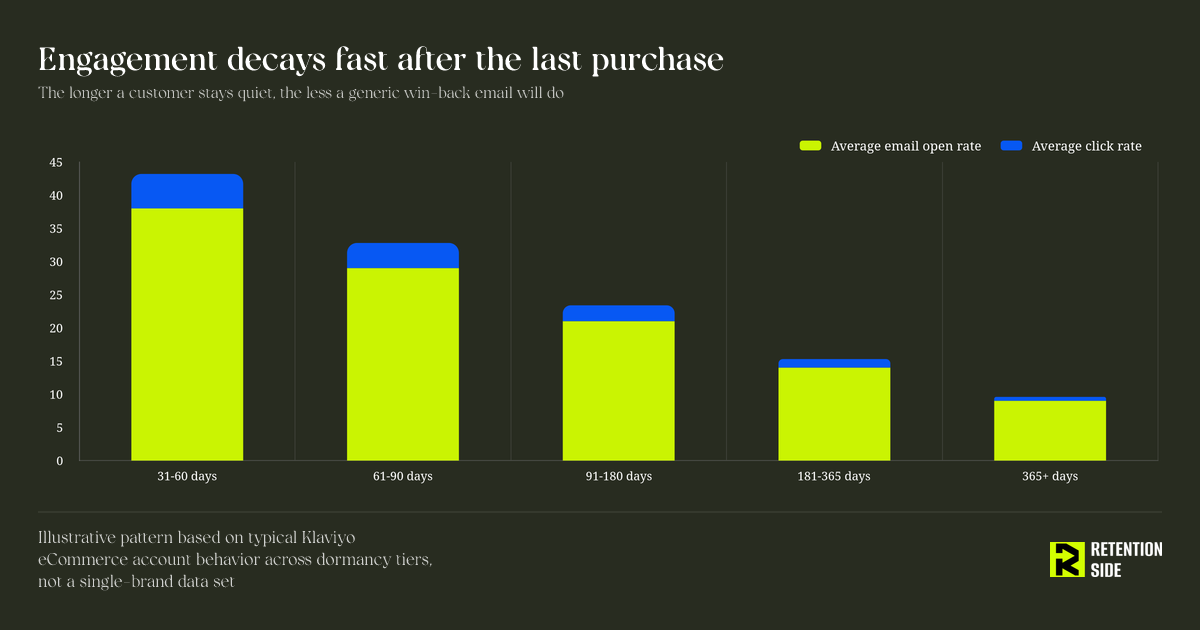
The drop-off shown here is why tiering matters so much. By the time a customer crosses six months of inactivity, open rates and click rates have usually fallen far enough that a single generic win-back email isn’t going to move the needle. The message, offer, and channel all need to change as engagement decays, not stay static across the whole dormant population.
Behavioral signals beyond last purchase date
Days since last purchase is the anchor for dormancy tiering, but it’s not the only variable that should shape how you treat a lapsed customer. A few signals consistently change the right approach:
Email and SMS engagement trend. A customer who’s still opening emails but not buying is a very different problem than one who’s stopped opening entirely. The first needs a better offer or better product relevance. The second needs a channel change or a re-permission attempt before you keep spending send volume on them.
Historical order value and frequency. A dormant customer with three prior orders and a high average order value deserves a different level of investment than a one-time, low-AOV buyer. This is where dormant segmentation should overlap with your VIP or high-value customer logic. The same 120-day-lapsed customer might get a personal touch, like a direct mail piece or a higher-value incentive, if their lifetime value justifies it.
On-site browsing behavior. Customers who keep visiting product pages without purchasing are showing you they haven’t mentally checked out. That’s a very different reactivation problem than silence across every channel.
Reason for the pause, when you can infer it. Did they stop after a bad delivery experience, a return, or a support issue? If your customer service or fulfillment data shows friction right before the drop-off, a straight promotional win-back email is the wrong first message. An acknowledgment or a service recovery message often needs to come first.
Layering these signals on top of pure recency turns a basic list split into an actual prioritization system, which matters because most brands don’t have unlimited send volume or unlimited incentive budget to throw at every lapsed customer equally.
Where the reactivation revenue actually comes from
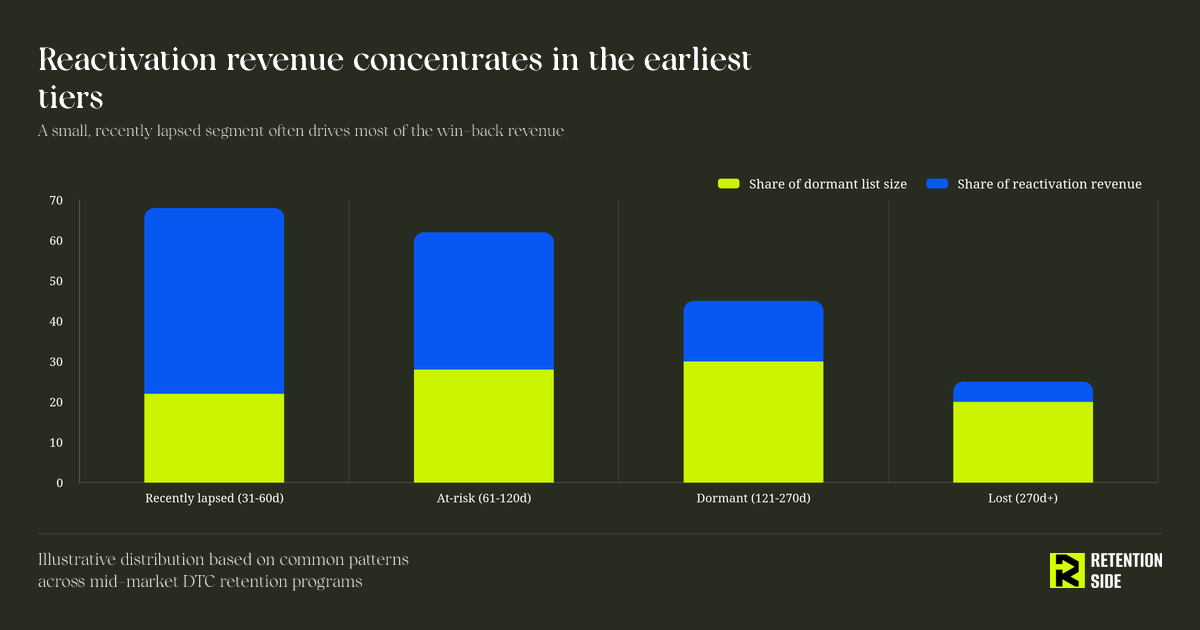
This is the pattern that should shape budget and effort allocation. The recently lapsed and at-risk tiers are usually smaller than the dormant and lost tiers combined, but they generate a disproportionate share of win-back revenue. That’s not a coincidence. These customers are closer to their natural next purchase, still recognize your brand, and need less convincing.
The practical implication: don’t spread equal effort across all four tiers. Put your strongest creative, your fastest testing cycle, and your most consistent send cadence into the recently lapsed and at-risk segments. Reserve the deepest discounts and the more expensive channels, like direct mail, for a smaller, more deliberate push into the dormant and lost tiers, and be honest with yourself about diminishing returns the further out you go.
Channel and incentive strategy by tier
Segmentation only matters if it changes what you actually send. Here’s how the tiers typically translate into channel and offer decisions:
Recently lapsed: Email first, SMS as a secondary touch if they’re opted in. Lead with product relevance, new arrivals, or a restock reminder. Save the discount for a second or third touch if there’s no response, and keep it modest.
At-risk: Email and SMS working together, with slightly more urgency in the messaging. This is often where a mid-tier incentive, like a percentage-off code or free shipping, starts to make sense as a second or third message in the sequence, not the opening move.
Dormant: This is where channel diversity starts to pay off. If you have accurate mailing addresses and the customer’s lifetime value supports it, a direct mail piece can cut through in a way email no longer does at this stage. For lower AOV customers, a stronger SMS or email incentive, combined with a clear expiration date, tends to outperform another soft nudge.
Lost: One final, clearly-framed win-back attempt with your strongest offer, followed by a decision point. Either they respond, or you move them to a suppressed or reduced-frequency list. Continuing to mail this group indefinitely mostly just damages deliverability for your entire list, since a chunk of unengaged addresses drags down the engagement metrics that inbox providers weight heavily.
This is exactly the kind of decision that shows why retention shouldn’t be thought of as an email-only function. Once you’re segmenting dormancy properly, the channel mix question naturally follows, and email alone often isn’t enough to reach every tier effectively.
Common mistakes in dormant segmentation
Treating every lapsed customer as equally recoverable. Some customers in your “dormant” segment were never going to be repeat buyers regardless of what you send them. Chasing them with escalating discounts just trains your list to expect deals.
Leading every win-back message with a discount. If the first thing a lapsed customer hears from you after months of silence is a coupon, you’ve taught them that patience gets rewarded with better pricing. Lead with relevance and reason first, and use the discount as an escalation tool, not the opening line.
Never cleaning the list. Brands worried about losing subscriber count often keep emailing deeply unengaged dormant customers indefinitely. This isn’t a list growth problem, it’s a deliverability problem, and it quietly suppresses inbox placement for your active customers too.
Using one flow for the entire dormant population. A single “we miss you” flow triggered at 90 days, sent to everyone regardless of repurchase cycle or engagement history, is the exact pattern this article is arguing against. It’s easier to build, but it underperforms a tiered approach every time we’ve compared the two.
Ignoring why the customer went quiet. Not every dormancy is about losing interest. Shipping problems, a bad support experience, or a pricing change can all sit behind the silence. A segmentation system that only looks at dates misses this entirely.
Measuring whether your segmentation is working
The metric that matters here isn’t open rate or even click rate on your win-back flow. It’s reactivation rate: the percentage of customers in each dormancy tier who convert back into an active, purchasing customer within a defined window after entering the flow.
Track this by tier, not in aggregate. If your recently lapsed tier is converting well but your dormant tier isn’t, that’s useful information, it tells you the tiering threshold and messaging for the dormant group need work, rather than suggesting the whole win-back program is broken. Aggregate reactivation numbers hide this kind of detail and often lead brands to overhaul the wrong part of the flow.
It’s also worth watching how reactivation performance shifts over time independent of your flow itself. If reactivation rates drop across the board, the cause might not be your segmentation or messaging at all. It could be a shift in acquisition quality bringing in less loyal customers to begin with, a change in average order value affecting perceived value of your incentives, or broader engagement decay tied to deliverability issues. Dormant customer win-back doesn’t operate in isolation from the rest of your retention system, and a dip here is worth checking against what’s happening elsewhere before you assume the segmentation logic itself has failed.
How this fits into the bigger retention system
Dormant segmentation isn’t a standalone project. It’s one piece of a broader lifecycle strategy that includes your post-purchase flows, your loyalty program if you have one, your campaign cadence, and your overall channel mix. A customer shouldn’t reach the dormant tier as a surprise. If your post-purchase and replenishment flows are working well, you should already have visibility into who’s approaching their expected repurchase window, and ideally you’re reaching them before they lapse, not after.
When we build retention systems at Retention Side, dormant segmentation sits downstream of that earlier lifecycle work. Email is almost always the starting point because it’s the fastest to build and the easiest to measure, but for higher-value dormant customers, especially in the dormant and lost tiers, we’ve found that layering in SMS, direct mail, or even a loyalty program nudge recovers customers that email alone would have missed. The tiering work described here is what makes that channel decision possible in the first place. Without it, you’re guessing at who deserves the more expensive outreach instead of knowing.
Conclusion
Dormant customers aren’t a single audience, and treating them as one flattens exactly the signal you need to win them back efficiently. The brands that recover the most revenue from lapsed customers aren’t the ones sending the biggest discounts. They’re the ones who’ve done the work to understand their actual repurchase cycle, split dormancy into meaningful tiers, and matched message, offer, and channel to where each customer really sits.
Start with your purchase cycle data, build out at least four tiers instead of one flat segment, and resist the urge to lead every win-back message with a coupon. The reactivation revenue is concentrated in the tiers closest to the purchase cycle, so that’s where your effort and testing should concentrate too. Get that right, and dormant segmentation stops being a cleanup task and starts functioning as a real, ongoing part of your retention system.