

Most ecommerce brands diagnose email problems at the wrong layer. They see a campaign underperform and rewrite the subject line. They see open rates dip and blame Klaviyo. They see revenue from email flatten and assume the list is fatigued. None of that is wrong exactly, but it’s rarely where the real problem lives.
The mistakes that actually cap email revenue for growing brands are structural. They sit underneath the copy, the design, and the send time. A brand can have great creative and still lose most of its potential email revenue because the list is unsegmented, the flows haven’t been touched since launch, or deliverability has been quietly degrading for months without anyone checking. These aren’t tactical slip-ups. They’re gaps in the retention system that email is supposed to run on.
This article walks through the mistakes we see most often in brands doing $300K/month and up, ordered the way we’d actually diagnose them if we were auditing your program today.
Why most ecommerce email mistakes are structural, not tactical
We think about email through four pillars: deliverability, list growth, automated flows, and campaigns. When email underperforms, the cause almost always traces back to one of these, and the order in which you check them matters. Deliverability comes first, then list health, then flow coverage and trigger reliability, then creative and offer quality.
The order isn’t arbitrary. If your emails aren’t reaching the inbox, no amount of segmentation or flow optimization will fix your revenue numbers, because the emails were never seen in the first place. If your list is full of disengaged or invalid addresses, your flows will underperform even if they’re perfectly built, because you’re triggering messages to people who were never going to open them. Fixing a downstream layer without addressing the upstream problem produces a temporary bump at best, then the same ceiling reappears a few weeks later.
That’s the lens for everything below. Each mistake on this list is really a failure at one of these four layers, and most brands are dealing with more than one at the same time.
Mistake 1: treating email as a broadcast channel, not a segmented system
This is the most common mistake we see, and it’s often invisible to the brand making it. The list gets built through pop-ups and checkout opt-ins, and every campaign goes out to close to the entire list every time. No behavioral segmentation, no engagement tiers, just a blast.
The problem compounds in two directions. First, engagement quality drops. Retail and ecommerce subscribers are 22.6 times more likely to click on behavior-based emails than on broadcast sends, and 60.7 times more likely to convert. Broadcast open rates have been sliding too, down from 30.58% to 26.90% year over year, with conversion rates dropping from 0.18% to 0.09% over the same period. Sending to everyone every time isn’t neutral. It actively trains your list to engage less.
Second, and more damaging long-term, unsegmented blasts hurt deliverability. Gmail and Yahoo read engagement signals at the mailbox level. When a meaningful share of recipients ignore or delete a campaign without opening it, that behavior tells the inbox provider your sending pattern looks like something worth filtering. You end up training the algorithm against you one broadcast at a time.
Segmentation doesn’t mean micromanaging fifty audiences. It means separating your engaged buyers from your lapsed browsers, your recent purchasers from people who haven’t opened an email in ninety days, and sending each group something relevant to where they actually are. That single shift changes both the revenue per send and the long-term health of your sending reputation.
Mistake 2: ignoring deliverability until revenue drops
Deliverability problems are quiet. Nothing breaks visibly. Campaigns still send, reports still populate, and revenue just… declines, gradually, in a way that’s easy to attribute to seasonality or ad performance instead of the actual cause.
The data on how widespread this is should be uncomfortable for most marketing teams. Average deliverability across email service providers sits at 83.1%, which means nearly 17% of legitimate marketing emails never reach the intended inbox at all. Of that gap, roughly 10.5% of permission-based email lands in spam, and another 6.4% simply disappears, never delivered anywhere. Bounce rates above 2% start damaging sender reputation, and Gmail and Yahoo now require bulk senders to keep spam complaint rates under 0.3%, with anything under 0.1% considered healthy.
Despite how much revenue rides on this, most brands aren’t watching it. Only 23.6% of email marketers verify their lists before sending campaigns, and 61.6% have never monitored how much revenue they’ve lost to poor deliverability. That’s not a small oversight. It’s the majority of the industry flying blind on the one variable that determines whether anything else in email marketing can work. The consequences show up directly in the P&L too: 64.6% of US businesses say deliverability issues have directly affected revenue or customer retention.
Fixing this isn’t complicated, but it requires actually looking. Check your authentication setup (SPF, DKIM, DMARC), monitor spam complaint and bounce rates weekly rather than quarterly, and verify your list before major sends instead of after a campaign underperforms.
Mistake 3: underinvesting in automated flows
Here’s a stat that should reframe how you allocate effort inside your Klaviyo account: automated flows made up just 2% of all email sends in 2025 but generated 30% of total email-driven revenue. Each automated email earned $2.87 per send on average, compared to $0.18 for a scheduled campaign. That’s a 16x difference in revenue efficiency between an automation and a broadcast.
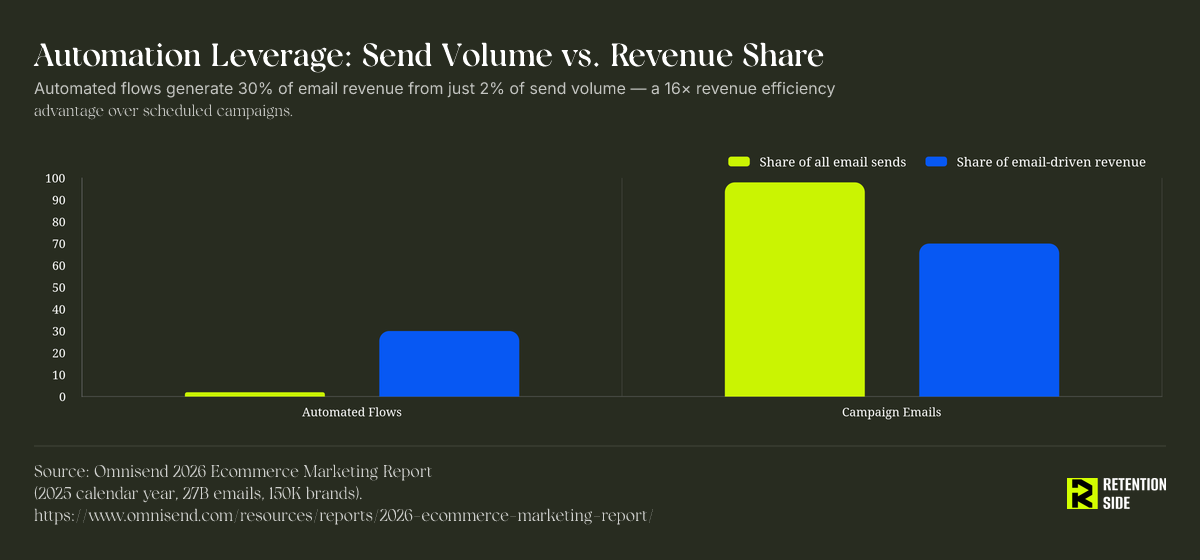
The gap is even sharper when you isolate specific flows. Klaviyo’s benchmark data puts average campaign revenue per recipient at $0.10, while the average abandoned cart flow generates $3.07 per recipient, roughly 30 times more. Flows overall produce nearly 41% of total email revenue from just 5.3% of sends, with click rates roughly 3x higher and placed-order rates around 13x higher than campaigns.
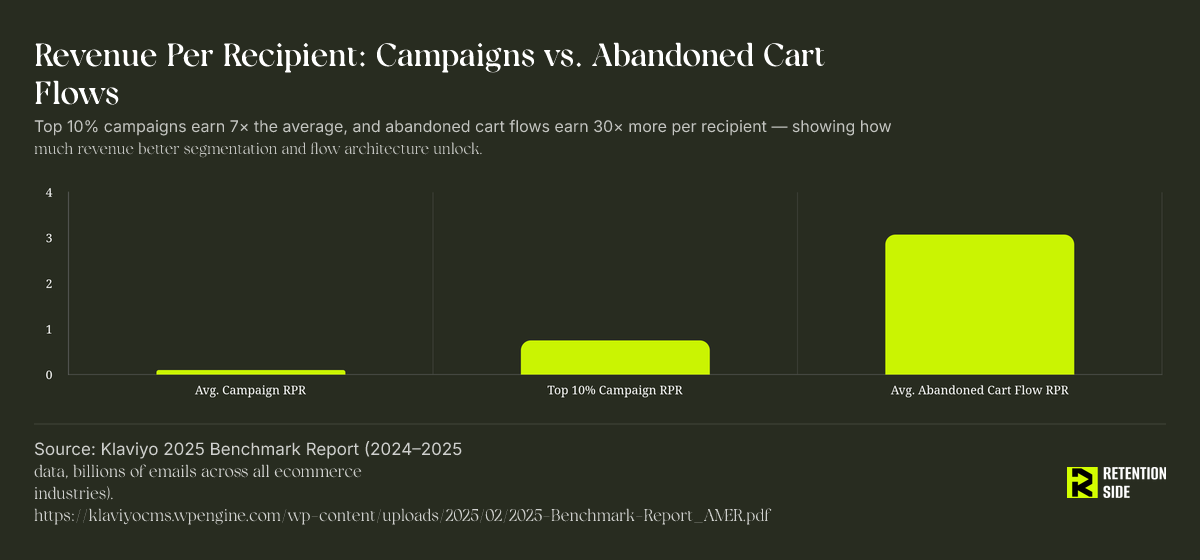
Brands that treat flows as a “set it up once during onboarding” task are leaving most of this on the table. If you don’t have a working welcome series, abandoned cart flow, browse abandonment flow, and post-purchase sequence, you’re not competing for the highest-converting inventory in your entire email program. Campaigns matter, but they will never be as efficient as automated flows because flows trigger on intent and behavior, not on a calendar date.
Mistake 4: letting flows go stale
The inverse mistake is just as common: flows exist, but nobody has touched them since launch. We see this constantly with brands that are twelve, eighteen, twenty-four months past their original Klaviyo setup. The welcome flow still references a product line that’s been discontinued. The abandoned cart flow’s incentive no longer matches current margin targets. The post-purchase flow is still just an order confirmation and a shipping notice, missing the highest-engagement window a customer will ever have with your brand.
That post-purchase gap deserves specific attention because it’s one of the most underused opportunities in ecommerce email. A customer who just bought is warm, curious, and paying attention. If your post-purchase flow stops at logistics, you’re skipping the chance to set expectations, reduce buyer’s remorse, introduce complementary products, and start building the habits that lead to a second purchase. A flow limited to “your order shipped” is a missed relationship-building window, not a finished flow.
Flows are never actually finished. They should be reviewed on a schedule, tested against new offers or messaging, and updated whenever your product line, pricing, or customer expectations shift. Treating flow-building as a one-time setup task rather than an ongoing discipline is how a well-built system quietly becomes irrelevant.
Mistake 5: conditioning your list with discount-only campaigns
If every campaign email a subscriber receives from you includes a discount, you’re teaching them a specific behavior: wait for the next sale before you buy. That’s a rational response to the pattern you’ve created, and it’s expensive. Full-price purchasing declines, engagement drops between promotions because subscribers learn there’s nothing worth opening in between, and unsubscribe rates climb as the relationship narrows down to “coupon provider.”
This shows up gradually. A brand doesn’t wake up with a discount-dependent list overnight. It happens campaign by campaign, as the easiest way to hit a revenue number becomes another 15% off code, until the list has been trained to only respond to markdowns.
The fix is a genuinely mixed campaign calendar: educational content that helps customers use the product better, social proof and community-driven sends, lifecycle-anchored messages tied to where a customer actually is, and promotions that are spaced out and varied in structure rather than the same percentage-off mechanic every time. The goal isn’t to eliminate discounting. It’s to make sure discounting is one tool among several, not the entire relationship.
Mistake 6: expanding to new channels before fixing the email foundation
SMS, push notifications, and direct mail all have a role in a mature retention system, and we build all of them. But we consistently see brands add a new channel to solve a problem that’s actually sitting in their email foundation. If your email deliverability is shaky, your segmentation is thin, and your flows have coverage gaps, adding SMS doesn’t fix any of that. It just gives you the same underlying problems across two channels instead of one, plus a new cost center and a new way to fatigue your customers.
Channel expansion works when it’s additive to a foundation that’s already solid, not a substitute for fixing what’s broken. If email revenue is underperforming, the answer usually isn’t “add another channel.” It’s “diagnose why the channel you already have isn’t performing,” and only after that’s resolved does it make sense to layer in SMS, WhatsApp, push, loyalty, or direct mail based on how your specific audience actually communicates and where the incremental reach genuinely exists.
Mistake 7: misattributing email underperformance to the channel
When email revenue drops, the instinct is almost always to look at email first, which makes sense, it’s the channel showing the symptom. But a drop in email-attributed revenue is frequently a downstream effect of something happening upstream: a shift in acquisition channel mix that’s bringing in lower-intent traffic, a website conversion issue suppressing purchases across the board, or a change in customer behavior that has nothing to do with your Klaviyo account.
Rebuilding your email strategy in response to a problem that actually originates in acquisition or on-site conversion wastes time and doesn’t fix anything. It’s worth checking whether the drop in email performance correlates with a broader drop in site-wide conversion rate, a change in ad spend or channel mix, or a shift in the type of customer coming through the door before you assume the flows or campaigns themselves are the problem. Retention doesn’t operate in isolation. It’s downstream of acquisition quality and on-site experience, and diagnosing it as if it exists in a vacuum leads to fixing the wrong thing.
Mistake 8: ignoring mobile rendering and reading-time constraints
Mobile now accounts for 62% of all email opens, but it converts at roughly half the rate of desktop, 1.3% click rate versus 2.4%. Part of that gap is behavioral: average reading time on mobile is around 8 seconds, compared to 14 seconds on desktop, meaning your email has to communicate its value almost immediately. Part of it is design failure: 69% of users will delete an email that isn’t optimized for their device before they even finish reading it.
Designing for mobile-first isn’t a nice-to-have anymore given that split. Templates need to render cleanly on a narrow screen, images need to load fast without dominating the layout, and every email needs one clear call to action rather than three competing links. If most of your audience is opening on a phone and skimming for eight seconds, an email built and previewed only on desktop is optimizing for the smaller share of your audience.
How to audit your email program for these mistakes
If you want to know where your program actually stands, work through the same four layers in order rather than jumping straight to campaign copy.
Deliverability: Confirm SPF, DKIM, and DMARC are properly configured and passing. Pull your spam complaint rate and bounce rate for the last 90 days and check them against the 0.3% complaint threshold and 2% bounce threshold. Verify your list before your next major send rather than after a campaign underperforms.
List health: Segment your list by engagement tier, engaged, lapsing, and cold, and look at what percentage of your list falls into each. Suppress or run a re-engagement sequence on subscribers who haven’t opened in 90 to 120 days before they drag down your sender reputation further.
Flow coverage: Map every stage of your customer journey, first visit, cart abandonment, browse abandonment, first purchase, post-purchase, repeat purchase, lapsing, against the flows you actually have live. Any gap in that map is a gap in automated revenue you’re not capturing, and any flow that hasn’t been reviewed in six months is a candidate for a refresh.
Campaign quality: Look at your last twenty campaigns and count how many included a discount versus how many delivered standalone value. If the ratio is heavily skewed toward discounting, that’s your list-conditioning risk showing up in the data before it shows up in your unsubscribe rate.
Where this leaves your email program
None of these mistakes are about better copywriting or smarter subject lines. They’re about whether the underlying system, deliverability, segmentation, flow coverage, and campaign discipline, is actually built to support the revenue you’re trying to get out of it. Fix the structural layer first, and the tactical improvements you make on top of it will actually compound instead of disappearing after a few weeks.
The brands that treat email as an architecture rather than a series of one-off sends are the ones still growing their email revenue two or three years into a Klaviyo account, not just in the first ninety days after setup.