

What you’ll learn
- How to build a holiday email calendar backward from key dates instead of forward from a generic template
- Why deliverability prep in October determines whether your BFCM sends land in the inbox in November
- How segmentation and flow updates protect margin while still driving urgency
- Where email revenue actually concentrates during Q4, and what that means for your sending cadence
- How to avoid the January cliff that follows most holiday programs
Key takeaways
- Holiday email is not “more of the same emails, sent more often.” It requires structural changes to segmentation, flow logic, and sending infrastructure that should start weeks before Black Friday.
- Deliverability, not creative, is usually what breaks first during BFCM. A list that hasn’t been cleaned and warmed properly will see rising volume punished by spam placement at the exact moment revenue is on the line.
- Campaigns carry more weight than flows during peak week, but flows still need to be rebuilt for urgency, stock levels, and shipping deadlines, not left running on autopilot.
- The brands that win Q4 are the ones that also protect January. A holiday program without a reactivation and full-price-normalization plan just borrows revenue from the following quarter.
- Every channel decision during BFCM, from SMS backup sends to post-purchase SMS confirmations, should be made based on audience behavior and deliverability risk, not just because “everyone sends SMS during Black Friday.”
Why holiday email needs its own system, not a bigger version of your normal one
Most brands treat holiday email as a volume problem. Send more campaigns, drop bigger discounts, add urgency copy, and hope the list responds. That mindset works reasonably well when a list is healthy and engaged, but it breaks down fast at the exact moment you need it most.
The real difference between holiday email and always-on email marketing is compression. You’re trying to move a normal quarter’s worth of commercial intent into about six weeks, while every other brand in your subscribers’ inbox is doing the same thing. Inbox providers notice the spike in sending volume across the entire industry, subscribers get fatigued faster, and any weakness already sitting in your program, whether that’s a stale list, thin segmentation, or flows that haven’t been touched since last January, gets magnified under that pressure.
This is why we treat holiday planning at Retention Side as a systems exercise, not a calendar exercise. The question isn’t “what should our Black Friday email say.” It’s “what does our list, our flows, our segmentation, and our sending reputation need to look like by the time Black Friday arrives so that increased volume converts instead of getting buried in Gmail’s Promotions tab or worse, the spam folder.”
Building the holiday calendar backward, not forward
Most holiday calendars get built forward: start with a Black Friday teaser, add a Black Friday email, a Cyber Monday email, maybe a “last chance” email, and call it done. That approach misses most of the actual revenue window and ignores the operational reality of running a promotion at scale.
Build it backward instead, starting from your last guaranteed shipping date and working toward today:
- Last-chance shipping deadline – the date after which you can no longer guarantee holiday delivery. This anchors your final urgency push and needs its own dedicated messaging, not a rehash of Black Friday copy.
- Post-Cyber Monday recovery window – the days immediately after Cyber Monday when open rates and revenue dip hard. This is where educational and value-driven content needs to reappear, not more discounting.
- Cyber Monday – typically your single highest-revenue day of the year, and worth its own campaign sequence rather than an extension of Black Friday messaging.
- Black Friday and Thanksgiving weekend – the core of the promotional period, usually requiring multiple sends per day segmented by engagement and purchase intent.
- Early access week – VIP and top-tier segment previews before the wider list gets the offer. This is where segmentation quality actually pays for itself.
- Pre-BFCM warm-up (2 to 4 weeks out) – list cleaning, engagement campaigns, and gradual volume increases to condition both subscribers and mailbox providers.
- Deliverability and infrastructure prep (4 to 6 weeks out) – the least glamorous step and the one most brands skip, which is exactly why it matters.
Working backward like this forces you to see holiday email as a sequence of interconnected weeks rather than a handful of isolated sends. It also surfaces the parts of your program, like early access segmentation or shipping-deadline messaging, that a forward-built calendar tends to overlook entirely.
Deliverability prep is the part everyone skips and then regrets
If your emails don’t land in the inbox, none of the rest of this matters. That’s not a caveat, it’s the foundation. Delivery and deliverability aren’t the same thing. Delivery means the message technically arrived somewhere. Deliverability means it landed in the inbox, not buried in spam or filtered into Promotions where open rates quietly die. We break down the full system in our email deliverability guide; for BFCM, the same principles apply but with less time to course-correct.
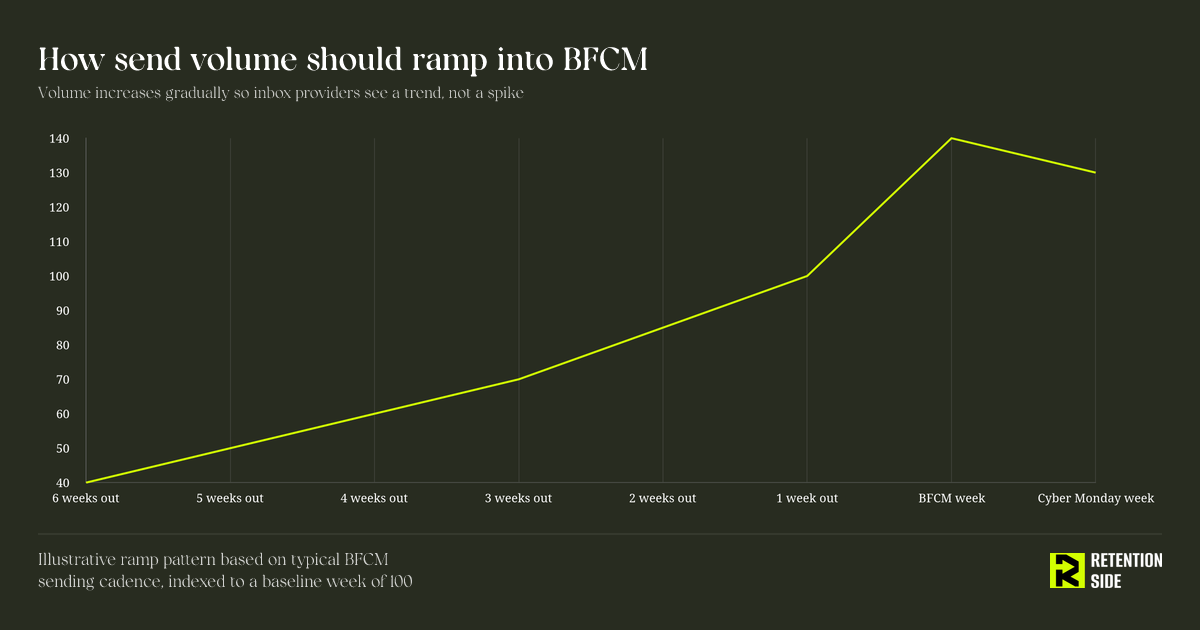
Holiday sending volume is exactly the kind of change that trips up domain reputation. If your list has been sitting at a steady, moderate cadence for months and you suddenly triple your send frequency in the first week of November, Gmail and Yahoo’s filters — which since February 2024 enforce explicit sender requirements for anyone sending more than 5,000 messages a day — read that as a signal worth scrutinizing, not celebrating. The fix isn’t complicated, but it does require lead time:
- Suppress or re-engage chronically unengaged subscribers before the ramp-up starts. Carrying dead weight into BFCM only drags down open rates at the moment you need strong engagement signals the most.
- Increase volume gradually over several weeks rather than jumping straight to peak frequency — Litmus notes that even volume spikes from events like BFCM should be approached with a warm-up mindset, not just new IPs. Mailbox providers respond better to trends than spikes.
- Monitor spam complaint rates and bounce rates weekly, not just after a big send. A complaint spike during a low-stakes October campaign is a warning you want, not a problem you want to discover during Black Friday week.
- Keep your sunset flow active through Q4. It feels counterintuitive to remove subscribers right before your biggest revenue period, but sending to disengaged addresses during your highest-volume weeks is one of the fastest ways to tank deliverability across your entire list, including for engaged subscribers.
None of this is exciting work, and it’s easy to deprioritize when there’s creative to finalize and discount codes to configure. But we’ve seen brands with genuinely strong offers underperform their own benchmarks purely because deliverability wasn’t addressed until it was too late to fix mid-peak.
Segmentation carries more weight during BFCM, not less
There’s a temptation during peak season to simplify: blast the whole list, keep messaging broad, worry about precision later. That instinct works against you. Segmentation is what lets you run more sends without burning out your list, and it’s what protects margin by not discounting to people who would have bought at full price anyway.
A practical holiday segmentation setup, building on what we cover in our guide to ecommerce email segmentation, typically separates the list into at least these groups for BFCM specifically:
- VIPs and repeat purchasers who get early access before the public offer goes live, protecting their sense of being valued rather than just another name on the blast list
- Highly engaged non-purchasers who need urgency and social proof more than a discount, since they’re already paying attention
- Price-sensitive or discount-responsive segments, identified by past behavior, who should see the strongest offer messaging
- Recent purchasers, who need a different message entirely, likely post-purchase upsell or referral content rather than another acquisition-style discount
- Disengaged or low-activity subscribers, who either get suppressed from high-frequency sends or moved into a targeted win-back attempt rather than full BFCM cadence
This is also where the case for treating form submission rate as a vanity metric becomes obvious. A holiday popup that captures a flood of low-intent email addresses in exchange for 20% off does nothing for you if none of those addresses convert to paying customers. Lead-to-customer rate is the number that matters, and it’s especially visible during Q4 when list quality gets stress-tested by volume.
Flows need a seasonal rebuild, not a status check
Flows are behavior-based and time-sensitive by design, which means the ones built for a normal Tuesday in June don’t automatically hold up during a week when shipping deadlines, stock levels, and urgency expectations are completely different. Treat your BFCM flow audit as a rebuild, not a review.
Priority flows to update before peak season:
- Abandoned cart and browse abandonment – shorten delay times and add stock-level or deadline urgency that reflects actual holiday shipping cutoffs, not generic “still thinking it over” copy
- Post-purchase flows – update shipping expectation messaging so customers aren’t left guessing whether a gift will arrive on time, and layer in upsell opportunities aligned with what we outline in our guide to upsell emails for ecommerce
- Win-back flows – holiday season is one of the best windows to re-engage lapsed customers, since gifting occasions give you a natural, non-desperate reason to reach back out — our winback email campaign guide covers the trigger timing and sequence structure that determine whether reactivation actually works
- Welcome flow – new subscribers acquired through holiday-specific popups need a welcome sequence that acknowledges the reason they signed up, rather than a generic year-round message that ignores the discount they were promised
Flows are never finished. The version that worked last November needs adjustment for this year’s product catalog, shipping timelines, and offer structure. Treating flows as “set it and forget it” infrastructure is one of the most common reasons holiday performance disappoints even when campaign creative looks strong.
Where holiday email revenue actually concentrates
Understanding where revenue clusters during Q4 changes how you allocate creative time, testing effort, and team bandwidth. Most brands spread their planning evenly across the whole quarter, when in reality the bulk of email-attributed revenue lands in a much narrower window.
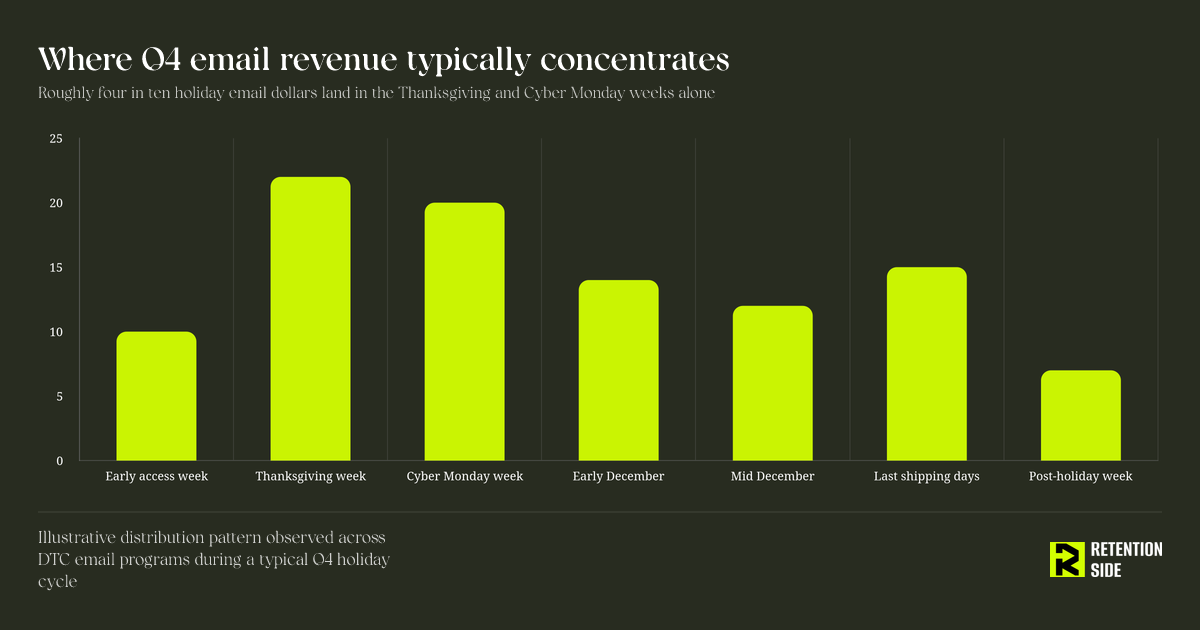
Thanksgiving week and Cyber Monday week alone typically account for a large share of total quarterly email revenue — Adobe’s 2024 holiday data put Cyber Week at $41.1 billion in online spending, with Cyber Monday alone hitting a record $13.3 billion. That’s not a reason to ignore the weeks before and after, since early access sends and last-shipping-day urgency both punch above their apparent weight, but it is a reason to be deliberate about where your best creative, your sharpest subject lines, and your most careful segmentation go. Spreading effort evenly across six weeks when 40% of the outcome depends on two of them is a planning mistake worth correcting.
This concentration also explains why frequency questions come up so often during Q4. Our piece on how often ecommerce brands should send emails covers this in more depth, but the short version for holiday specifically: the underleveraging problem is far more common than the oversending problem, especially in brands with strong flow coverage but a thin campaign calendar. If your list is properly segmented and your deliverability is healthy, peak week is exactly when a thin campaign calendar costs you real money.
Campaigns take the lead during peak week, flows stay the backbone
There’s a meaningful shift in how revenue splits between flows and campaigns once BFCM week arrives, and planning for that shift changes where you should be spending your time.
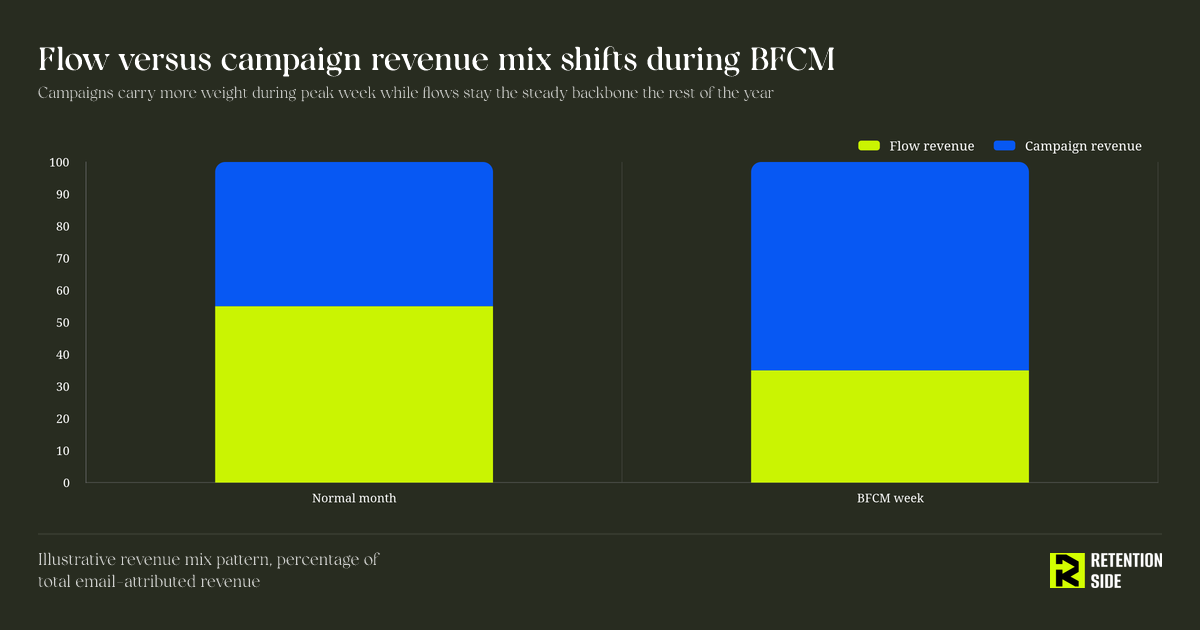
During a normal month, flows tend to carry more of the revenue load because they’re always running in the background, catching abandoners and post-purchase moments continuously. During BFCM week, campaigns take over as the primary driver, since manual sends are how you communicate time-bound urgency, stock scarcity, and offer specifics that a static flow simply can’t convey in the same way. Klaviyo’s BFCM 2024 report confirmed this shift in practice, with customers driving over $3 billion in attributed value across the Thanksgiving-to-Cyber-Monday window, much of it through campaign sends timed to peak shopping hours.
That doesn’t mean flows become unimportant during peak week. It means your flow strategy shifts from “steady revenue generator” to “safety net that captures the traffic your campaigns are driving.” A campaign-heavy week only works if the underlying flows, especially cart abandonment and browse abandonment, are tuned to catch the surge in site traffic those campaigns create. Campaign strategy during this window depends heavily on segmentation, which is why the segmentation work covered earlier isn’t optional groundwork, it’s the mechanism that lets aggressive campaign frequency avoid becoming aggressive fatigue.
Incentive strategy: balancing conversion lift against margin protection
Every brand wants a strong enough offer to compete during BFCM without training its full-price customers to wait for a discount every time they want to buy. That tension doesn’t resolve itself; it needs a deliberate structure.
A few principles that hold up across most DTC categories:
- Segment your incentive, not just your discount amount. Your most price-sensitive segment might get a straightforward percentage-off offer, while your loyal, high-frequency buyers might respond better to early access, a gift-with-purchase, or a loyalty point multiplier that doesn’t compress margin the same way a blanket discount does.
- Protect at least one full-price channel or moment. Whether that’s a new product launch timed for right before Black Friday or a VIP tier that never sees the discount at all, giving your best customers something other than “wait for the sale” keeps full-price purchasing behavior alive.
- Watch what the incentive trains subscribers to expect next quarter. If your list only hears from you during discount periods, engagement and full-price purchasing decline over time, and that erosion shows up clearly by the following Q4 when the same offer needs to be even deeper to get the same response.
- Test incentive structure, not just size. A/B testing during BFCM shouldn’t stop at “20% off vs 25% off.” Test free shipping thresholds, bundled offers, and tiered spend-based incentives against straight percentage discounts. The winner is rarely obvious in advance.
Coordinating channels beyond email during peak season
Email is almost always the backbone of a holiday retention plan, but it’s not the whole plan. SMS timing, push notification cadence, and even direct mail or WhatsApp touches for international audiences all need to be considered as part of one coordinated system rather than separate channels firing independently at the same subscriber.
The practical risk during BFCM specifically is channel fatigue compounding faster than usual. A subscriber getting three emails and two SMS messages in the same day about the same sale isn’t experiencing a well-orchestrated retention system, they’re experiencing noise, and noise during your highest-stakes week is exactly when unsubscribes and opt-outs spike. Coordinating send times across channels, assigning SMS to genuinely time-sensitive moments like “sale ends in three hours” rather than duplicating every email, and reserving push notifications for app-engaged audiences rather than blasting everyone are the kinds of decisions that separate a coordinated retention system from a pile of disconnected channel tactics. This is the same channel-mix thinking we walk through in more depth in what channels make a good ecommerce retention strategy, and it applies with even more force when volume across every channel spikes at once.
Avoiding the January cliff
The brands that plan holiday email well but ignore the weeks after it usually see a familiar pattern: a huge spike in revenue and list growth in November and December, followed by a January that looks worse than the prior year, not just worse than the peak. That drop isn’t inevitable, it’s the result of not planning for it.
A few things that prevent the cliff:
- Build a reactivation sequence specifically for holiday-acquired subscribers. Someone who joined your list for a 20% off popup in November needs a different onboarding path than someone who’s been on your list since spring. Treat them as a distinct cohort with its own welcome and nurture sequence — the principles in our guide to increasing repeat purchases apply, but the messaging and timeline need to be tailored to subscribers who joined for a discount rather than brand affinity.
- Reintroduce full-price, value-driven content in January. If every email in November and December was promotional, subscribers need a reminder of why they’re on your list beyond discounts. Educational content, product stories, and non-discount campaigns rebuild that relationship before you need it to convert again.
- Run list hygiene again in January. The subscribers who joined purely for a holiday discount and never engaged again are the ones most likely to hurt your deliverability heading into the new year if you don’t address them.
- Review flow performance from the holiday period and adjust. Flows are never finished, and the version you rushed to update before BFCM likely needs refinement based on what actually happened, not what you assumed would happen.
Common mistakes we see heading into BFCM
- Waiting until November to address deliverability. By the time volume ramps up, it’s too late to fix a reputation problem without sacrificing revenue during the exact weeks that matter most.
- Running one segmentation strategy for the entire quarter. Holiday segmentation needs its own logic, separate from your always-on approach, because purchase intent and price sensitivity shift during peak season.
- Treating flows as already finished. Flows built months ago rarely reflect current shipping deadlines, stock realities, or seasonal urgency, and running them unchanged wastes the highest-traffic weeks of the year.
- Discounting without a segmentation strategy behind it. A blanket discount to the entire list erodes margin without the lift that a properly targeted offer would generate.
- No plan for the weeks after Cyber Monday. A holiday program that ends the day after Cyber Monday leaves shipping-deadline urgency, post-holiday recovery, and January reactivation entirely unaddressed.
Conclusion
Holiday email marketing rewards brands that treat it as an extension of their retention system rather than a separate, once-a-year event bolted onto the calendar. The deliverability groundwork, the segmentation logic, the flow updates, and the channel coordination all need to be in place before volume increases, not scrambled together once Black Friday is a week away.
The brands that come out of Q4 stronger aren’t necessarily the ones with the biggest discount. They’re the ones whose list was clean and engaged heading into November, whose flows were rebuilt for actual holiday behavior instead of left on autopilot, and whose plan extended past Cyber Monday into January reactivation. That’s the system-level thinking we bring to every Klaviyo program we run at Retention Side, and it’s the difference between a holiday spike that fades fast and one that compounds into a stronger retention base for the year ahead.