

The question of how often to send emails comes up in almost every email audit we run at Retention Side. Brands are either sending too little – sitting on a list of warm subscribers and mailing them once a month – or overcorrecting into a campaign-heavy schedule that quietly destroys deliverability and trains their audience to ignore them.
Neither extreme has a clean answer. The right frequency is not a number on a chart. It is a function of your product category, your content quality, your segmentation architecture, and how well your list is maintained. This article works through all of it – including a direct answer to the common frameworks floating around online – so you can make a decision that is grounded in your actual brand situation rather than a generic benchmark.
Key takeaways
- There is no universally correct email send frequency. The right cadence depends on product category, content quality, audience engagement, and segmentation.
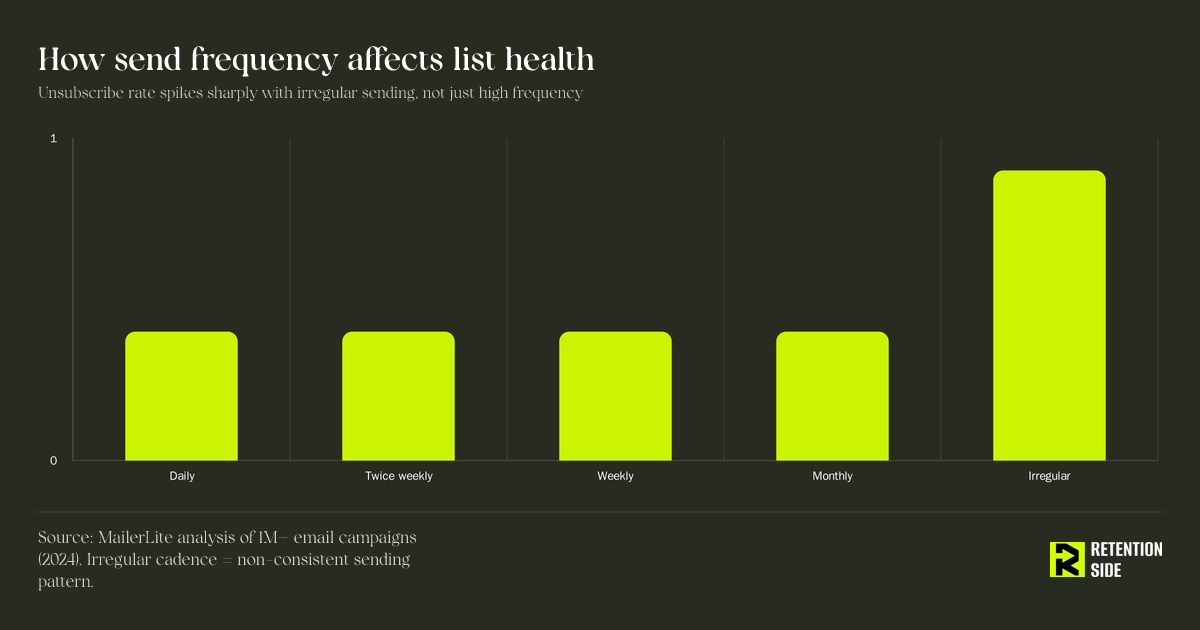
- Inconsistent sending is often more damaging to deliverability than high frequency. Irregular sending patterns produce higher unsubscribe rates than daily sends.
- Segmentation changes what “frequency” means entirely. A highly segmented list can sustain more sends than an unsegmented one – because different segments receive different emails, not the same volume.
- Campaigns and automated flows operate on completely different frequency logic. Conflating the two leads to poor decisions on both sides.
- Content mix matters as much as volume. A program sending predominantly promotional emails will erode list health over time regardless of cadence.
- The metrics that tell you whether your frequency is right are deliverability indicators and repeat customer rate – not open rate or click rate.
What we’ll cover
- Why frequency is the wrong starting question
- How product category and repurchase cycle shape your cadence
- The role of segmentation in frequency decisions
- How automated flows and campaigns interact with send volume
- Content mix: what you send matters as much as how often
- Signs your cadence is too high – and signs it is too low
- Seasonal frequency adjustments and how to handle them
- FAQ: The email rules explained for ecommerce brands
Why frequency is the wrong starting question
Most brands approach email frequency as a volume problem. “Should we be sending two or three times per week?” What they are actually trying to solve is a relevance problem.
The real question is not how many emails you should send. It is: does every email you send give a meaningful portion of your list a reason to open it and do something with it?
A brand sending four campaigns per week to a tightly segmented list – where each send reaches the subset of subscribers it is most relevant to – will produce better list health outcomes than a brand sending one weekly blast to its entire database. The first brand is sending more email in total but delivering more relevance per subscriber per send. The second brand is sending less but hitting everyone with everything, which trains the full list to tune out.
This matters because deliverability is a function of engagement signals, and engagement signals are a function of relevance. When a large portion of your subscribers habitually ignore your emails, inbox providers pick that up. Sender reputation degrades. Inbox placement declines. The emails that were going to your best buyers start routing to spam or promotions – and the frequency question becomes moot because nobody is seeing them anyway.
The frequency decision, then, is inseparable from three prior decisions: how well you have segmented your list, how strong your content is across different email types, and what your product category actually warrants in terms of communication density.
How product category and repurchase cycle shape your cadence
The most important variable in campaign frequency is what you sell and how often customers naturally need to buy it again.
A brand selling a daily-use skincare serum can reasonably sustain 3-4 campaigns per week to their most engaged segment. Customers are using the product daily. Replenishment is a genuine, recurring need. Content that covers usage tips, complementary products, and ingredient education has a natural reason to exist. The category supports a higher-frequency relationship.
A brand selling a high-ticket piece of furniture or a once-a-decade purchase has very little to say on a weekly basis that will not feel forced. Two emails per month to their post-purchase list – a relationship maintenance cadence rather than a commercial cadence – is probably closer to right. Anything more risks making the brand feel desperate or out of touch with the purchase reality.
Between those extremes are the categories most DTC brands fall into:
Consumable products with a 30-90 day repurchase cycle – supplements, haircare, cleaning products, pet food. These brands can sustain 2-4 campaigns per week to engaged subscribers without straining the relationship, because there is a recurring commercial reason to stay in contact. Win-back flows also make real strategic sense here, triggered well before the 90-day mark.
Apparel and accessories with seasonal buying patterns – 2-3 campaigns per week during active seasons, with clear drop-off between seasons unless content shifts to brand-building and community-oriented sends that do not require a buy-now CTA.
Home goods and one-time-purchase-adjacent products – 1-2 campaigns per week maximum, with content that earns attention through value rather than commercial pressure. These lists are more fragile; a week of aggressive promotional sends can produce disproportionate damage.
Specialty or niche brands with a passionate audience – frequency can run higher than category norms suggest, because the audience opted in because they genuinely care about the space. A fly-fishing brand with a deeply engaged subscriber base can send more than a generic sporting goods retailer, because the audience has a different relationship with that content.
The honest calibration comes from watching your deliverability metrics over time as you adjust cadence. If spam complaint rates are rising or inbox placement is declining as you increase frequency, the list is telling you something. If those metrics stay stable while revenue attributed to campaigns grows, there is room to push further.
The role of segmentation in frequency decisions
Segmentation does not just let you personalize content – it fundamentally changes what “frequency” means at the subscriber level.
Consider a list of 80,000 subscribers. A brand sending three campaigns per week to their entire list is exposing every subscriber to three sends per week. A brand sending five campaigns per week to intelligently segmented audiences – where each send reaches only the relevant subset – may be sending some subscribers two emails per week and others one, while delivering more total relevant contact than the first brand.
The second brand is “sending more” from an operations standpoint but delivering less intrusion at the individual subscriber level. That is the counterintuitive reality of segmentation: you can run a higher-frequency program and reduce per-subscriber noise at the same time.
The segments that matter most for frequency decisions:
Engagement tier – Active subscribers (those who have interacted with your emails within the last 30-60 days) should receive your highest-frequency sends. They are showing you they want to hear from you. Subscribers who have not engaged in 90+ days should receive dramatically reduced frequency, and in many cases should be filtered into a re-engagement or sunset path rather than a full campaign send. Sending full campaign volume to disengaged segments is the most common deliverability-damaging mistake brands make.
Purchase lifecycle stage – A first-time buyer who just received their order is in a completely different communication zone than a loyal multi-purchase customer. The first-time buyer’s post-purchase flow may legitimately include multiple emails in the first two weeks. The loyal repeat buyer may need a different cadence – less urgency, more loyalty acknowledgment, less “here’s why you should try us” copy that they stopped needing three purchases ago.
Category or product interest – If you have collected zero-party data at signup, or if you can infer category interest from purchase history, you can send category-relevant campaigns to the relevant segment rather than product-agnostic promotions to everyone. A subscriber who only buys from your skincare range does not need a campaign about your supplements – and sending it to them anyway is a frequency drain that produces no value.
Revenue tier or LTV – VIP customers and high-LTV buyers often respond well to communication that acknowledges their status: early access, exclusive offers, first-look product drops. These sends can exist on top of your standard campaign calendar without requiring you to reduce frequency for the broader list.
The practical implication: before making any decision about whether to increase or decrease your weekly campaign count, ask whether your segmentation architecture is set up to make frequency a different experience for different parts of your list. If everyone is getting everything, frequency optimization is limited before you solve segmentation. A full Klaviyo audit will typically surface these gaps clearly.
How automated flows and campaigns interact with send volume
This is the dimension of frequency that most brands handle poorly, and it matters enormously for both the subscriber experience and for deliverability.
Automated flows – the behavior-triggered sequences in Klaviyo – run independently of your campaign calendar. A subscriber who triggered an abandoned cart flow and is in the middle of a 3-email recovery sequence may simultaneously be on your standard campaign list. Without deliberate flow-campaign filtering, that subscriber receives both: the abandoned cart flow and your weekly promotional campaign in the same 48-hour window.
That overlap is not just a relevance issue. It trains the subscriber to associate your brand with inbox noise. More critically, it can produce a communication sequence that makes no sense from a customer journey perspective – a discount offer from the abandoned cart flow lands 12 hours before a full-price “new arrivals” campaign, and the subscriber’s trust in your messaging coherence erodes.
The fix is suppression logic and flow filters in Klaviyo: when a subscriber enters a high-touch flow (welcome series, abandoned cart, post-purchase), they should typically be excluded from standard campaign sends for the duration of that flow. The logic requires a deliberate decision about which flows carry a campaign exclusion and which do not.
This also means that “total email frequency” is not just a campaign count question. A subscriber receiving five campaign sends per week while simultaneously running through a welcome series is experiencing a significantly higher contact volume than the campaign calendar alone suggests. Total contact frequency – flows plus campaigns combined, at the individual subscriber level – is the number that matters for list health.
A working principle: for any subscriber actively in a high-priority flow (welcome, post-purchase, abandoned cart), reduce or suppress campaign sends. For subscribers with no active flow, they are entirely dependent on your campaign calendar for communication, so that calendar’s frequency is the whole frequency picture. The four-pillar framework covered in our Klaviyo setup guide goes deeper on how campaigns and flows should be architected to work together rather than against each other.
Content mix: what you send matters as much as how often
Frequency without content discipline is how brands create a promotional loop that gradually destroys list quality.
The underlying problem is this: when subscribers only hear from you during sales, discounts, and promotional events, they stop expecting anything else. Their mental model of your brand shifts from “brand I’m interested in” to “source of promotional noise I tune out until there’s a sale I care about.” That shift is hard to reverse once it sets in – and it shows up in declining engagement between promotions, lower full-price purchasing, and a customer base that has been conditioned to wait for discounts. MarketingSherpa’s research with 2,400 consumers found that 19% of subscribers cite emails being “always trying to sell me something” as a top reason for unsubscribing – sitting alongside frequency itself as the two dominant drivers of list churn.
Sustainable email programs at the brands Retention Side works with are built around a campaign calendar that balances commercial sends with genuinely valuable content – not content that is “educational” as a thin wrapper for a product pitch, but content that gives a subscriber a real reason to open an email that does not involve a percentage off.
What that looks like in practice varies by category. For a supplements brand it might be protocol guides, ingredient deep-dives, or customer success stories. For an apparel brand it might be styling content, trend context, or behind-the-scenes production content. For a home brand it might be interior inspiration, care guides, or sustainability context around materials. The test is simple: if you removed all purchase CTAs from the email, would a subscriber who never bought from you still find it genuinely interesting?
The content-to-commercial ratio is where several popular frameworks come in – each offering a different split. We will address each one in the FAQ section below. What all of them share is the underlying principle: promotional sends need to be offset by value-first sends or the list deteriorates over time, regardless of frequency.
A practical guideline for most ecommerce brands: for every two or three promotional campaigns, include at least one email that has a clear value rationale that does not depend on a discount or a sale. Over a monthly campaign calendar, that means roughly one third of your sends should have a primary purpose other than “buy this now.” The actual ratio that works for your brand will depend on your category and your audience – and it will show up clearly in how engagement trends over time as you adjust the mix. This dynamic is also covered in depth in our piece on customer lifetime value for ecommerce, where campaign content mix is one of the key levers that separates brands with compounding LTV from those that plateau.
Signs your cadence is too high – and signs it is too low
Most brands know their cadence is wrong. They just need to know which direction.
Signs you are sending too often
The most reliable signal is deliverability degradation. If your inbox placement rate has been declining over time, and there is no obvious infrastructure or authentication cause, increasing campaign frequency is often the root issue – particularly if it has coincided with decreased segmentation discipline. Research by Return Path found that senders who maintain consistent sending patterns experience 20-30% higher inbox placement rates compared to those with irregular cadences – meaning erratic volume changes are often more damaging than sustained high frequency.
Other signals: your unsubscribe rate is trending upward. Complaints are rising. Revenue from campaigns has started to decline even as you send more frequently, which usually means more sends are going to disengaged subscribers who are hurting your reputation for the sends that matter.
It is also worth noting a newer infrastructure pressure: Gmail’s Subscription Center rollout, which began in mid-2025, now surfaces to users exactly how many emails they have received from any given sender and makes unsubscribing frictionless. Brands sending high volumes to disengaged segments are being directly exposed in the inbox. Some senders saw unsubscribe spikes nearly double their average numbers within weeks of the rollout. The implication is direct: indiscriminate sending volume is no longer just a deliverability risk, it is now visible to subscribers in a way it has never been before.
A subtler signal is when your most engaged segment – the people who have purchased multiple times and engaged recently – starts showing declining engagement. Those subscribers should be your most robust cohort. If they are tuning out, the content or frequency has crossed a line.
Signs you are sending too little
The signal here is opportunity cost that is harder to see. If your campaign list is growing but revenue attributed to campaigns is flat or declining as a proportion of total store revenue, you may be underleveraging your list.
Specific indicators: you are running fewer than one campaign per week to your engaged segment. Your win-back flow is catching large volumes of people because the campaign program is not keeping them warm. You see spikes in revenue when you do send (indicating pent-up demand), but there are long gaps between sends. Your list is growing but the unengaged segment is growing faster than the active one, which suggests that new subscribers are signing up, failing to see sufficient follow-through, and drifting into disengagement before being activated.
For most ecommerce brands above $300K/month, the underleveraging problem is more common than the over-sending problem – especially in brands that have strong flow coverage but a thin campaign calendar.
Seasonal frequency adjustments and how to handle them
There are periods where increasing email frequency is not just acceptable – it is the right strategic move. The problem is that most brands handle seasonal surges poorly because they do not plan the ramp-up or ramp-down deliberately.
Black Friday and Cyber Monday represent the most obvious example. Sending two or three emails in a single day during BFCM is standard practice among high-performing ecommerce brands – and it works, because the context is clear, the audience expects commercial activity, and the competition for attention is high enough that frequency is a legitimate strategy. Some brands successfully send 8-10 emails across the BFCM weekend to their full active list without disproportionate list damage, because subscribers understand what the weekend is.
The problem is not the surge. The problem is when brands ramp frequency aggressively before a peak period without warming their list to the higher cadence, or ramp down abruptly afterward without a re-stabilization plan. Both create reputation issues. This challenge extends to Shopify brands in particular, where Q4 campaign pressure regularly pushes teams to blast unsegmented lists for six weeks straight – a pattern that consistently produces deliverability damage into Q1.
The practical approach to seasonal frequency:
Before a peak period – begin gradually increasing frequency 2-3 weeks before. If you normally send two campaigns per week, move to three, then four before the peak period begins. This conditions your list and your sending infrastructure to handle higher volume, rather than spiking from two to ten overnight.
During the peak period – use extreme segmentation to protect your highest-value subscribers from the full volume. Your most loyal repeat buyers do not need eight promotional emails to be reminded that it is BFCM. They may need one early-access send and two well-timed promotional reminders. The full-volume aggressive frequency should target your broader engaged list, not your best customers.
After the peak period – pull back gradually and shift content toward value-led sends. The first week after BFCM is a particularly important moment for brand relationship recovery: subscribers who received a lot of promotional email want to know you are not just a discount machine for the rest of the year.
FAQ: The email rules explained for ecommerce brands
Several content-mix and frequency frameworks appear frequently when brands research email strategy. Each has genuine utility, but each also gets misapplied in ecommerce contexts. Here is what each one actually means – and where it does and does not apply to your brand.
What is the 3-21-0 email rule?
The 3-21-0 method is an inbox management system for personal productivity, not a marketing framework. Coined by author Kevin Kruse and popularized in productivity circles, it describes how an individual should handle their own email inbox: check email in 3 sessions per day, spend 21 minutes per session, and work toward an inbox zero goal (0 unread emails).
The numbers refer to the recipient’s email processing behavior, not a sender’s frequency or content strategy.
It has no direct application to how often ecommerce brands should send campaigns. If you have encountered it referenced as a marketing sending rule, that is a misapplication. The 3-21-0 method is useful context for understanding how time-conscious your subscribers are with their inboxes – which is an argument for relevance and brevity in your emails, not a frequency prescription.
The real takeaway for ecommerce senders: your subscribers are processing their inboxes in short, batched sessions. Your subject line, preview text, and first few lines are doing most of the work. Frequency is secondary to the decision your email creates in a subscriber who spends 3-5 seconds deciding whether to open or delete.
What is the 80/20 rule in email marketing?
The 80/20 rule in email marketing is a content-mix principle. It suggests that 80% of your emails should provide educational, entertaining, or genuinely valuable content, while only 20% should be directly promotional.
The ratio comes from the broader Pareto principle (80% of outputs from 20% of inputs) and has been adapted into various marketing disciplines. In email, its logic is straightforward: if the overwhelming majority of what you send gives subscribers something useful, they develop a positive association with receiving your emails, which protects engagement and deliverability and makes the commercial 20% more effective when it arrives.
In an ecommerce context, the 80/20 split is a useful principle but a difficult operational standard for most brands – particularly those with strong promotional calendars built around seasonal events, product launches, and clearance cycles. A campaign calendar that is 80% non-commercial is hard to sustain without a very strong content brand and a team with real capacity to produce valuable editorial content.
A more realistic interpretation for ecommerce: use the 80/20 principle as a directional guide rather than a rigid ratio. Ensure that a meaningful portion of your campaign calendar – not just a token newsletter here and there – gives subscribers content that is genuinely worth reading when they have no immediate purchase intent. That content is what keeps them subscribed and engaged during the periods between promotions, which is most of the calendar year. MarketingSherpa’s consumer research consistently shows that irrelevant content is the second-most cited reason for unsubscribing, just behind volume. The two problems compound each other.
Where the 80/20 framework does apply in ecommerce email more cleanly is in the welcome series and post-purchase flows: the automated sequences that run during high-engagement windows. In those sequences, leading with brand story, education, social proof, and use-case content before the commercial ask is exactly the right architecture – and the 80/20 intuition maps well to how those sequences should be built. Our Klaviyo flows guide covers the specific content architecture for each of these sequences in detail.
What is the 70/30 rule in marketing?
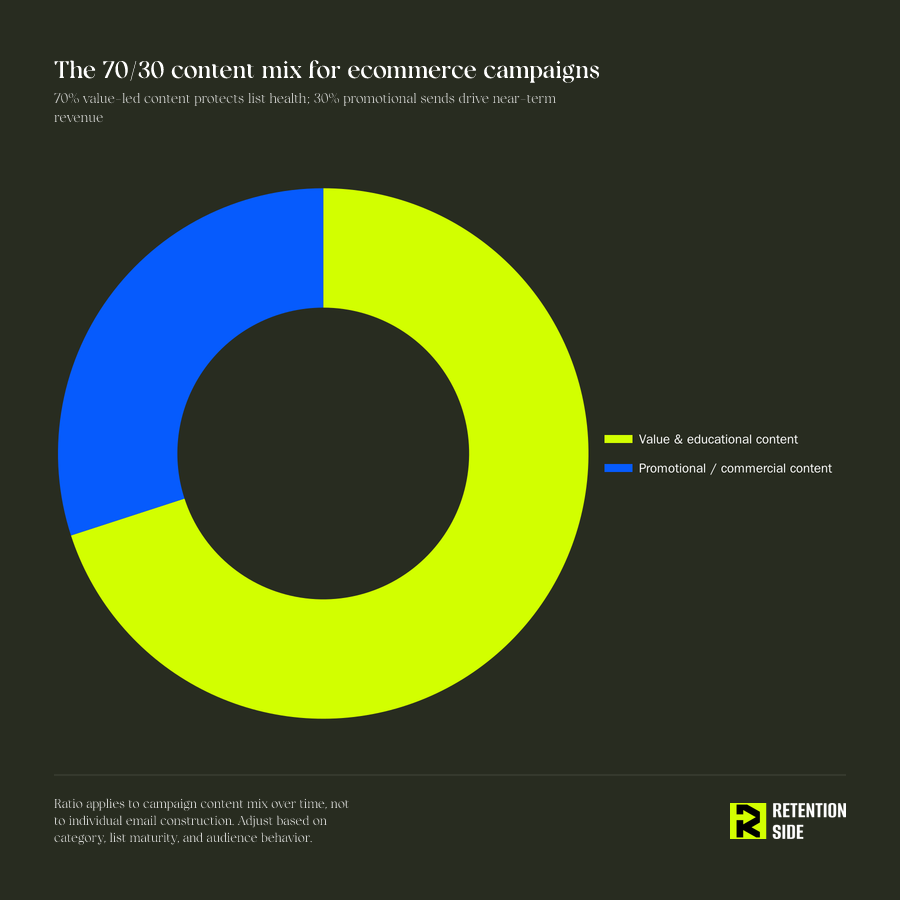
The 70/30 rule is a close relative of the 80/20 principle, with a slightly different emphasis. In email marketing specifically, it describes a content structure where 70% of each email (or a campaign calendar) is dedicated to educational, relationship-building, or community-oriented content, and 30% is explicitly commercial.
The 70/30 framing is also used in a wider marketing budget context – notably in Les Binet and Peter Field’s research on advertising effectiveness, where they recommend roughly 60% of media investment in brand-building (long-term) and 40% in activation (short-term conversion). The proportions differ, but the underlying logic is identical: pure activation without brand investment produces short-term results at the cost of long-term value.
For ecommerce email, the 70/30 rule applied to campaign content mix is arguably more achievable than the 80/20 version and maps more directly to how most mature DTC programs run. A brand that structures its campaign calendar so that roughly 30% of sends are promotional-first and 70% are value-or-relationship-first will generally maintain better long-term list health than one that inverts that ratio.
The important nuance: this does not mean every non-promotional email avoids product entirely. A product education email, a “how to get more from your purchase” guide, or a customer story can all include a buy-now link without being primarily commercial in intent. The 70% does not mean zero CTA – it means the primary reason to send the email is the value, and the commercial component is secondary.
What is the 60/40 rule in email?
The 60/40 rule has two distinct interpretations that get conflated. Understanding which one you are dealing with changes its relevance entirely.
The content-balance interpretation: In cold outreach and B2B email sequences, the 60/40 rule describes a sequence structure where 60% of touchpoints are value-first (sharing insights, resources, relevant content) and 40% are explicit asks or calls to action. It is functionally similar to the 80/20 and 70/30 principles but skewed slightly more toward commercial intent – because in cold outreach contexts, the goal is to earn a meeting, not to build a long-term subscriber relationship.
For ecommerce brands sending to permission-based lists, the 60/40 split is probably too promotional. A campaign calendar where 40% of sends are explicit buy-now emails will erode list quality faster than a 70/30 or 80/20 approach, because your subscribers have higher expectations of relevance from an opt-in list than a cold outreach recipient does.
The design interpretation: In email design and deliverability, the 60/40 rule refers to a recommended ratio of 60% text to 40% image content within an individual email. The purpose is practical: image-heavy emails with minimal text trigger spam filters and render poorly on clients that block images by default. A 60/40 text-to-image balance protects inbox placement and ensures the email communicates its core message even when images do not load.
This design interpretation is genuinely relevant for ecommerce brands, many of whom default to image-heavy email templates that look good in Klaviyo preview mode but load as a wall of broken image boxes for a portion of their list. Maintaining meaningful text content in every email – not just in the image alt text – is part of solid email design practice and is one of the signals that inbox placement tools monitor when assessing whether your emails should be routed to primary inbox or promotions.
The distinction matters: the content-mix 60/40 rule is primarily a cold-outreach framework and should be used cautiously in ecommerce; the design 60/40 rule is directly applicable to how you build your email templates.
Building a cadence that actually works
The working framework that Retention Side applies when calibrating campaign frequency for ecommerce brands comes down to a sequence of decisions, not a number:
Step 1: Know your send-to-inbox placement baseline. Before adjusting frequency up or down, confirm what your current deliverability health looks like. Increasing frequency on a list with inbox placement problems makes them worse. The starting point is always deliverability, not volume.
Step 2: Segment before you schedule. Map out your primary audience segments – engagement tier, purchase lifecycle stage, product interest – and decide which segments can sustain which frequency. Your most engaged buyers can absorb more. Your disengaged subscribers should receive less, or be moved to a re-engagement path.
Step 3: Define the campaign calendar by segment, not just by date. A campaign calendar that says “2 sends per week to the full list” is not a segmented campaign strategy. A calendar that says “3 sends per week to engaged non-purchasers, 2 sends per week to active buyers, 1 send per week to lapsed buyers in win-back stage” is a real frequency strategy.
Step 4: Account for flows in total contact volume. For each active flow in Klaviyo, know how many emails a subscriber in that flow will receive per week, and build campaign suppression logic to ensure total contact frequency stays within a reasonable range for each subscriber. The best Klaviyo flows for ecommerce all require this suppression logic to be built deliberately – it does not happen by default.
Step 5: Monitor the right metrics. The feedback loop that tells you whether your frequency is right is: spam complaint rate, inbox placement rate, and repeat customer rate over time. Not open rate. Not click rate. Those metrics are directional signals, not accountability targets.
Conclusion
Email send frequency is a strategic decision, not a default setting. The brands that get it right are not the ones following a universal rule – they are the ones who know what their list can sustain, segment accordingly, maintain content quality across the calendar, and watch the metrics that actually reflect program health.
For ecommerce brands above $300K/month, the opportunity on the campaign side is usually not about sending less – it is about segmenting better, mixing content more deliberately, and integrating flow suppression logic so the total subscriber experience is coherent rather than noisy. The brands that do this consistently build lists that grow in quality over time and generate compounding returns from email rather than a plateau.
If your current program is running a fixed weekly volume to your whole list and you are not sure whether it is working, the first question is not “should we send more or less?” It is “do we know what our most engaged subscribers are receiving relative to our least engaged?” That answer usually tells you more than any benchmark ever will.
At Retention Side, frequency calibration is one of the first things we address when auditing a new client’s Klaviyo account – because it sits at the intersection of deliverability, segmentation, and content strategy, and getting it right unlocks meaningful improvement in all three areas.