

Most ecommerce brands treat customer lifetime value as a scoreboard number instead of a lever they can actually pull. They check it, report it, maybe put it on a dashboard next to CAC, and move on. That’s a missed opportunity, because CLV is one of the few metrics that tells you whether your retention system is actually working or whether you’re just running promotions and calling it lifecycle marketing.
If you’re running a brand doing meaningful monthly revenue, you already know acquisition costs aren’t going down. The brands pulling ahead right now aren’t necessarily spending more on ads. They’re extracting more value from every customer they already have, and they’re doing it through deliberate retention infrastructure, not one-off win-back campaigns sent whenever revenue dips.
This article covers how to actually think about CLV as an operator, not just how to calculate it.
Key takeaways
- Customer lifetime value is a lagging indicator of retention system health, not a standalone metric to optimize directly.
- The biggest CLV leak in most ecommerce businesses happens between the first and second purchase, not later in the lifecycle.
- Flows and campaigns play different roles in extending CLV. Flows catch behavior-based moments; campaigns build the relationship between those moments.
- Deliverability directly caps CLV. A customer who stops seeing your emails in the inbox effectively becomes a lower-value customer, even if they never unsubscribe.
- Channel expansion (SMS, loyalty, direct mail, WhatsApp) should be based on customer behavior and communication preference, not adopted because a competitor uses it.
- Segmentation quality determines whether campaigns strengthen or erode long-term CLV.
What we’ll cover
- Why CLV should be treated as a system output, not an isolated KPI
- A practical way to calculate and interpret CLV for decision-making
- Where lifetime value actually leaks across the customer lifecycle
- The specific flows that extend CLV, and why post-purchase and replenishment often outperform welcome flows
- How campaign strategy and segmentation either build or erode CLV over time
- Why deliverability is a CLV problem, not just an email problem
- When and how to expand beyond email to protect and grow CLV
- Common mistakes that quietly cap lifetime value
Why CLV should be treated as a system output, not an isolated KPI
Here’s the mistake we see constantly: a brand decides to “improve CLV,” and the plan becomes a loyalty program launch, or a subscription offer, or a slightly better win-back flow. Those things can help. But CLV isn’t something you improve directly. It’s the output of everything upstream of it: acquisition quality, first purchase experience, post-purchase communication, segmentation discipline, and whether your emails and texts actually reach the customer in a usable way.
Think of it like this: if your repeat purchase rate is weak, your CLV problem isn’t really a CLV problem. It’s a retention problem showing up downstream. If you try to fix CLV by launching a rewards program without fixing why customers aren’t coming back, you’ll get modest lift at best, because you’re treating a symptom.
This is the same logic we apply across retention work at Retention Side. Email marketing, and Klaviyo specifically, is usually the entry point because it’s the highest-leverage channel for most DTC brands. But email performance and CLV are downstream of the same root causes: audience quality, segmentation, message relevance, and whether the brand shows up consistently without over-relying on discounts.
How to calculate CLV in a way that’s actually useful for decisions
The textbook formula is simple: average order value times purchase frequency times customer lifespan. That’s fine for a boardroom slide. It’s less useful for actually making decisions, because it treats CLV as a single static number instead of something that varies dramatically by acquisition source, product category, and cohort.
A more useful approach for operators:
Segment CLV by acquisition channel. A customer acquired through a referral or an organic search almost always has a different lifetime value than one acquired through a cold paid social ad. If you’re blending these into one CLV figure, you’re hiding the exact insight you need, which is where to invest more and where to pull back.
Segment CLV by first product purchased. In most catalogs, certain entry products correlate with much higher repeat rates. If you know this, you can weight acquisition spend and onboarding flows toward those products.
Look at CLV over a fixed window, not lifetime. “Lifetime” is theoretical. A 12-month or 24-month CLV window gives you something you can actually act on and compare across cohorts in a reasonable timeframe.
Modeling this out matters because small movements in repeat purchase behavior compound significantly over time. The chart below shows a simple illustrative model at an $80 average order value: as repeat purchase rate climbs from 20% to 50%, modeled 24-month CLV nearly doubles.
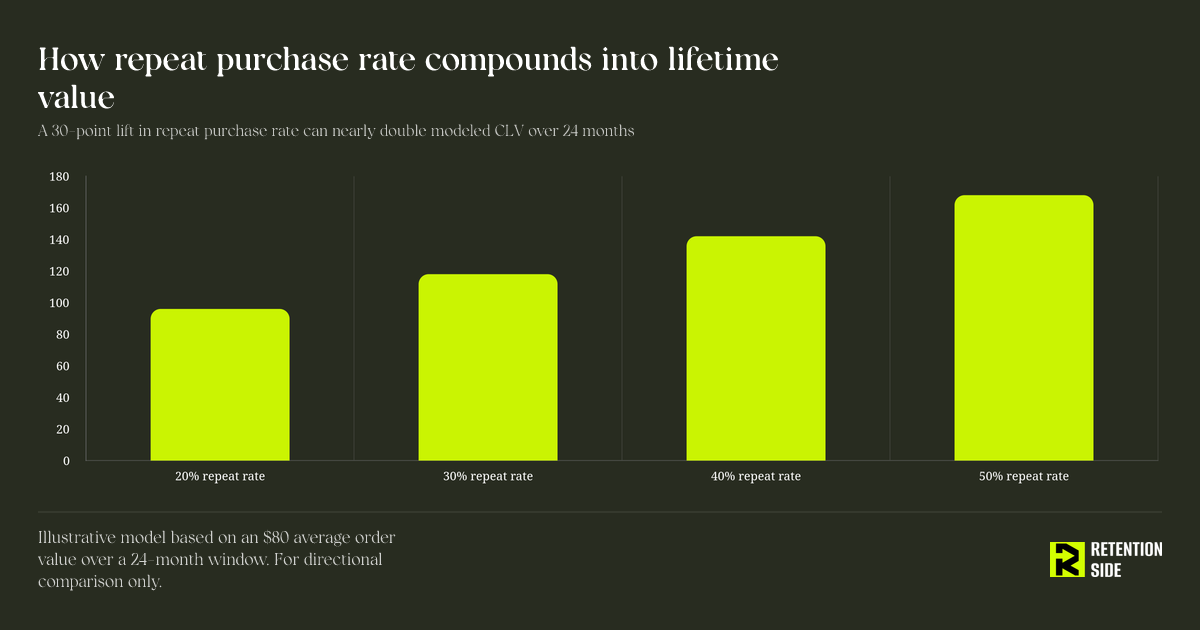
The takeaway isn’t the specific numbers, which will vary by your AOV and margin structure. It’s the shape of the curve. Repeat purchase rate is one of the highest-leverage inputs into CLV, which is exactly why so much retention strategy should concentrate on the moments that drive or kill a second purchase.
Where lifetime value actually leaks across the customer lifecycle
If you want to know where to focus first, look at your own cohort retention curve rather than industry benchmarks. In most ecommerce businesses we look at, the steepest drop happens between the first and second purchase, not somewhere deep in the customer lifecycle. Bain & Company’s research on online customer loyalty found that the average online apparel shopper wasn’t profitable for the retailer until their fourth purchase, and that repeat customers spent significantly more per transaction over time — which is exactly why the gap between purchase one and purchase two is where the real CLV damage happens.
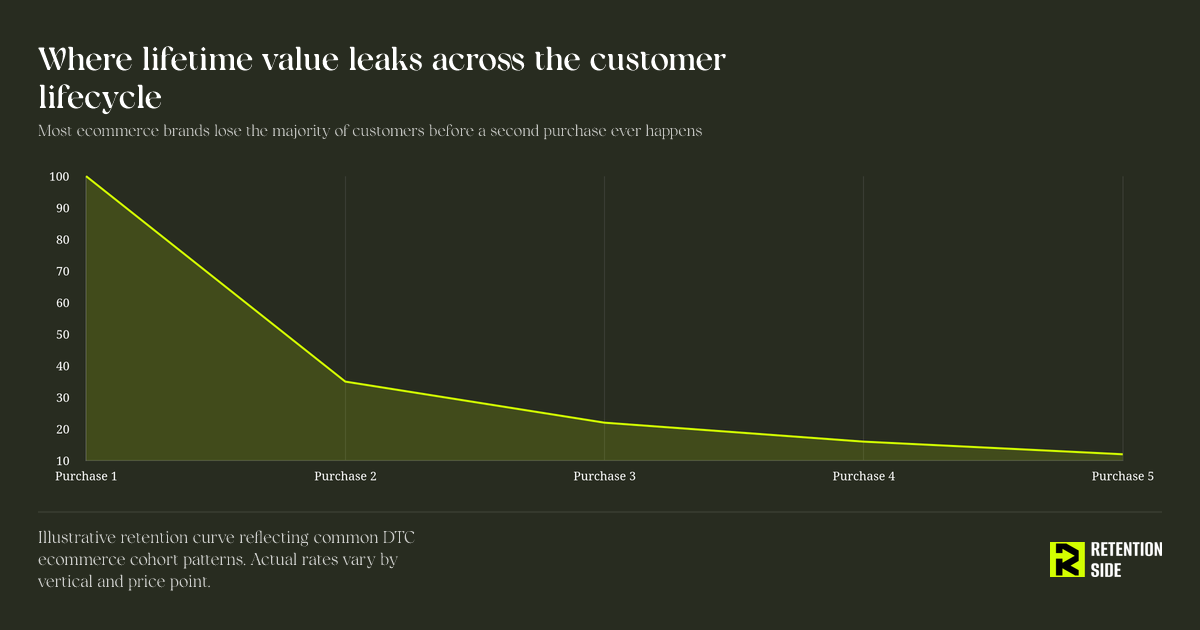
This matters because it changes where you should spend your energy. A lot of brands over-invest in win-back flows targeting customers who haven’t purchased in six or nine months, while under-investing in the 30 to 60 day window right after a first purchase, which is where the real leak is happening. By the time someone qualifies for a “win-back” segment, you’ve usually already lost the relationship. The higher-leverage work is upstream of that: making sure the post-purchase experience, the second-purchase incentive logic, and the product education actually give someone a reason to come back before they go quiet.
This is also why customer lifetime value and customer retention rate should be looked at together rather than in isolation. Retention rate tells you how many customers are sticking around; CLV tells you how much that stickiness is worth. A brand can have a decent retention rate but flat CLV if the customers who stay aren’t increasing order value or frequency over time.
The flows that actually extend lifetime value
Flows are behavior-based and time-sensitive by design, which makes them the right tool for catching customers at the exact moments that determine whether they become repeat buyers or one-time purchasers. Not every flow needs to be a revenue flow. Some exist purely to build the relationship, set expectations, or reduce the chance of a bad experience turning into churn.
For CLV specifically, a few flows tend to matter more than brands expect:
Post-purchase flows. This is not just an order confirmation and a shipping update. A strong post-purchase sequence sets usage expectations, prevents buyer’s remorse, and starts building toward the second purchase before the first product has even arrived. This is often the single highest-leverage flow for CLV because it directly targets the steepest drop-off point in the lifecycle curve above.
Replenishment flows. For consumable or repeat-cycle products, timing matters enormously. A replenishment flow triggered too early feels pushy; triggered too late, you’ve already lost the reorder to habit or a competitor. Getting this timing right, based on actual historical reorder data rather than a guess, is one of the more underrated levers for CLV in consumable categories.
Browse and cart abandonment flows. These aren’t just for new customer conversion. For existing customers, they’re a signal of purchase intent that, handled well, extends the relationship instead of just recovering a single transaction.
Win-back flows. These matter, but they should be seen as a last resort recovery mechanism, not the primary CLV strategy. If your win-back flow is doing more work than your post-purchase flow, that’s usually a sign the earlier lifecycle stages need attention.
The chart below shows a directional pattern we see in mature, CLV-focused Klaviyo programs: post-purchase and replenishment flows often generate more revenue share than the welcome flow once a program matures, even though welcome flows get disproportionate attention early on.
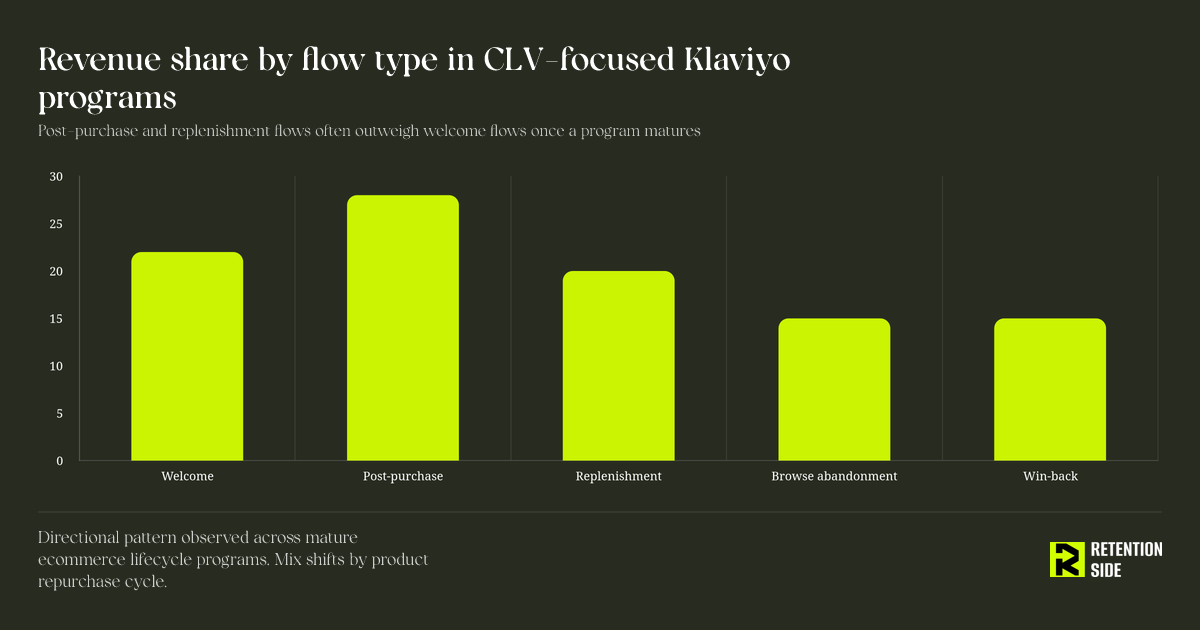
Flows are never “done.” A post-purchase flow built two years ago probably isn’t accounting for current shipping times, current product mix, or current customer expectations. Treat every flow as something to be tested and refined on a recurring basis, not a one-time build.
Campaigns and segmentation: the part most brands get wrong
Flows catch the moments. Campaigns build the relationship in between. This distinction matters a lot for CLV, because campaign strategy is where most brands accidentally cap their own lifetime value.
Here’s the pattern we see constantly: a brand relies heavily on discount-driven campaigns because they’re the easiest lever to pull for a quick revenue bump. Over time, subscribers learn that the only reason to open an email is to catch a sale. Full-price purchasing declines. Engagement declines because the list starts filtering out anything that isn’t a discount. And CLV flattens, because you’ve trained your best customers to wait instead of buy.
Segmentation is the fix, but it has to go deeper than “engaged vs. unengaged.” For CLV purposes, useful segmentation usually includes:
- Purchase frequency tier (one-time, occasional, frequent)
- Product category affinity
- Margin sensitivity (customers who only respond to discounts vs. those who buy at full price)
- Lifecycle stage (new, active, at-risk, lapsed)
A campaign calendar built around these segments can balance promotional sends with educational and value-driven content, which protects full-price purchasing behavior and keeps your best customers engaged for reasons beyond the next sale. This is a place where segmentation strategy and CLV strategy are really the same conversation, not two separate workstreams.
Deliverability is a CLV problem, not just an email problem
This gets overlooked constantly, and it shouldn’t. If your emails aren’t landing in the inbox, none of the flow and campaign strategy above matters, because the customer never sees it. Validity’s 2025 Email Deliverability Benchmark Report found that one in six legitimate marketing emails fails to reach the inbox — which means a significant portion of your retention infrastructure may be silently failing without any error showing up in your dashboard.
Delivery and deliverability are not the same thing. Delivery means the email was technically accepted by the receiving server. Deliverability means it actually landed somewhere useful, the inbox, rather than spam or a promotions tab where it’s functionally invisible to most people. A brand can have excellent delivery rates and terrible deliverability, and the dashboard will look fine while revenue quietly erodes.
Here’s the direct connection to CLV: a customer who stops seeing your emails in the inbox doesn’t necessarily unsubscribe. They just stop engaging, get flagged as inactive by your own segmentation, and drift out of the lifecycle entirely. From a CLV standpoint, that customer’s value just got capped, not because they lost interest in the brand, but because the infrastructure failed to reach them. This is especially relevant with the way Gmail and other major inbox providers have continued tightening filtering behavior, which makes list hygiene, sender reputation, and authentication non-negotiable rather than optional technical housekeeping.
If you’re seeing flat or declining CLV alongside declining email engagement metrics, deliverability should be one of the first things you check before assuming the strategy itself is broken.
Expanding beyond email to protect and grow CLV
Email, especially through Klaviyo, is usually the right starting point for retention because it’s cost-efficient and gives you the most control over segmentation and personalization. But treating email as the entire retention strategy caps CLV in a different way: you’re relying on a single channel to carry the entire customer relationship, and not every customer wants to engage with a brand exclusively through their inbox.
The decision to expand into other channels should be based on actual audience behavior, not trend-chasing. A few practical signals worth watching:
SMS tends to work well for time-sensitive moments, back-in-stock alerts, and shipping updates, where immediacy matters more than a long-form message. It’s also a strong complement to email for customers who’ve shown high engagement but low email open rates.
Loyalty programs can meaningfully extend CLV, but only when the reward structure actually reflects customer behavior and margin reality. Smile.io’s 2025 ecommerce loyalty report found that loyalty-generated value grew year over year across all major ecommerce industries, with small-to-medium brands seeing the greatest increase at nearly 24%. A loyalty program that erodes margin faster than it drives repeat purchases isn’t a CLV win, it’s a discount program with better branding.
Direct mail has found a real niche again for high-AOV brands and for win-back attempts on customers who’ve gone fully unresponsive to digital channels. It costs more per send, so it needs to be targeted carefully rather than blasted broadly.
WhatsApp and Viber matter enormously for brands with international or specific regional customer bases where these channels are the default way people communicate, not an alternative one.
Push notifications can support CLV for brands with a strong app or PWA experience, particularly for re-engagement and time-sensitive promotions.
The point isn’t to run all of these at once. It’s to build retention as a system where channel mix expands based on where your customers actually are and how they actually want to hear from you, rather than because a competitor added SMS and you felt like you needed to match it.
Common mistakes that quietly cap lifetime value
A few patterns show up repeatedly in brands struggling to move CLV despite reasonable retention effort:
Optimizing form conversion instead of lead quality. A high-converting popup that captures low-intent emails with a steep discount can actually hurt CLV, because you’re filling your list with customers who were never going to buy at full price. Lead-to-customer rate matters more than form submission rate, and it directly feeds your CLV numbers downstream.
Treating every flow as finished after launch. Flows built once and never revisited slowly drift out of sync with actual customer behavior, shipping realities, and product mix.
Ignoring the acquisition-retention connection. Retention doesn’t operate in isolation. If acquisition quality drops because of a channel shift, an offer change, or an audience expansion, CLV will decline even if your retention program hasn’t changed at all. Before assuming a flow or campaign is underperforming, check whether the incoming customer quality has shifted.
Over-indexing on discounts as the primary lever. Discounts can drive a second purchase, but if they become the only reason customers buy, you’ve built a CLV ceiling into your own strategy.
Ignoring deliverability until performance drops significantly. By the time deliverability problems show up clearly in open rates, they’ve usually already been quietly capping engagement and CLV for months.
Building a CLV-focused retention system
None of this works as a single initiative. It works as a system where acquisition quality, form and list growth strategy, flows, campaigns, segmentation, deliverability, and channel mix all reinforce each other. That’s the lens we apply to every retention engagement at Retention Side, starting with Klaviyo email marketing as the foundation and expanding into SMS, loyalty, direct mail, WhatsApp, or Viber only where the customer data actually supports it.
If you’re evaluating whether your current retention setup is actually built to grow CLV, or just built to send campaigns and hope for the best, a useful gut check is this: can you point to specific flows built around your actual lifecycle drop-off points, specific segments that separate discount-driven customers from full-price buyers, and a clear read on your inbox deliverability, not just delivery? If any of those three are missing, that’s where the CLV ceiling is coming from.
Conclusion
Increasing customer lifetime value in ecommerce isn’t about finding one tactic that moves the number. It’s about fixing the specific point in your lifecycle where customers are quietly leaking out, usually between the first and second purchase, and building flows, campaigns, segmentation, and deliverability practices that address that point directly. Channel expansion matters, but only once the core retention system, usually anchored in email and Klaviyo, is actually working the way it should.
Brands that treat CLV as a system output rather than a vanity metric are the ones that keep growing revenue from existing customers even as acquisition costs climb. That’s the work worth doing, and it compounds a lot more reliably than another round of paid acquisition spend.