

If you run retention for a brand doing $300K a month or more, you probably already have opinions about Klaviyo. You’ve fought with the segment builder, argued about flow logic, and watched a campaign underperform for reasons that had nothing to do with subject lines. What most operators don’t do is step back and look at Klaviyo the way you’d look at any vendor you depend on for revenue infrastructure: is it growing, is it investing in the right things, and where is it actually weak.
That matters more than it sounds. Klaviyo isn’t just a tool you log into. It’s the deliverability infrastructure, the flow engine, and increasingly the data layer your entire retention system runs on. When Klaviyo changes its pricing model, ships a new AI feature, or falls behind a competitor on a specific channel, that decision lands directly on your P&L. This piece pulls together the 2026 numbers that matter: Klaviyo’s financial trajectory, the benchmark statistics that should shape how you allocate send volume between flows and campaigns, the product trends worth paying attention to, and the honest weaknesses you should budget and architect around.
What this article covers
- Klaviyo’s 2026 financial and customer statistics, and what they signal about platform stability
- The flow-versus-campaign benchmark data that should be driving your send strategy right now
- What’s new on the platform in 2026 and how it connects to retention use cases
- Where Klaviyo genuinely falls short, and how to plan around it
- What the consolidation trend among Klaviyo’s biggest customers means for your own stack
- Answers to the questions operators keep asking about Klaviyo’s growth, investment case, and weaknesses
Klaviyo by the numbers in 2026
Start with the basics, because they set the frame for everything else. Klaviyo closed fiscal 2025 with $1.23 billion in revenue, up 31.6% year over year, continuing a five-year run that took the company from $290.6 million in FY2021 to over a billion dollars by FY2025. That’s more than a four-fold increase in four years, at a company that was already past the “early growth” stage when the period started.
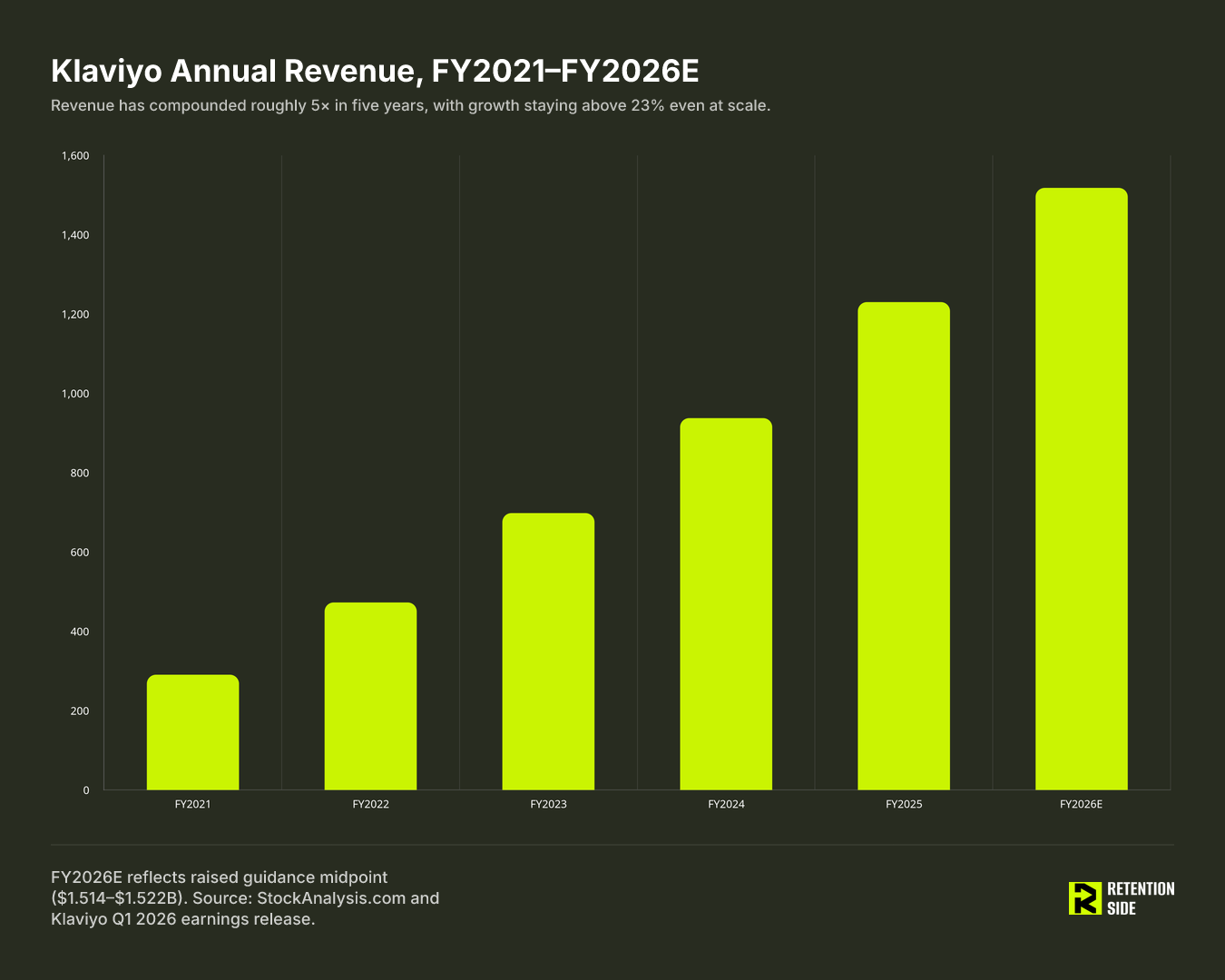
Q1 2026 kept the pace. Klaviyo reported $358 million in quarterly revenue, up 28% year over year, with GAAP net income of $9.0 million (versus a $14.1 million loss in the same quarter a year earlier) and a non-GAAP operating margin of 16%, the highest in the company’s history as a public entity. Off the back of that quarter, Klaviyo raised its full-year 2026 revenue guidance to a range of $1.514 to $1.522 billion, implying roughly 23% growth for the year even as the revenue base gets larger.
A few numbers underneath the top line matter more to you as an operator than the headline growth rate:
- 196,000+ paying customers as of March 31, 2026. If you’ve seen older figures citing 167,000 customers and 900 million profiles, those are outdated. The current, verified figures from Klaviyo’s Q1 2026 earnings put the platform at 196,000+ customers and roughly 8 billion consumer profiles processing almost 4 billion daily events and signals.
- Customers generating over $50,000 in annual recurring revenue grew 38% year over year, to 4,175 accounts. This is the cohort that looks like your brand, and it’s growing faster than the customer base as a whole, which tells you Klaviyo’s product roadmap is increasingly built for larger, more complex accounts rather than small self-serve shops.
- Dollar-based net revenue retention hit 110%, up from 108%. Existing customers are spending more over time, not less, which is a meaningfully different signal than raw customer count growth.
- International revenue grew 39%, with EMEA excluding the UK up 51%, and international now makes up 36.6% of total revenue. Klaviyo isn’t a US-only platform anymore, and its roadmap increasingly reflects that.
None of this changes what you do inside the platform tomorrow. But it does tell you something useful: Klaviyo is not a company coasting on early hype, cutting corners to protect margin, or losing its customer base to churn. It’s investing, it’s profitable, and the accounts that look like yours are the fastest-growing segment. That’s the kind of platform stability that matters when you’re building multi-year retention infrastructure on top of it, not switching vendors every eighteen months.
The benchmark statistics that actually matter to your P&L
Company financials are context. The benchmark data is where you should actually be adjusting behavior. Klaviyo’s 2026 benchmark report, drawn from more than 183,000 brands, confirms something Retention Side has been telling clients for years, but the scale of the gap is still worth sitting with.
Flows generate roughly 41% of total email revenue from just 5.3% of total sends. Read that again. Ninety-five percent of the email volume most brands push out generates less than three-fifths of the revenue. The other 5% of sends, structured as behavior-triggered automations rather than manual blasts, does almost as much work with a fraction of the volume.
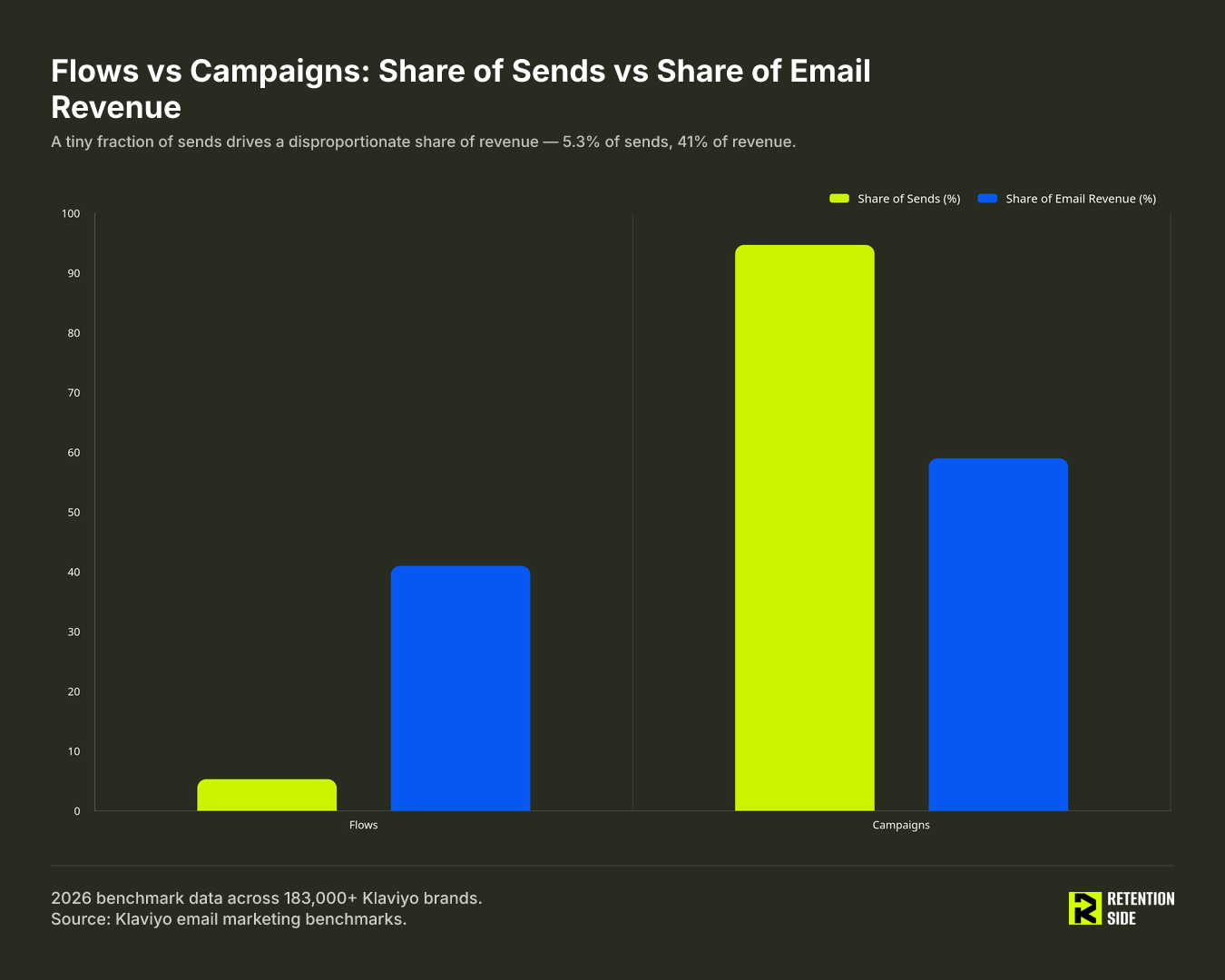
The mechanics behind that gap are stark. Flow emails convert at roughly 13 times the placed-order rate of campaigns, and revenue per recipient for flows runs about 18 times higher than campaigns. Click rates follow the same pattern, with flows at 5.58% versus 1.69% for campaigns, roughly a three-to-one gap. Even the buyer composition differs: flow-driven revenue is 48% new buyers, compared to just 16% for campaigns, meaning your automations are doing more first-purchase conversion work than your promotional calendar is.
Zoom into a single flow category and the gap widens further. Klaviyo’s benchmark data shows the average email campaign generates about $0.10 in revenue per recipient, while abandoned cart flows average $3.07, a roughly 30x difference. Top-decile campaigns still only reach 5x the order rate and 7x the revenue per recipient of an average campaign, which tells you campaign optimization has a ceiling that flow architecture simply doesn’t.
Campaign open rates give you a baseline to sanity-check your own numbers: the 2026 average sits at 31%, with top-10% performers at 45.1%. That spread varies by category, with clothing and accessories brands averaging 33.1% and mass merchants sitting lower at 28.7%, so benchmark yourself against your category, not the blended average.
Third-party data reinforces the same pattern from a different angle. An independent analysis of 619 Klaviyo accounts processing 740 million emails found that flow-dominant accounts send 3.7 times fewer emails but earn 3.75 times more revenue per email and 16% more total revenue than campaign-heavy accounts. Brands with click rates above 10% generate 20 times more revenue per email than brands under 2%.
None of this means campaigns are optional. Campaigns carry brand storytelling, product launches, and the full-price sell that flows can’t replicate on their own. But if your send calendar is built primarily around a promotional cadence and your flows haven’t been rebuilt or expanded in the last year, this data is telling you exactly where the unclaimed revenue is sitting. Flow architecture isn’t a nice-to-have optimization anymore; the gap between flow-driven and campaign-driven revenue efficiency has grown wide enough that under-investing in flows is now a measurable cost, not a theoretical one.
What’s new on the Klaviyo platform in 2026
Klaviyo repositioned itself in February 2025 as a “B2C CRM” rather than strictly an email and SMS platform, and the product releases since then have followed that repositioning rather than contradicting it. A few developments are worth tracking, not because they’re flashy, but because they change what’s architecturally possible in your account.
Klaviyo launched Marketing Agent and Customer Agent in September 2025, AI-driven tools aimed at automating campaign build and customer service response respectively. In Q1 2026 it moved Composer into private preview, an AI content and layout tool. Alongside these, Klaviyo has been rolling out Reviews, Service, Marketing Analytics, and Customer Hub as adjacent products, plus an AI Audience Optimization feature that scores unsubscribe risk before you send.
The practical read for a retention operator: these features push toward automated segmentation logic (predicted lifetime value tiers, RFM-style automation) and post-purchase engagement (reviews, service, cross-sell) living inside the same platform where your flows and campaigns already run. That consolidation is genuinely useful if you’re trying to reduce the number of tools your team has to reconcile data across. It’s also a reason to revisit your account architecture periodically rather than assuming the setup you built two years ago still reflects what the platform can do. If your flows haven’t been audited against current platform capability, that’s worth doing before adding new tools rather than after.
Where Klaviyo still falls short
None of the growth numbers above mean Klaviyo is without real weaknesses. Being clear-eyed about them is part of running a serious retention program, not a knock against the platform.
The most consequential change of the last two years is the February 2025 pricing shift to billing on all active profiles rather than contacts actually emailed. That means anonymous site visitors and cart abandoners who’ve never received a single email now count toward your pricing tier. Operators have nicknamed this the “database bloat tax,” and the math is real: roughly $1,380 a month at 100,000 profiles, climbing past $1,700 for 200,000 profiles on email alone, and $2,800 or more once SMS is added. The uncomfortable part is the tension it creates with list hygiene, the exact practice Klaviyo’s own deliverability guidance recommends. Suppressing unengaged profiles protects your sender reputation, but under this billing model it doesn’t necessarily reduce your bill the way it used to, since inactive profiles that remain in your account can still count toward the tier depending on how they’re suppressed. This is the single most common complaint driving Klaviyo’s Trustpilot rating down to 1.8 out of 5, even as G2 (4.6), Capterra (4.6), and the Shopify App Store (4.7) remain strong. That split alone should tell you something: the people evaluating the product on functionality love it; the people who got surprised by a billing change do not.
SMS is a real gap at scale. Klaviyo entered SMS as an add-on to its email platform, and it shows once a brand crosses roughly $20 million in revenue. Operators running high SMS volume consistently point to Attentive as stronger on deliverability tooling, two-way conversational messaging, and dedicated SMS-specific customer success support. If SMS is a primary channel for your brand rather than a secondary one, it’s worth evaluating whether Klaviyo’s SMS module or a specialized SMS platform serves you better, rather than assuming your email vendor should automatically be your SMS vendor too.
A few other gaps are worth flagging for planning purposes rather than as dealbreakers: Klaviyo has no native web push channel, which platforms like Omnisend offer out of the box; you cannot A/B test entire automation paths inside a flow, only individual elements; there’s no true marketing-side mobile app, only developer SDKs; and roughly a quarter of G2 reviewers cite the segment builder as overwhelming at first, particularly for teams coming from simpler platforms like Mailchimp. None of these are reasons to leave the platform. They’re reasons to plan your channel mix and team training around what Klaviyo does well rather than assuming it’s a complete answer for every channel.
There’s also a structural dependency worth naming: Shopify owns roughly 11% of Klaviyo and recommends it as the default integration for Shopify Plus merchants. That’s a genuine distribution advantage, but it’s also a concentration risk if your retention strategy assumes Klaviyo and Shopify will always be aligned. Competitive pressure is real too, with Attentive pushing on the SMS flank, Sendlane and Drip competing on price for mid-market brands, and Omnisend undercutting on cost at every contact tier while offering native web push. None of these have displaced Klaviyo’s market position, but they’re the reason Klaviyo keeps shipping new features rather than resting on its lead.
What comes next for operators running on Klaviyo
The clearest trend among Klaviyo’s largest customers isn’t a new feature, it’s consolidation. Dollar Shave Club cut total cost of ownership by more than 30% by consolidating CRM functions into Klaviyo. Princess Polly now drives more than 60% of its Klaviyo-attributed revenue from flows, not campaigns, and has grown Klaviyo-driven revenue 2.8 times year over year. Tibi reports 59% year-over-year growth in Klaviyo revenue and over 100x return on the platform investment. These aren’t hypothetical case studies; they’re brands that made the same decision your business is implicitly making right now, which is whether to keep stacking point solutions or consolidate the retention stack around a platform that’s clearly still investing in itself.
The pricing pressure isn’t going away, and if the database bloat tax has already hit your account, the right response is architectural, not just budgetary: tighten list hygiene practices at the point of collection, build clearer suppression logic, and treat profile growth as a cost input the same way you’d treat ad spend. The brands that will benefit most from Klaviyo’s 2026 platform, the AI audience scoring, the flow benchmarks, the CRM consolidation, are the ones that treat flow architecture as a compounding asset rather than a set-and-forget checklist item. Given that flows already generate 41% of email revenue from 5.3% of sends, and that gap is widening rather than closing, the brands still under-investing in flow structure are leaving the most obvious revenue on the table in 2026.
Frequently asked questions
Is Klaviyo a growing company?
Yes, and by most relevant measures the growth is accelerating rather than slowing. Klaviyo posted $1.23 billion in FY2025 revenue, up 31.6% year over year, following a trajectory from $290.6 million in FY2021 to over a billion dollars in four years. Q1 2026 revenue reached $358 million, up 28% year over year, with the company raising its full-year 2026 guidance to roughly $1.51 to $1.52 billion, about 23% growth on an already much larger base. Customer count grew to 196,000 paying customers, and the cohort of customers generating over $50,000 in annual recurring revenue grew 38% year over year to 4,175 accounts. Net revenue retention of 110% shows existing customers are also spending more over time. By financial, customer, and retention metrics, Klaviyo is a growing company, not one coasting on its 2023 IPO momentum.
Is Klaviyo a strong buy?
Analyst sentiment leans positive but the picture depends on the time window used. Sources using a three-month lookback, including Stock Analysis and S&P Global with 22 analysts, and TipRanks with 19 analysts, both land on a “Strong Buy” consensus, with average price targets implying 45% to 63% upside from recent trading levels. MarketBeat’s 12-month window, which includes older and more cautious ratings, lands on “Moderate Buy” instead. The stock itself has traded roughly 49% below its 52-week high despite the company’s accelerating fundamentals, and several banks cut price targets after Klaviyo’s Q2 2026 results while keeping Buy or Overweight ratings. This is analyst sentiment on a publicly traded stock, not investment advice, and operators evaluating Klaviyo as a vendor should weigh the underlying growth and customer retention numbers more heavily than short-term stock price movement.
What are the weaknesses of Klaviyo?
The most significant weakness for growing brands is the February 2025 shift to billing on all active profiles rather than contacts actually emailed, which raises costs for brands with large anonymous or unengaged profile counts and creates tension with standard list hygiene practices. This is the dominant driver behind Klaviyo’s 1.8-out-of-5 Trustpilot rating, even though functional review platforms like G2 and Capterra rate it around 4.6 out of 5. Beyond pricing, Klaviyo’s SMS capability is considered weaker than dedicated platforms like Attentive once brands scale past roughly $20 million in revenue, particularly around two-way conversational messaging and dedicated SMS support. The platform also lacks native web push, doesn’t support full path-level A/B testing inside flows, has no true marketing-side mobile app, and carries a real learning curve, with about a quarter of G2 reviewers citing the segment builder as initially overwhelming.
What big companies use Klaviyo?
Klaviyo’s Q1 2026 earnings named new and expanded enterprise accounts including ALICE + OLIVIA, AllSaints, Cuyana, Legends Global, and Weber Grills. Its published case studies include Dollar Shave Club, which cut total cost of ownership more than 30% by consolidating its CRM into Klaviyo; Princess Polly, which grew Klaviyo-attributed revenue 2.8 times year over year with more than 60% of that revenue coming from flows; and Tibi, which reports over 100x return on its Klaviyo investment and 59% year-over-year revenue growth through the platform. Other named customers include P.E Nation, Alessi, Thirdlove, Marc Fisher Footwear, Naked Wardrobe, Dagne Dover, Hint Water, Montana Knife Company, and Boston Proper, spanning fashion, beauty, food and beverage, and outdoor goods categories.
The bottom line for your retention strategy
Klaviyo’s 2026 numbers describe a platform that’s financially healthy, still investing aggressively in product, and increasingly built around the mid-market and enterprise accounts that look like Retention Side’s clients. That’s a reasonable foundation to build a multi-year retention system on. But the benchmark data is the part that should actually change your next quarter: flows are outperforming campaigns by a wide and growing margin, and the brands treating flow architecture as a one-time setup rather than a living system are the ones leaving revenue unclaimed. Know where the platform is strong, plan around where it isn’t, and let the data decide how you split your send volume rather than by habit.