


Most brands don’t decide to hire an ecommerce email agency because everything is running smoothly. They decide because something stopped working: flow revenue plateaued, a Marketing Director inherited an account nobody has touched in months, or a founder finally noticed that email used to be 25-30% of revenue and now it’s 12%. The timing question isn’t really “should we ever hire an agency.” It’s “what specific signal tells us we’re past the point where internal bandwidth or a generalist freelancer can solve this.”
This article is written for brands doing at least $300k a month, where email and SMS are already generating meaningful revenue but the system itself hasn’t kept pace with the business. If you’re pre-revenue or just getting Klaviyo set up for the first time, the calculus is different. For everyone else, here’s how to actually think about the decision.
Key takeaways
- Hiring should be triggered by specific operational signals, not a vague sense that “email could be better.” Plateaued flow revenue, deliverability decay, and founder/marketing bandwidth ceilings are the three most common triggers.
- Flows typically carry the majority of automated email revenue in a mature account, so if flows haven’t been touched in 6+ months, that’s usually where the gap is, not campaign volume.
- Deliverability problems compound quietly. By the time open rates visibly drop, inbox placement has often already been eroding for weeks.
- In-house hires, freelancers, and agencies solve different problems. The right choice depends on whether you need a system built, a system maintained, or a system expanded across channels.
- A retention-focused agency should evaluate your full lifecycle system, not just email: flows, campaigns, segmentation, deliverability, and where SMS, push, or other channels fit.
- The cost of waiting is usually invisible until you quantify it. A single underperforming flow at $300k/month revenue can leave real money on the table every month it goes unoptimized.
What we’ll cover
This article walks through the operational signals that indicate it’s time to hire, what a genuine retention agency engagement looks like versus a generic “email agency,” the tradeoffs between hiring in-house versus outsourcing, how to evaluate agencies without getting sold a pitch deck, and direct answers to the most common questions brands ask before making this decision.
The signals that actually matter (not “we should probably improve email”)
Founders and Marketing Directors often sense something is off before they can name it. Here are the concrete signals worth paying attention to.
Flow revenue has plateaued or declined
If your welcome series, abandoned cart, browse abandonment, post-purchase, and win-back flows haven’t been touched in six months or more, they are almost certainly underperforming relative to what they could be doing. Flows are not “set and forget.” They are behavior-based automations tied to specific customer journey stages, and customer behavior changes: your audience shifts, your average order value moves, your product mix changes, competitors adjust their offers. A flow built a year ago is answering questions your current customer isn’t asking anymore.
Deliverability is degrading and nobody notices until it’s bad
Delivery and deliverability get confused constantly, and that confusion costs brands money. Delivery just means the email was technically accepted by the receiving server. Deliverability means it actually landed in the inbox, not the spam folder or a buried promotions tab. A brand can have a 99% “delivered” rate in Klaviyo’s dashboard and still be losing half its revenue to inbox placement problems that never show up as a bounce.
This matters more since Gmail and Yahoo rolled out stricter bulk sender requirements. Brands that were fine for years suddenly saw open rates drop without any obvious change on their end. The chart below shows how this typically plays out: accounts with active list hygiene and engagement management hold steady, while neglected accounts see inbox placement erode gradually, then sharply, over a matter of months.
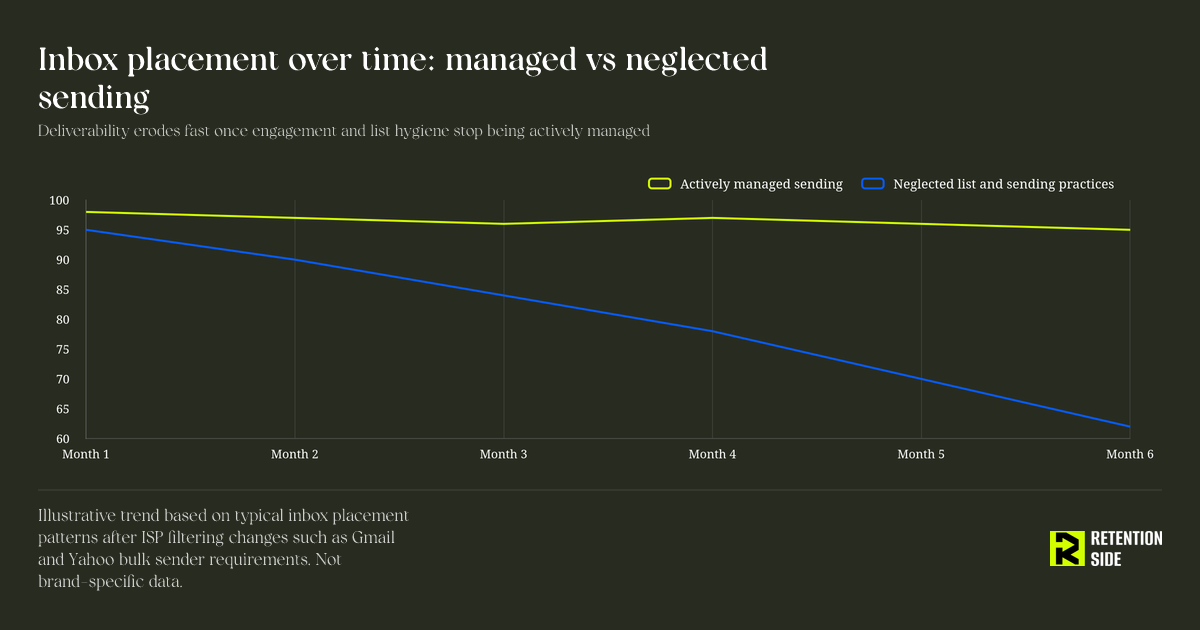
If nobody on your team is actively monitoring spam placement, sender reputation, and engagement-based segmentation, this decay happens quietly. By the time it shows up as a revenue problem, you’ve likely already lost several months of inbox access with your most valuable subscribers.
The person managing email is stretched across too much
This is the most common real-world trigger. A Marketing Director is running paid acquisition, managing the website, overseeing content, and “also doing email” in whatever time is left. Email gets a monthly campaign calendar and not much else. Flows never get revisited. Segmentation stays basic. A/B testing doesn’t happen because there’s no bandwidth to run it consistently, let alone analyze results and act on them.
This isn’t a competence problem. It’s a bandwidth problem, and it’s the clearest sign that email needs a dedicated owner, whether that’s an in-house hire or an agency.
You’re leaving channels on the table
Email is almost always the starting point for retention, but it’s rarely the whole system. If your best customers would respond well to SMS, if cart abandonment recovery could benefit from a well-timed push notification, or if a high-AOV segment would respond to direct mail or WhatsApp, and none of that exists yet, you’re capped on what email alone can do. A generalist “email marketer” role usually doesn’t extend into building a multi-channel retention system. That expansion typically requires either a broader internal team or a retention partner that thinks beyond one channel.
Growth has outpaced the sophistication of your setup
A brand doing $50k/month and a brand doing $500k/month should not have the same email setup. But plenty of $300k+/month brands are still running the flows and segmentation strategy they built when they were a fraction of that size. If your list size, order volume, and product catalog have grown significantly but your Klaviyo account structure hasn’t evolved with it, you’re running a small-brand system at a mid-market revenue level. That gap is exactly where agencies earn their fee.
What a retention-focused agency actually does differently
A lot of brands hire “an email agency” expecting campaign calendars and templates. That’s not retention work, that’s email production. There’s a real difference, and it matters for what you should expect to get out of the engagement.
Retention Side’s view is that email marketing should be treated as one part of a broader retention system, not a standalone channel. That means the engagement should start with an honest audit: what are flows actually doing, where is deliverability at, how is the list segmented, and what’s the realistic lead-to-customer rate versus just form submission volume. Subscriber quality matters more than subscriber count, and a good agency should be looking at that distinction from day one instead of celebrating a big pop-up conversion rate that’s filling your list with people who never buy.
From there, the work should map to actual customer journey stages: welcome and onboarding, abandonment recovery, post-purchase experience, win-back, loyalty and replenishment where relevant. Not every flow needs to generate direct revenue immediately. Some exist to collect information, set expectations, or reduce support tickets. A good agency understands that distinction instead of optimizing every single flow purely for short-term revenue.
The chart below shows a common pattern in well-built Klaviyo accounts: flows tend to carry the majority of automated email revenue, while campaigns drive engagement, promotional lift, and the day-to-day relationship with your list.
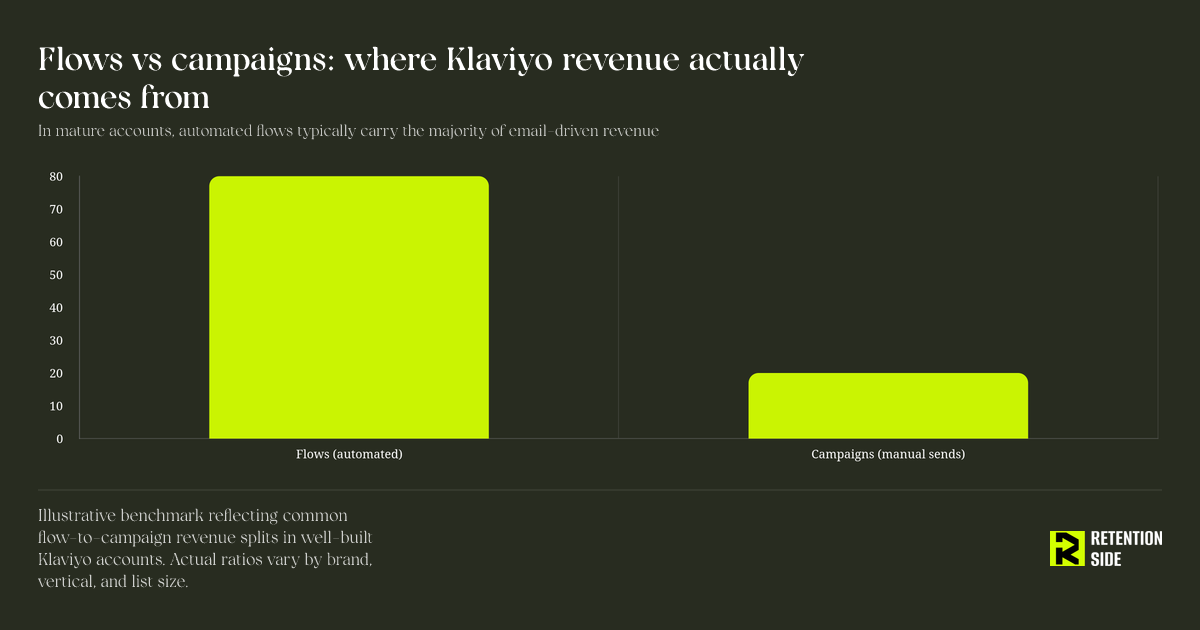
This is why an agency engagement that only touches campaigns and ignores flows is usually missing the bigger opportunity. If your campaigns look fine but flows haven’t been audited in a year, you’re optimizing the smaller half of the equation.
In-house, freelancer, or agency: how to actually decide
This is where a lot of brands get stuck, so it’s worth being direct about the tradeoffs instead of pretending one option is universally right.
A dedicated in-house hire makes sense when you have enough volume and complexity to keep one person fully occupied, and when you want someone embedded in daily brand decisions, product launches, and customer service feedback loops. The tradeoff is ramp-up time, hiring risk, and the reality that one person rarely has deep expertise across strategy, copywriting, design, deliverability, and technical Klaviyo build simultaneously. Most in-house email hires are strong in one or two of those areas and average in the rest.
A freelancer works well for narrow, defined tasks: building a specific flow, cleaning up a template, doing a one-time audit. It tends to break down when the brand needs an ongoing system that gets tested and improved continuously, because freelancers are often juggling multiple clients and don’t have the bandwidth to treat your account as a system that evolves month over month.
An agency makes sense when you need a full system built or rebuilt, when deliverability and multi-channel strategy are part of the problem (not just campaign execution), and when you want a team with specialized roles, strategist, copywriter, designer, deliverability specialist, rather than one generalist wearing every hat. This is also where the “worth it” question tends to get resolved: a good agency isn’t billing for campaign sends, it’s billing for the compounding value of a system that improves month over month across flows, segmentation, deliverability, and testing.
None of this means every brand needs Retention Side or any agency at all stages. A brand doing $40k/month with a simple product catalog and one flow sequence probably gets more value from a sharp freelancer or a part-time hire than from a full agency retainer. The decision should scale with complexity and revenue, not with anxiety about “falling behind.”
The cost of waiting is usually bigger than it looks
Here’s a way to think about it concretely. If your flows are underperforming by even a modest margin, and flows represent the majority of your automated email revenue, that gap compounds every single month it goes unaddressed. A brand at $300k/month with email representing 20% of revenue, and flows underperforming by 15-20% relative to what a properly optimized system could produce, is quietly leaving a meaningful five-figure amount on the table annually. That’s before accounting for deliverability decay, which can silently cut inbox access to a growing share of your list.
The instinct to “wait until things are more stable” or “fix it internally next quarter” is understandable, but it usually means another quarter of the same underperformance, plus whatever new problems show up in the meantime (an ISP filtering change, a list hygiene issue, a competitor’s more aggressive retention strategy pulling attention away from your brand).
How to evaluate an agency without falling for a pitch deck
Once you’ve decided the signals point toward hiring, the evaluation process matters as much as the decision itself. A few things worth pressing on during initial conversations:
Ask how they think about deliverability, specifically. Not “do you handle deliverability,” but what they actually monitor, how they segment based on engagement, and how they’d diagnose a sudden open rate drop. Vague answers here are a red flag, because deliverability is foundational; if it’s wrong, nothing else in the account matters.
Ask what they consider the real KPI for list growth. If the answer is “form conversion rate” without mentioning lead-to-customer rate or subscriber quality, that’s a sign they’re optimizing for a vanity metric instead of revenue.
Ask how they approach flows versus campaigns. A good answer maps flows to customer journey stages and drop-off points, not just “we build the standard flows.” Ask specifically how they’d handle a flow that isn’t converting: is the fix messaging, timing, segmentation, or the offer itself?
Ask how they think about channels beyond email. Not every brand needs SMS, push, direct mail, WhatsApp, or Viber on day one, but a partner who only ever recommends email regardless of your audience or product isn’t thinking about your retention system, they’re thinking about their own service menu. If SMS is on the table, it’s worth understanding what an ecommerce SMS marketing agency should bring alongside email.
Ask what a drop in performance would prompt them to investigate. A strong answer acknowledges that a decline in email metrics doesn’t always mean email is broken. It could be traffic quality, acquisition changes, a website conversion issue, or a shift in customer behavior. An agency that immediately blames “the list” or immediately proposes more sends without diagnosing the actual cause is optimizing for busywork, not results.
This is also where it’s worth being honest about the difference between Retention Side’s approach and a lot of the market. Plenty of agencies position themselves as email agencies and stop there. Retention Side’s view is that email, usually through Klaviyo, is the entry point into a broader retention system that should expand deliberately into other channels based on audience behavior and cost efficiency, not because it’s trendy. That framing changes what the engagement actually looks like month to month.
Frequently asked questions
What is the 80/20 rule in email marketing?
In the context of ecommerce email, the 80/20 rule usually refers to the idea that roughly 80% of email-driven revenue tends to come from a relatively small set of high-performing sources, most commonly automated flows rather than one-off campaigns. In a well-structured Klaviyo account, flows like abandoned cart, browse abandonment, post-purchase, and welcome series often generate the bulk of automated revenue because they’re triggered at moments of high purchase intent, while campaigns contribute more to engagement, brand relationship, and promotional lift. The practical takeaway isn’t to abandon campaigns, it’s to make sure flows get proportional attention. If a brand spends most of its time building campaign calendars and almost none auditing or improving flows, it’s misallocating effort relative to where the revenue actually originates. The same 80/20 framing also shows up in customer terms: a small percentage of customers (repeat buyers, VIPs, high-AOV segments) often drive a disproportionate share of total revenue, which is why segmentation and retention strategy should weight effort toward protecting and growing that group rather than treating every subscriber identically.
Is it worth it to hire a digital marketing agency?
It depends entirely on what problem you’re trying to solve and where your business is in its growth. For ecommerce brands doing meaningful monthly revenue, whether hiring an agency is “worth it” comes down to a few factors: whether the internal team has the bandwidth and specialized expertise to build and continuously improve a full retention system, whether the cost of a plateaued or declining channel exceeds the cost of the retainer, and whether the agency in question actually operates as a system-level partner rather than a task-execution vendor. A retainer that costs a fraction of what an underperforming flow system is leaving on the table every month is a straightforward financial decision once you actually quantify the gap. Where agencies stop being worth it is when a brand hires one without a clear problem to solve, expecting the agency to simply “do email” without any strategic direction, or when a brand is small enough that a single skilled hire or freelancer would deliver more value per dollar. The honest answer is that “worth it” is a function of specificity: worth it for what, compared to what alternative, and measured against what timeframe. A good agency should be comfortable being evaluated on exactly those terms.
What is the 60/40 rule in email?
The 60/40 rule in email marketing generally refers to a recommended balance between promotional content and value-driven or educational content sent to a list. Under this framing, roughly 60% of campaign sends lean toward non-promotional content, brand storytelling, product education, customer stories, useful tips tied to the product, while about 40% carry a direct promotional or sales-driven message. The logic behind this ratio is straightforward: if subscribers only hear from a brand when there’s a discount, they train themselves to wait for the next sale instead of buying at full price, and engagement declines over time because every email starts to feel transactional. This is consistent with how retention strategy should treat campaign planning generally: segmentation should inform not just who receives a campaign, but what kind of campaign they receive, and a healthy send calendar protects full-price purchasing behavior by not over-indexing on discounts. Brands don’t need to follow the 60/40 split exactly, but the underlying principle, that value and promotion both need consistent representation in the calendar, holds regardless of the precise ratio a given brand settles on.
What is the 3-2-1-0 email rule?
The 3-2-1-0 rule is a deliverability and inbox management guideline that’s most commonly referenced in the context of avoiding spam filters and keeping a sender’s list clean, though the specific numbers get interpreted somewhat differently depending on the source. The general framing behind rules like this is about disciplined list hygiene: sending at a sustainable frequency, removing or suppressing consistently unengaged subscribers, monitoring bounce and complaint rates closely, and avoiding practices that spike spam complaints or hard bounces, since both directly damage sender reputation with mailbox providers like Gmail and Yahoo. Rather than treating a numbered rule like this as a strict formula to follow, the more useful takeaway for ecommerce brands is the underlying principle: deliverability depends on ongoing list hygiene and engagement-based sending decisions, not a one-time cleanup. Brands that regularly suppress unengaged segments, watch complaint rates by ISP, and adjust sending frequency based on engagement trends protect their inbox placement far more effectively than brands relying on any single numbered heuristic. The specific numbers matter less than the discipline of actively managing deliverability as an ongoing practice rather than a “set it and forget it” task.
Conclusion
The decision to hire an ecommerce email agency shouldn’t come from a vague feeling that things could be better. It should come from specific, identifiable signals: flows that haven’t been touched in months, deliverability that’s quietly eroding, a team stretched too thin to run consistent testing, or growth that’s outpaced the sophistication of the current setup. Once one or more of those signals shows up clearly, the question shifts from “should we hire” to “what kind of partner actually solves this specific problem.”
The brands that get the most value out of an agency relationship are the ones that go in with a clear picture of where the system is breaking down, whether that’s flows, deliverability, segmentation, or channel expansion, and evaluate potential partners against that specific gap rather than a generic pitch. Retention Side’s approach starts there: audit the full system, understand where the real leaks are, and build out the right mix of flows, campaigns, and channels based on what your customers actually respond to, not based on a standard service package. That’s the difference between hiring an agency to send emails and hiring a partner to build a retention system that keeps compounding long after the first month of work.