

Most brands treat winback as a single flow: someone hasn’t bought in 90 days, so they get an email with a discount code. That approach works often enough to justify keeping it around, which is exactly why most brands never fix it. A generic 90-day winback flow leaves real revenue on the table because it ignores purchase cadence, it waits too long to intervene, it relies on one channel, and it treats every lapsed customer as the same problem.
Winback is not a flow. It’s a system that has to account for why customers actually go quiet, how fast their engagement decays, and what mix of channels and messaging will realistically bring them back before they’re gone for good. This article breaks down how we think about that system at Retention Side, and how you should be thinking about it if lapsed customer revenue is being left to a single automation.
Key takeaways
- Winback starts with correctly defining “lapsed,” which depends on your product’s natural repurchase cycle, not an arbitrary day count copied from another brand.
- Engagement decays faster than most brands assume. Waiting until day 90 to start a winback sequence usually means you’re already talking to a much colder audience than you think.
- A single-channel, single-touch winback flow underperforms a tiered system that escalates messaging, incentive, and channel based on how long someone has been gone.
- Discounts are a lever, not the strategy. Leading with a discount every time trains customers to wait for one and erodes margin on customers who might have come back anyway.
- Deliverability discipline matters more in winback than almost anywhere else in your program, because you’re emailing people who have already shown reduced engagement.
- Not every lapsed customer is winnable, and pushing hard on unwinnable segments damages sender reputation for the rest of your list.
What we’ll cover
We’ll walk through how to define lapsed customers properly, why timing determines most of your winback outcome, how to build a tiered flow structure instead of one generic sequence, how to bring SMS and direct mail into the mix without overspending, how to use incentives strategically instead of by default, and how to protect deliverability while messaging a cooling segment.
Start by defining “lapsed” correctly
Before you build a single email, you need to answer a question most brands skip: lapsed compared to what?
A customer who buys skincare every 45 days and hasn’t ordered in 60 days is lapsed. A customer who buys a mattress once every three years and hasn’t ordered in 60 days is behaving completely normally. If your winback flow triggers off a flat “no purchase in 60 days” rule across your entire catalog, you’re going to email loyal, on-cycle customers with “we miss you” messaging that makes no sense to them, and you’ll damage the credibility of every message that follows.
The fix is to build your lapse windows around actual purchase cadence, not a number you picked because it felt reasonable. Pull your repeat purchase data by product category or customer cohort and look at the median time between orders. A consumable brand might see lapse begin at 45 to 60 days. A durable goods or high-consideration brand might not consider someone lapsed until 6 to 12 months. If you sell a mix of both, you need multiple lapse definitions running in parallel, segmented by what the customer actually bought.
This is the same thinking that should shape your broader lifecycle segmentation strategy: cadence-based triggers reflect real behavior, calendar-based triggers reflect convenience for whoever built the flow. We cover the trigger-timing mechanics — including how to set lapse windows from your own repurchase data instead of inherited defaults — in our Shopify winback email strategy guide.
Timing is the single biggest lever in winback
Once you know what “lapsed” means for your customer base, the next question is how fast you need to move. The honest answer: faster than most brands are comfortable with.
Email engagement doesn’t degrade in a straight line. It falls off a cliff the longer someone goes without interacting with your brand. A customer who was opening your campaigns two months ago is a very different prospect than the same customer six months later, even if neither has technically “converted” back yet.
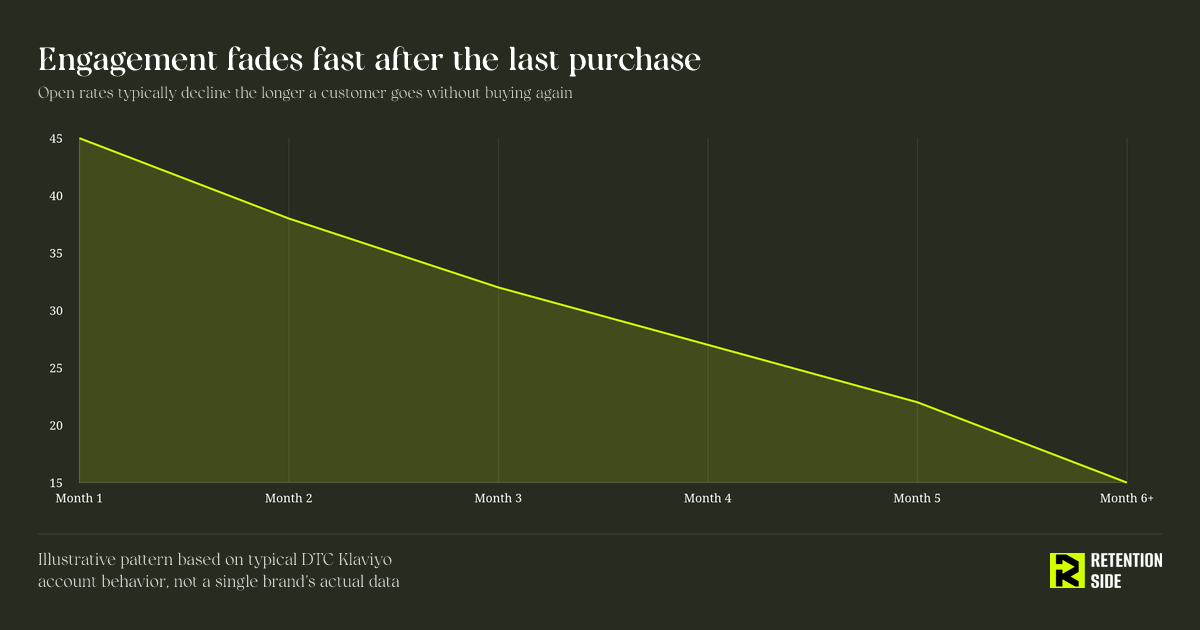
This is why waiting for a single 90-day trigger is usually too late. By the time that email lands, a meaningful share of the audience has already stopped opening anything from you, which means the winback flow is fighting an uphill battle before it even sends. The brands that recover the most lapsed revenue start earlier, with lighter-touch messaging, and escalate from there. Our deeper breakdown of winback email campaign architecture covers why the trigger is the single most important variable in the entire flow — not the copy, not the design, not the incentive.
The same pattern shows up directly in conversion data. The longer someone has been gone, the harder it gets to bring them back, and the drop-off isn’t gradual.
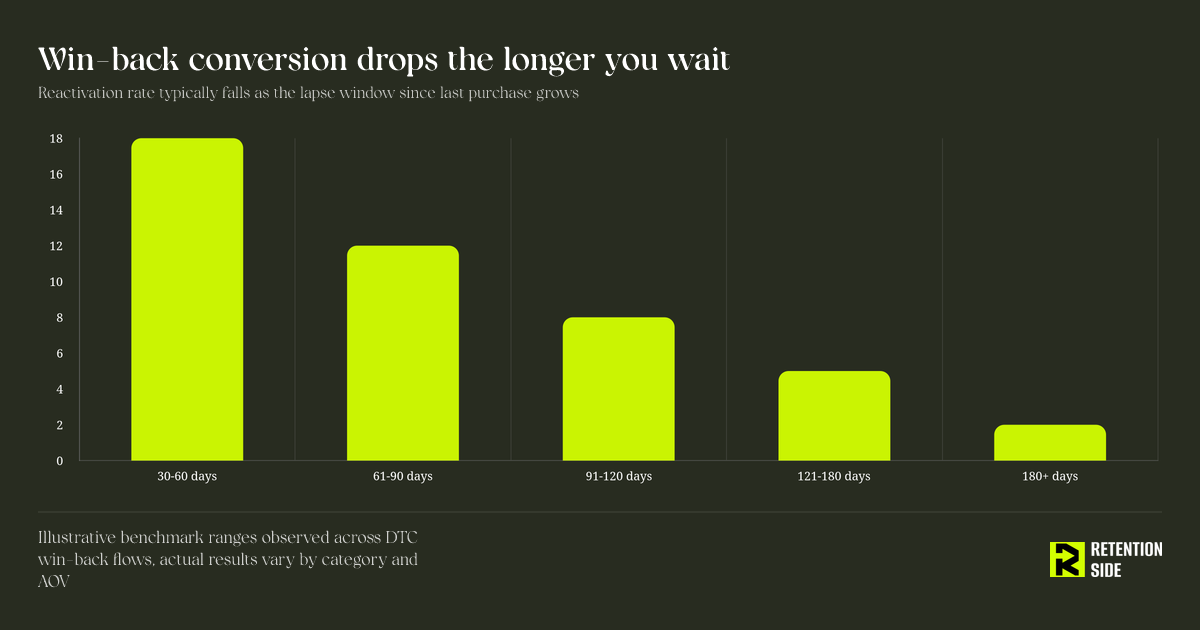
The practical implication: your winback system needs an early-stage touch that isn’t really a “winback” message at all. It’s a check-in, a soft nudge, a piece of useful content, or a product reminder that keeps you in the customer’s inbox before they’ve fully disengaged. Save the heavier incentive-driven messaging for later tiers, once soft re-engagement hasn’t worked.
Build tiers, not a single flow
A single winback email or a three-email flow that fires once at a fixed interval treats every lapsed customer identically. A tiered structure treats the same population as what it actually is: people at different distances from the point of no return. This maps directly to the advanced Klaviyo segmentation framework we use to separate at-risk buyers from fully lapsed ones, because the messaging priority for each group is fundamentally different.
A reasonable tier structure looks something like this:
- Early stage (just past normal cadence): Light, non-promotional. A product usage tip, a replenishment reminder, or a “here’s what’s new” message. No discount. The goal is staying relevant, not selling.
- Mid stage (clearly lapsed, still plausible): Slightly stronger nudge. Highlight new products, social proof, or a reason to come back that isn’t purely price-based. This is often where a modest, non-discount incentive works, like free shipping or a bonus item, rather than a percentage off.
- Late stage (cooling fast): This is where a real incentive earns its place. A meaningful discount, a limited-time offer, or a bundle that changes the math for the customer. Be direct about scarcity or timing if it’s genuine.
- Last chance / sunset stage: A final, clearly-labeled last attempt, often paired with a preference update ask (“still want to hear from us?”) rather than another sales pitch. This tier does double duty: it either wins the customer back or it moves them into a suppression or reduced-frequency segment, which protects deliverability for your engaged list.
Each tier should have its own goal, its own tone, and its own success metric. Early-stage flows should be judged on engagement recovery, not immediate revenue. Late-stage flows should be judged on conversion and margin impact. If you’re judging every tier by the same revenue-per-recipient metric, you’ll end up cutting the early, low-pressure touches that are actually protecting the health of your list, because they don’t look profitable in isolation.
Escalate channels, not just messages
Email carries most winback programs, and it should, since it’s the lowest-cost channel and the easiest to test. But an email-only winback sequence caps out fast, especially against a segment that has already shown reduced email engagement. If someone stopped opening your emails, sending them more emails on the same channel isn’t a strategy, it’s a hope.
This is where the rest of the retention stack earns its place. SMS reaches customers who have quietly stopped engaging with email but still check text messages. Omnisend’s ecommerce SMS and email benchmark report found that brands using SMS alongside email captured nearly half a million additional orders that email alone would have missed. Direct mail can cut through digital fatigue entirely for high-value lapsed customers where the AOV justifies the cost — and the data backs this up: the ANA Response Rate Report shows direct mail response rates of 2.7%–4.4%, compared to roughly 0.12% for email. Push notifications work for app-based brands with a warm but quiet install base. The decision of which channel to add isn’t about chasing every option, it’s about matching the channel to what you know about that segment’s behavior and the economics of reaching them.
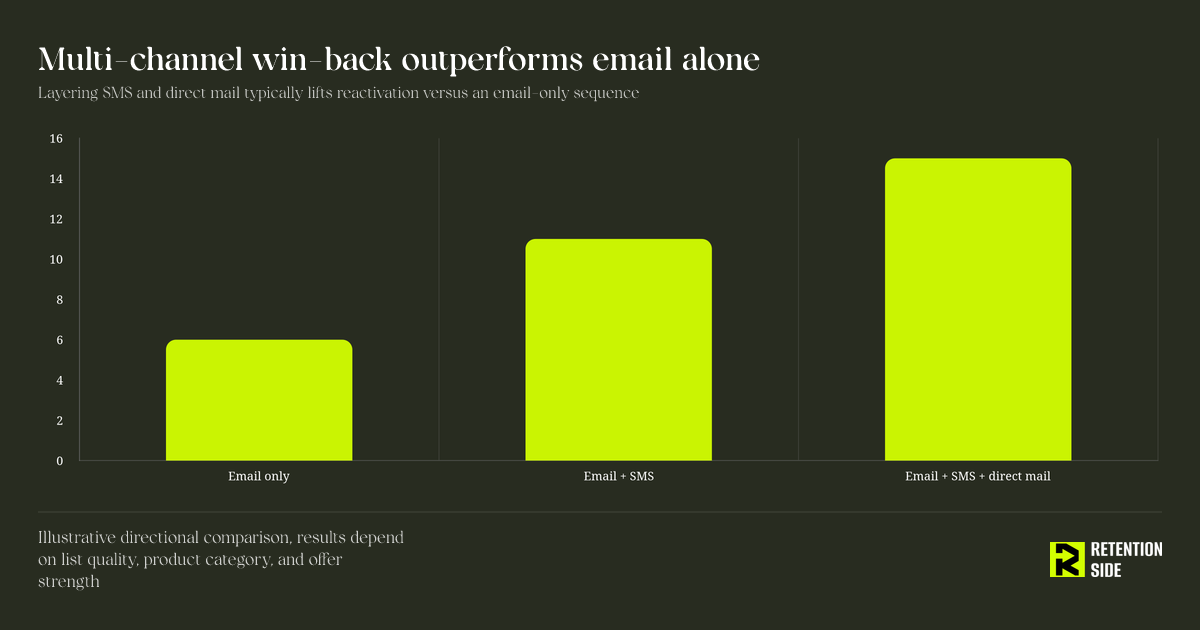
The pattern holds for an obvious reason: a customer who ignored three emails is statistically less likely to respond to a fourth, but might respond to a text that lands differently, or a physical mail piece that shows up when their inbox has fully tuned you out. This mirrors the broader point we make about retention channel strategy in general, that the right channel mix depends on audience behavior and communication preference, not on defaulting to whatever channel is easiest to set up. Layering channels for your highest-value lapsed segments, rather than your entire lapsed list, keeps the economics sensible. Direct mail against a $40 average order value lapsed segment rarely pencils out. Against a $250 AOV segment with high lifetime value, it often does.
Use incentives strategically, not automatically
The default winback instinct is to lead with a discount, and for a lot of brands that’s the entire strategy: customer goes quiet, customer gets 20% off. This works often enough that nobody questions it, but it has real costs that don’t show up in the winback flow’s own reporting.
First, it trains your most price-sensitive lapsed customers to wait out the clock for a discount rather than repurchasing at full price. Second, it treats every reason for lapsing as a price problem, when plenty of lapsed customers left because of a product issue, a shipping experience, a change in need, or simply because they forgot, not because your price was too high. Third, discounting early-stage lapsed customers who might have come back anyway is pure margin giveaway.
The better approach ties incentive intensity to tier, as covered above, and considers non-discount incentives before jumping to price. Free shipping, a bundled gift, early access to new products, or a loyalty point bonus can move a customer without training them to expect a percentage off every time engagement dips. Save the sharpest discount for the segment that’s genuinely about to be lost for good, where the math of a discounted reactivation clearly beats the alternative of losing the customer’s remaining lifetime value entirely.
Protect deliverability while you’re at it
Winback campaigns are inherently risky from a deliverability standpoint, and this is where a lot of otherwise well-built flows quietly do damage. You’re sending to people who, by definition, have shown lower engagement than your active list. Mailbox providers read low opens, low clicks, and rising spam complaints or unsubscribes from this segment as signals about your sending quality overall, not just about that one segment. Gmail’s email sender guidelines now require bulk senders to keep spam complaint rates below 0.3% — a threshold that’s easy to breach when you’re mailing a segment that hasn’t opened anything in months.
A few practices matter specifically because of this:
- Send winback campaigns from consistent infrastructure, not a separate domain or IP path that hasn’t built reputation.
- Keep frequency in check within the flow itself. Bombarding a cooling segment with daily touches accelerates spam complaints.
- Build a genuine sunset path. Customers who don’t respond to the full winback sequence should move to a reduced-frequency or suppressed segment, not stay in active rotation indefinitely. AWS’s deliverability best practices guide reinforces this: proactively removing inactive recipients is one of the most effective ways to protect sender reputation.
- Watch engagement metrics at the tier level, not just overall list health, so a struggling late-stage tier doesn’t quietly drag down your sender reputation for everyone else.
This connects to a point we make constantly: delivery and deliverability are not the same thing. Our Klaviyo deliverability guide covers this distinction in depth. A winback email can technically deliver to an inbox that never gets checked, or worse, get delivered straight to a spam folder because of how the segment behaves. If your winback flow is quietly hurting the deliverability of your welcome series, browse abandonment, or post-purchase flows, the flow is costing you more than it’s earning, even if it shows positive attributed revenue on its own.
Know when winback isn’t the real problem
Sometimes a rising number of lapsed customers isn’t a lifecycle problem at all. If your lapse rate is climbing month over month, it’s worth checking whether the issue is upstream: a change in acquisition quality bringing in less committed buyers, a product or shipping experience issue causing dissatisfaction, or a website or checkout problem suppressing the kind of repeat purchase behavior a good winback flow depends on. The gap between acquisition cost and retention cost is steep enough — Invesp’s research puts retention costs at 5–25x lower than acquisition across industries — that ignoring upstream quality while pouring effort into winback is an expensive misallocation.
No winback sequence, however well segmented and well timed, fixes a product that isn’t earning repeat purchases on its own merits. Winback recovers customers who would have come back under normal circumstances but got distracted, forgot, or needed a nudge. It doesn’t manufacture loyalty that was never there. Before investing heavily in winback infrastructure, it’s worth confirming that your lapse problem is actually a lifecycle marketing gap and not a symptom of something upstream that needs fixing first. For more on this dynamic, our retention vs. acquisition analysis breaks down when each priority should take precedence.
How to measure whether winback is actually working
The easiest mistake in winback measurement is judging the whole system by flow revenue alone. A more honest measurement approach looks at:
- Reactivation rate by tier: What share of customers in each stage actually placed another order within a defined window after entering that tier.
- Time to reactivation: Are customers coming back faster as you move touches earlier in the lifecycle, or is timing not actually the lever you thought it was for your specific product.
- Reactivated customer LTV: Not just whether they bought again, but whether the reactivated customer behaves like a normal repeat customer afterward, or churns again shortly after redeeming an incentive.
- List health impact: Are your winback sends holding steady on deliverability metrics, or are they dragging down engagement and placement for the rest of your program.
None of these show up in a single “flow revenue” number in your ESP dashboard, which is exactly why so many brands overestimate or underestimate what their winback program is actually doing. Our ecommerce email marketing benchmarks provide reference points for flow performance, engagement rates, and deliverability metrics so you can contextualize winback results against real category data.
Conclusion
A generic winback flow isn’t nothing, but it’s not a system either. It’s one blunt tool applied to a population that actually splits into several distinct groups with different reasons for going quiet and different odds of coming back. The brands that recover meaningful revenue from lapsed customers are the ones that define lapse correctly for their own repurchase cadence, move early instead of waiting for an arbitrary day count, escalate messaging and channel by tier instead of firing the same email at everyone, and use incentives with intent instead of as a default reflex.
At Retention Side, winback is one piece of the broader lifecycle system we build for clients, sitting alongside acquisition flows, post-purchase sequences, and loyalty programs, because a lapsed customer rarely churns for a single, isolated reason. Treat winback as a system that reflects how your specific customers actually behave, and it starts recovering revenue that a generic flow was always going to miss.