

Most Shopify brands have some version of a winback flow running. What most of them have is not what a winback is actually supposed to do.
The typical setup: a two or three-email sequence that fires when someone hasn’t purchased in 90 or 180 days, starting with “We miss you!” and ending with a discount code. It generates a trickle of attributed revenue, nobody questions it, and it runs untouched for years. Meanwhile, a meaningful portion of lapsed customers who could have been reactivated have already moved on – because the flow waited far too long to fire, sent messages that weren’t relevant to what those customers actually bought, and led with a discount that trained buyers to expect one.
A well-built Shopify winback email strategy is one of the most high-leverage tools in the retention toolkit. It targets a specific audience – people who already chose your brand once – at the specific moment their engagement is fading but has not yet gone. Done right, it lifts your returning customer rate, protects customer lifetime value, and does it at a fraction of the cost of acquiring new customers from scratch.
This article explains exactly how to build that strategy: how to set the trigger correctly, how to structure the email sequence, how to segment across customer types, and how to connect the winback layer to the rest of your retention system.
Key takeaways
- Winback trigger timing is the single most important variable in the strategy. Most brands set it far too late – based on generic defaults, not actual repurchase data.
- Incentives belong at position three in the sequence, not position one. Leading with a discount conditions lapsed customers to wait for it every time.
- One-time buyers and repeat buyers require separate messaging. The same email that nudges a loyal customer back will feel generic and irrelevant to someone who bought once.
- Winback flows and winback campaigns serve the same strategic goal but operate differently. Mature programs run both.
- The metrics worth tracking are returning customer rate and flow-level reactivation rate – not open rate or click rate.
- Winback is a revenue-generating flow. A sunset flow, which is a list hygiene mechanism, is a separate thing entirely and should not be confused with winback.
What this article covers
- What a winback email is actually trying to do
- Why most Shopify winback flows fail at the trigger level
- How to calculate the right trigger window using your own data
- How to write a winback email that actually works
- How to segment across customer types
- Winback flows vs. winback campaigns – when you need both
- The incentive question: when to offer one and how to structure it
- How winback connects to your full retention system
- Frequently asked questions
What a Shopify winback email is actually trying to do
A winback email campaign targets a specific segment at a specific moment: customers who bought before, have since gone quiet, and are at risk of not coming back at all.
The strategic intent is not to make a sale in isolation. It is to re-engage a relationship before it expires. That framing matters because it shapes how the campaign is built. You are not marketing to strangers. You are reaching people who already chose your brand, trusted it with their money, and at some point stopped returning. The reasons vary – a better offer from a competitor, forgetting the brand exists, a mediocre post-purchase experience, a product that ran out and wasn’t replenished in time. A winback sequence that treats all of these causes as identical will underperform.
The economics behind winback are straightforward. Reactivating a lapsed customer who already knows and trusts your brand is materially cheaper than acquiring a new customer through paid channels. Research published by Harvard Business Review puts acquiring a new customer at five to 25 times more expensive than retaining an existing one – and Bain & Company’s work shows that a 5% improvement in customer retention rates can increase profits by 25% to 95%. For Shopify brands spending heavily on Meta and Google to fill the top of the funnel, the contrast in reactivation cost versus acquisition cost is usually stark. Every lapsed customer recovered by a well-timed winback sequence reduces the pressure on the acquisition budget.
The other thing to understand about winback is its position in the customer lifecycle. Winback is not a last resort. It is an early intervention triggered when a customer’s absence has become statistically notable – meaning they have been quiet longer than your actual repurchase data would predict. Waiting until the relationship is clearly over is not a winback. It’s an acknowledgement that you missed the window.
Why most Shopify winback flows fail at the trigger level
If there is one place where most winback email programs lose before they even begin, it is the trigger.
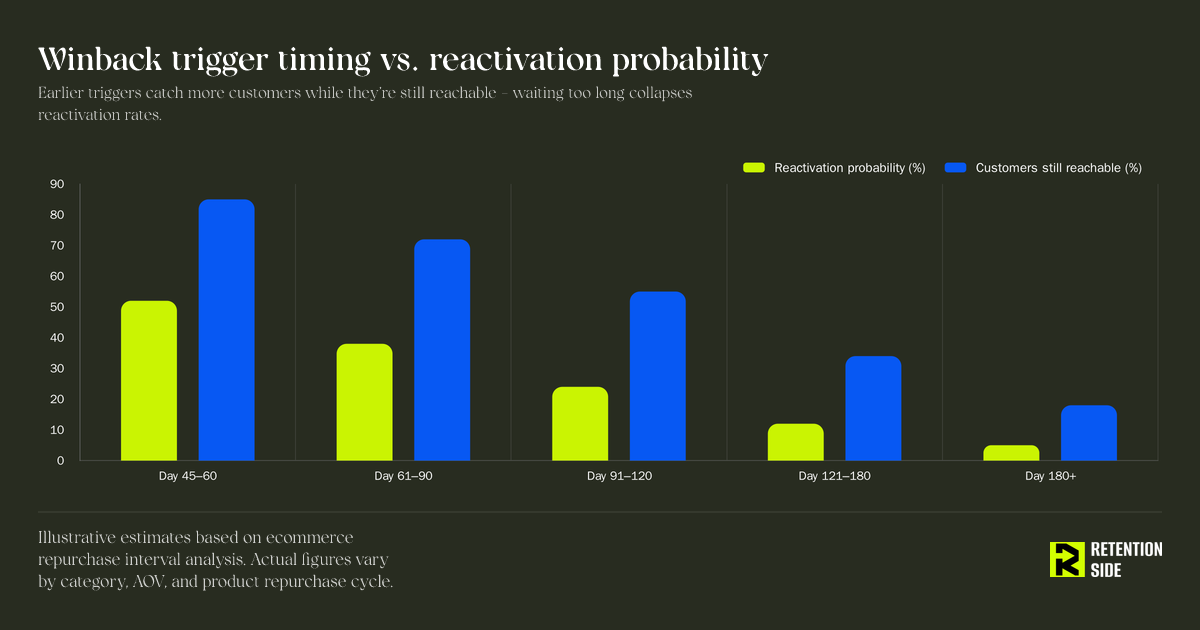
The industry default – a 90-day or 180-day inactivity window applied universally – is not a strategic decision. It is a template inherited from generic Klaviyo setups that no one bothered to adjust. For most ecommerce categories, it means the winback flow fires at exactly the wrong time: after the customers who were going to come back have already done so, and after a large portion of the customers who needed a nudge have already fully disengaged.
Think about what happens in the 180 days between a customer’s last purchase and the point when most winback flows fire. In that window, a customer selling a 30-day supplement supply has missed five or six natural repurchase opportunities. By the time your “We miss you!” email lands, they’ve been buying from a competitor for four months. The email is not a winback – it’s a goodbye card.
The right trigger is not 90 days or 180 days as a universal rule. The right trigger is calibrated to the actual repurchase behavior of your specific customer base. If your average customer reorders within 45 days, a customer who reaches day 60 without returning is statistically notable. That is when the winback should fire – not 120 days later. This is precisely the insight behind peer-reviewed research published in the International Journal of Research in Marketing, which found that timing reactivation initiatives to each customer’s individual interpurchase pattern – rather than applying a fixed time window – meaningfully improves reactivation performance.
Setting the trigger correctly is not technically complicated. It requires one thing: actually pulling your repurchase interval data and using it to inform a deliberate decision.
How to calculate your winback trigger window
Step 1: Export all orders from Shopify for the past 12 to 18 months. For each customer who has placed more than one order, calculate the number of days between each consecutive purchase pair.
Step 2: Find the median and 75th percentile of those intervals. If the median is 42 days and the 75th percentile is 68 days, that means 75% of your returning customers place their next order within 68 days.
Step 3: Set your first winback email to fire somewhere around the 75th percentile mark – adjusted slightly upward to avoid interrupting natural purchase cycles that just run a bit longer. For this example, something like day 70 to 75.
Step 4: Segment by product category if you sell items with meaningfully different repurchase cycles. A 30-day supply product and a seasonal outerwear item should not share the same trigger logic.
This analysis takes a few hours. It has a direct impact on how many customers you actually reach while they are still reachable. The chart below illustrates how reactivation probability drops as the trigger window extends beyond the natural repurchase cycle.
How to write a winback email that actually works
The most common winback email mistakes are not about copywriting. They are about strategy: what the email is trying to do at each stage of the sequence, and whether the sequence escalates logically or just repeats the same pitch in different words.
A well-structured winback sequence for most Shopify brands runs three to four emails. Here is how each one should be built.
Email 1 – Re-open the relationship, not the wallet
The first winback email should not contain a discount. Its job is to re-open the relationship with a relevant, low-pressure reason to return – and to do it in a way that reflects what the customer actually bought, not what you sell in general.
What works here: a genuine reason to be in touch. A product launch relevant to their purchase history. A reformulation of something they bought before. A curated recommendation based on their order. The email should feel like a thoughtful nudge from a brand that paid attention, not a broadcast message that went to 40,000 people at once.
What does not work: “We miss you!” subject lines connected to a generic email linking to the homepage. This combination signals automated irrelevance. The customer who receives it knows immediately that nobody looked at what they bought before hitting send.
The goal of email 1 is not conversion, though conversion at this stage is welcome. The goal is relevance. You are re-establishing that this brand knows something about this customer. That is what earns a second open.
Subject line approaches that work for email 1:
- Product-specific re-engagement: “Your [product name] routine – some new additions you’ll want to see”
- Natural follow-up framing: “Still using [product]? Here’s what pairs well with it”
- New reason to return: “We’ve been busy. Here’s what’s new since your last order”
Email 2 – Build the case for returning
If the customer has not responded to email 1 after three to five days, email 2 deepens the value case. This is where social proof earns its place: new reviews for the products they bought, results data if the category supports it, or a “here’s what our community has been saying” angle.
For supplement, skincare, and wellness brands, email 2 is where you restate the product’s core promise – the outcome the customer was trying to achieve when they first bought. Not in a pushy way. In the way a knowledgeable friend would remind you why something was worth sticking with.
Still no incentive at this stage. A customer who converts here converts because the value case is compelling, not because they needed a price reduction. That is a better customer cohort than the one that waits for the discount email.
Timing: send three to five days after email 1 if no purchase or engagement has occurred.
Email 3 – The incentive
By email 3, two value-focused touchpoints have been delivered without conversion. This is the right moment to introduce an incentive. The customer has demonstrated that they need an additional push, and the discount is now doing its actual job – not conditioning the customer to wait for one by being the first thing they see.
The incentive does not need to be aggressive. A targeted offer aligned to their purchase history – a discount on the specific product they bought before, free shipping on their next order, or a bundle deal for something complementary – is more effective and less margin-intensive than a blanket percentage-off code sent to the full lapsed segment.
Make the offer time-limited. Not falsely urgent, but specifically limited: a one-week expiry that creates a real reason to act now rather than “sometime later.”
Timing: three to five days after email 2.
Email 4 (optional) – The final signal
For brands with high-margin products or a large enough lapsed segment to justify the extra touchpoint, a fourth “last chance” email can capture a small additional layer of conversions. This email is transparent about its position in the sequence – it acknowledges that this is the last message in the series, and uses that transparency as a low-pressure close.
After email 4 (or email 3 for shorter sequences), customers who have not responded move into suppression from active marketing sends or into a re-permission path, depending on their overall engagement history.
How to segment a winback campaign across customer types
A winback sequence that treats every lapsed customer the same is leaving real performance on the table. The people sitting in your lapsed segment have meaningfully different purchase histories, different reasons for going quiet, and different messages that will resonate with them.
One-time buyers vs. repeat buyers
This is the most important segmentation split in the entire winback architecture.
A customer who bought once and never came back is a fundamentally different re-engagement challenge than a customer who ordered five times before going quiet. The one-time buyer may have had an adequate but not compelling experience – good enough to try, not good enough to become a habit. The loyal repeat buyer has a proven relationship with your brand. Their lapse is likely situational rather than attitudinal: something changed, but the underlying affinity is still there.
One-time buyer winback: The sequence needs to do more trust and value work. Surface reviews and social proof prominently. Remind them of the outcome the product was designed to deliver. Frame any incentive as a reason to give the brand a proper second chance, not just a price reduction.
Repeat buyer winback: The sequence can be more direct and personal. A customer who ordered five times does not need the brand origin story. They need a relevant reason to return – a new product in their category, an acknowledgment that they’ve been missed, or a targeted offer tied to their specific purchase history.
The post-purchase email flow that preceded the winback matters here too. A customer who received strong product education, a well-timed cross-sell, and a personalized post-purchase experience is more likely to respond to a winback than one who got an order confirmation and nothing else.
High-value vs. lower-value customers
A customer who spent an average of $200 per order warrants a different winback approach than one who spent $35. For high-value customers, the sequence can afford to invest more in the incentive tier – a free gift, a more meaningful discount, or a touchpoint that does not look like a mass broadcast. For lower-AOV customers, a clean, direct offer tied to their previous product is usually sufficient.
For brands with very high-LTV lapsed customers – those with multiple high-value orders who have now been inactive for longer than expected – direct mail deserves serious consideration as a winback channel. A physical piece arrives when inboxes are crowded, stands out in a way no digital touchpoint can, and signals that the brand values the relationship enough to invest in something tangible. It is high-cost relative to email, but so is the LTV of the customer it is trying to recover.
Segment by recency within the lapsed window
Not all lapsed customers are equally lapsed. A customer who triggered at day 62 (just past the repurchase window) is meaningfully different from one who has been inactive for 115 days. Earlier-stage lapsed customers may need a lighter touch. Further-along lapsed customers may need a stronger reason to return.
In Klaviyo, this is straightforward: use conditional splits inside the flow, with different content paths based on days since last purchase. This is not complex architecture – it is one of the details that separates a well-calibrated winback from a blunt instrument. For a deeper look at how to structure these audience splits, the Klaviyo segmentation strategy guide covers the segment logic in full.
Winback flows vs. winback campaigns: when you need both
There are two ways to execute a Shopify winback email strategy, and they serve the same goal differently.
A winback flow is a behavioral automation in Klaviyo. It fires automatically when a customer crosses the lapsed threshold – day 70, day 75, whatever your purchase interval data dictates. It runs continuously, 24/7, without anyone manually pressing send. Every customer who hits that threshold enters the sequence. This is the backbone of any winback program at scale.
A winback campaign is a manual broadcast to a defined segment of lapsed customers. It is used for specific moments: a product launch that is highly relevant to dormant buyers, a seasonal push that creates a natural reason to return, a restock event for a previously sold-out item, or a deliberate reactivation drive against a large dormant portion of the list.
Mature retention programs use both. The flow handles continuous real-time re-engagement as customers individually cross the lapsed threshold. The campaign handles specific moments where there is a genuinely compelling reason to reach the full lapsed audience at once. The strategic logic behind when to use each is covered in more depth in the ecommerce email marketing flows vs. campaigns explainer.
The operational note worth flagging: if you are running active winback flows, a campaign send to the same lapsed segment needs coordinated timing. A customer who received email 1 of the automated flow three days ago and then receives a broadcast winback campaign the following day is experiencing two simultaneous reactivation attempts – which tells them that your system has no idea what it’s doing. Flow exclusion logic and cross-channel suppression conditions are a prerequisite for this kind of coordination.
The incentive question: when to offer one and how to structure it
Incentives in winback campaigns create a real strategic tension that most brands resolve by defaulting to a discount. That default deserves scrutiny.
The case for incentives is real. A meaningful offer gives a lapsed customer a specific, time-limited reason to act now. Without one, some customers who would have responded to a discount will not convert.
The case against leading with incentives is equally real. Customers who receive a discount every time they lapse learn to lapse on purpose. If your winback flow fires at day 60 and email 1 contains a 15% off code, you have trained your customer base that the right strategy is to stop buying for two months and wait for the discount to arrive. Research from Northwestern Kellogg School of Management on long-run promotional effects shows that deep discounting conditions customers’ purchase expectations – particularly among established buyers – making them less likely to pay full price in future cycles. The customers who return without discounts are your most valuable cohort. Front-loading incentives selectively de-values that behavior.
The right structure is escalating: no incentive in email 1, no incentive in email 2, introduce the incentive in email 3 when the customer has demonstrated that they need an additional push to act.
Incentive sizing should also vary by segment. For high-LTV or high-frequency buyers, a more generous offer is justified by what that customer is worth over multiple future orders. For first-time or lower-value buyers, a smaller incentive – free shipping, a 10% reduction, or a relevant product sample – is often enough.
One margin consideration worth taking seriously: if your gross margins cannot absorb a re-engagement discount without making the recovered transaction unprofitable, a value-based winback approach – strong social proof, new product education, a loyalty program invitation – is more appropriate than discounting into the red. The metric that should inform this decision is customer lifetime value at the segment level, not the single-order economics of the reactivated purchase.
How winback connects to your full retention system
A winback email flow does not operate in isolation. Understanding where it sits in the retention architecture tells you a lot about how to build it – and what to do when the winback flow is working harder than it should be.
What winback is actually catching
The winback flow addresses one specific stage in the customer lifecycle: the at-risk lapsing segment. It exists, in part, because the post-purchase flow, the cross-sell sequence, and the loyalty program did not create enough pull to keep this customer returning naturally.
This has a direct architectural implication. If a large percentage of your customers are triggering your winback flow, that is not a winback problem. That is a post-purchase problem. The winback flow is catching churn that should have been prevented earlier in the lifecycle. A brand with a strong post-purchase email flow, relevant cross-sell and up-sell flows, and a functioning loyalty program will see fewer customers reach the winback trigger in the first place – because more of them have compelling reasons to return before they go quiet.
This is the logic behind thinking about your full Klaviyo flows for ecommerce as a system, not a collection of individual automations. Each stage of the customer journey should have behavioral coverage that makes lapsing less likely before the customer becomes a winback candidate.
Multi-channel winback
For brands running a broader retention stack, the winback strategy extends across channels. In a well-coordinated retention system:
Email carries the primary winback sequence – the full architecture described above.
SMS marketing plays a distinct supporting role for customers with an SMS opt-in. Not a parallel winback sequence, but a shorter, higher-urgency touchpoint deployed after the email sequence has run without a response. SMS should not echo the email. It should add something different: a tighter message, a closer deadline, a link that skips directly to a relevant product.
Direct mail is the high-impact, high-cost option for premium lapsed customers. A physical piece cuts through in a way no digital touchpoint can, and for brands selling high-AOV products with strong brand aesthetics, the investment is often justified by the lifetime value of the recovered customer.
Loyalty programs provide a natural, non-promotional reactivation mechanism. A points expiry reminder, a tier-status nudge, or an exclusive member offer is a relevant reason for a lapsed loyalty member to return that does not require a discount. The loyalty program provides the hook; the email or SMS carries the message.
The principle for multi-channel winback is coordination. Channels that fire simultaneously without a deliberate escalation logic create noise, not retention. Each channel should earn its place in the sequence based on the customer’s response – or non-response – at each prior touchpoint. For a broader view of how these channels work together, the guide to ecommerce retention channels covers the full stack and how to sequence it.
What to do with customers who don’t respond
After a complete winback sequence, customers who have not converted or engaged fall into one of two buckets.
Unengaged but not actively bouncing: These customers have not opened, not clicked, and not purchased. Continuing to send regular marketing campaigns to them erodes your deliverability. The right move is suppression from active marketing sends while keeping them in the customer database for potential future re-permission.
Hard disengagement: Customers who unsubscribed or flagged as spam during the winback sequence. Remove immediately and permanently from marketing sends. Any continued contact is counterproductive and, depending on jurisdiction and channel, legally problematic.
What should not happen: routing non-responders back into your normal campaign cadence as if the winback sequence never occurred. If they are receiving weekly promotional campaigns while simultaneously being in the winback flow, neither is doing its job – and your deliverability is absorbing the cost of sending to a confirmed non-engaged audience.
The winback flow and the sunset flow are not the same thing. The winback flow tries to reactivate lapsed customers. The sunset flow removes chronically disengaged subscribers from the active sending list to protect deliverability. They are sequential mechanisms, not competing ones. Customers who complete the winback flow without responding become candidates for the sunset path – not recipients of the same winback emails running again six months later. Klaviyo’s own guidance on sunset flows details how to configure this handoff so list hygiene and reactivation work together rather than across purposes.
Measuring what actually matters
Winback email performance is only as meaningful as the metrics you use to evaluate it.
Returning customer rate. The primary retention metric at the account level. If your winback program is working, you should see this trend upward over time as more lapsed customers re-enter the active buyer pool. This is a program-level metric, not a flow-level one.
Reactivation rate. The percentage of customers who enter the winback sequence and make a purchase during or shortly after it. Track this by segment – one-time buyers versus repeat buyers, high-AOV versus lower-AOV – to understand which audiences the current sequence resonates with and where adjustment is needed.
Repeat purchase rate of reactivated cohorts. Not all reactivated customers are equal. Some return and rebuild a long-term purchase relationship. Others take the incentive and disappear. Tracking what happens to reactivated customers in the 90 days after their return purchase tells you whether the winback is recovering genuinely valuable customers or generating one-off discount transactions.
Revenue attributed to the winback flow. A useful flow-level signal. Interpret it with appropriate context – some customers would have returned regardless, and the attribution model will credit the flow either way. The more meaningful question is whether the incremental revenue justifies the investment in building, running, and continuously optimizing the sequence.
What to ignore: Open rate and click rate are diagnostic signals for troubleshooting creative and subject line performance. They are not accountability metrics for whether the winback program is moving the business. An agency or internal team reporting winback performance primarily through opens and clicks is measuring the wrong thing. Push back and ask for reactivation rate by segment and the 90-day retention trajectory of recovered customers.
Frequently asked questions
What is the 80/20 rule in email marketing?
The 80/20 rule in email marketing – sometimes called the Pareto principle applied to retention channels – captures a pattern that most ecommerce operators with a mature email program will recognize: a disproportionate share of email revenue comes from a small subset of your list.
The most practical application in ecommerce email is this: roughly 20% of your subscribers tend to generate the large majority of your email-driven revenue. That 20% is typically composed of repeat buyers, recent purchasers, and highly engaged subscribers – the people who open consistently, click with intent, and buy without needing a discount.
The strategic implication for a winback strategy is significant. When a customer who was previously in that high-value 20% goes quiet and enters the lapsed segment, the economics of reactivating them are vastly different from those of reactivating a one-time buyer who made a single low-AOV purchase. High-frequency, high-AOV lapsed customers warrant more investment in the winback sequence – a more generous incentive, an additional touchpoint, potentially a direct mail piece – because the lifetime value of recovering that customer is much higher.
The 80/20 rule also applies at the flow level. Most of the revenue generated by an email program flows through a small number of high-performing flows and campaigns – typically the welcome series, abandoned cart, and post-purchase sequences. Winback often underperforms its potential not because the concept is wrong, but because it receives less optimization attention than the flows closer to acquisition. Closing that gap tends to compound quickly: better trigger timing, improved segmentation, and one additional split test per quarter can materially shift the reactivation rate for a flow that’s been running on autopilot.
Can you make $10k a month on Shopify?
Yes, but with important context: $10,000 per month in revenue on Shopify is a realistic milestone for many ecommerce businesses, but it is not a guaranteed outcome, and the route to getting there – and staying there – depends heavily on what happens after the first sale.
Many brands that reach $10k per month in revenue plateau there, or stagnate at break-even margins, because they are running almost entirely on acquisition. Every month, they spend on paid social and Google to bring in new customers, generate a burst of first-order revenue, and then fail to convert a meaningful portion of those customers into repeat buyers. The math eventually stops working: as paid acquisition costs rise and new-customer conversion rates fluctuate, a business with no retention infrastructure becomes expensive to run.
The brands that scale through $10k, $50k, and into $300k-plus per month sustainably are almost always the ones that have built a retention system alongside their acquisition engine. A properly built ecommerce email marketing strategy – with strong deliverability, a growing list of engaged subscribers, automated flows mapped to the customer lifecycle, and a campaign calendar that keeps buyers engaged between promotions – reduces the cost of generating repeat revenue and improves the ratio of returning customer revenue to total revenue over time.
Winback email strategy specifically contributes to this by recovering a portion of customers who would otherwise be permanent losses. On a $10k-per-month Shopify store, even modest winback flow performance – recovering 5% to 10% of lapsed buyers each month – adds up to meaningful incremental revenue without additional ad spend.
How to write an effective winback email
An effective winback email is built around one question: why should this specific customer come back right now? Not why they should buy from your brand in general – they already answered that question – but why now, and why this specific message is relevant to their actual history with you.
The practical answer to that question varies by position in the sequence:
Email 1 should not contain a discount. It should contain a specific, relevant reason to return based on what the customer bought. A new product in their category. A reformulation of something they ordered before. A curated recommendation that connects directly to their purchase history. The subject line should reflect that specificity. “Something new you’ll want to see” is vague. “[Product name] update – you’ll want to see this” is connected to something real.
Email 2 should deepen the value case without pushing for the sale. Social proof earns its place here – reviews for the products this customer purchased, real outcomes from real customers. For health, wellness, and beauty brands, restating the product’s core promise in concrete terms (the outcome the customer was trying to achieve when they first bought) works well at this stage.
Email 3 introduces the incentive – a specific, time-limited offer that gives a lapsed customer a concrete reason to act now rather than later. Keep the offer targeted to their purchase history. A free shipping threshold or a discount on the product they bought before is more effective than a blanket percentage-off code with no connection to what they actually care about.
Across all three emails: personalize beyond “Hi [first name].” Reference what they bought. Reflect their category. Show them that someone – or at least, some system – paid attention. That is the difference between a winback email that feels like a genuine reach-out and one that feels like an automated mass blast.
Does Kim Kardashian use Shopify?
Yes – SKIMS, Kim Kardashian’s shapewear and apparel brand, runs on Shopify. SKIMS is one of the more high-profile examples of a celebrity-founded brand that has scaled to significant revenue on Shopify’s infrastructure, reportedly reaching hundreds of millions in annual revenue.
What is worth noting from a retention standpoint is how SKIMS uses its Shopify stack. The brand runs Klaviyo for email and SMS marketing automation, Rise.ai for its loyalty and rewards program, and Okendo for customer reviews and user-generated content. That combination – email and SMS for direct communication, a loyalty program for structural repeat purchase incentives, and social proof tools to build conversion trust – is exactly the kind of multi-channel retention architecture that makes sense for a brand operating at that scale.
The SKIMS example is a useful illustration of a broader point: Shopify works as infrastructure for ecommerce businesses at nearly every revenue level. What varies is the sophistication of the retention layer built on top of it. A brand generating $50k per month and a brand generating $50 million per month are both running on Shopify – but the retention systems operating underneath are very different in depth, coordination, and strategic intentionality.
For ecommerce brands at the $300k-plus-per-month level, the question is not whether Shopify can support the business. It can. The question is whether the retention infrastructure on top of Shopify is built to compound customer lifetime value over time – or whether it’s still relying on acquisition alone to hit monthly revenue targets. The full framework for building that infrastructure is covered in the Shopify email marketing strategy guide.
Conclusion
A Shopify winback email strategy is not just another flow to check off the automation list. It is a deliberate intervention at the most critical moment in the customer lifecycle – the point where a real relationship is at risk of becoming a lost customer.
The gap between what most Shopify brands currently have (a generic time-based sequence with “We miss you!” in the subject line) and what a properly built winback strategy can deliver is almost entirely strategic. The trigger needs to be calibrated to your actual repurchase data. The sequence needs an escalation logic that earns the incentive rather than leading with it. The segments need to reflect the real differences between a first-time buyer and a loyal repeat customer who went quiet. And the whole thing needs to sit in the right place within your broader retention system – handing off correctly to post-purchase, cross-sell, and loyalty flows rather than running as an isolated automation with no relationship to the rest of the program.
At Retention Side, the winback flow is one of the most consistently high-leverage areas we find when auditing a brand’s email program. Not because it is the most complex thing to build, but because the distance between what most brands have and what a well-calibrated winback can do is significant – and the fix is almost always strategic rather than technical.
If you want to understand what a properly built winback strategy looks like for your brand’s specific repurchase data and customer segments, that is exactly the kind of diagnostic work that shapes every retention engagement we run.