


Most brands run a retention audit backwards. They start with campaign copy, subject lines, or flow templates because those are the visible, easy-to-critique parts of the system. Meanwhile the actual leak, usually deliverability, list hygiene, or a broken flow sequence, sits underneath the whole thing, quietly capping revenue no matter how good the messaging gets.
We run these audits constantly at Retention Side, and the pattern repeats across almost every brand doing $300k+ a month: the fixes that matter most are rarely the ones the marketing team notices first. This article walks through the order we actually use, and why that order matters more than most people assume.
Key takeaways
- Deliverability comes before everything else. If emails aren’t reaching the inbox, flow and campaign optimization is wasted effort.
- Delivery rate and deliverability are not the same metric, and confusing them hides the real problem.
- Flow gaps (missing stages, outdated logic, no re-engagement path) usually cost more revenue than weak campaign copy.
- Segmentation quality determines whether campaigns and flows can even work as intended.
- List growth volume is a vanity signal. Lead-to-customer rate is the number that actually matters.
- Retention problems often originate outside retention, in acquisition quality, website conversion, or product experience.
- A retention audit should produce a prioritized fix list, not just a list of observations.
What we’ll cover
This piece walks through a practical audit sequence: deliverability and sending health, flow architecture, segmentation and list quality, campaign cadence and incentive dependency, and finally the cross-functional issues that retention teams often get blamed for but can’t fix alone. Each section explains what to check, what a bad reading actually indicates, and what to fix first inside that layer.
Start with deliverability, not messaging
If you’re auditing an eCommerce retention system and you open with subject line testing or flow copy, you’re auditing the wrong layer first. None of that matters if the email isn’t landing somewhere a human will read it.
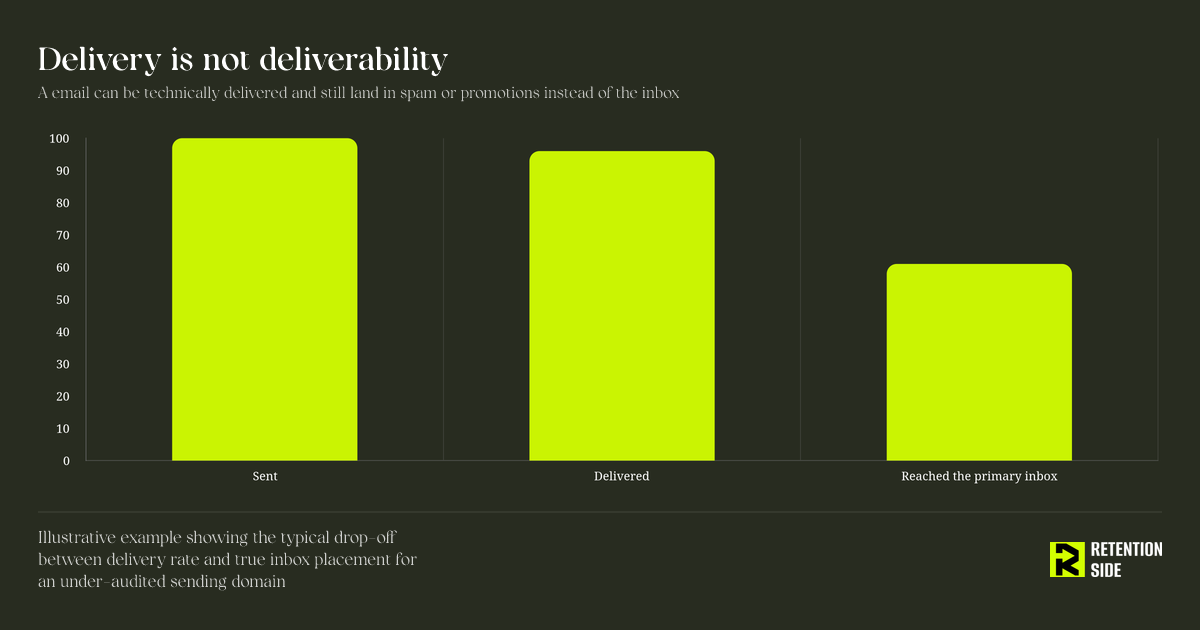
Delivery and deliverability get used interchangeably, and that’s the first thing to correct in any audit. Delivery means Klaviyo (or whatever ESP) technically handed the email off and it wasn’t bounced or blocked outright. Deliverability means the email actually reached a placement where the subscriber could see and act on it, the primary inbox, not the spam folder, not a promotions tab that nobody checks.
A brand can have a 98% delivery rate and a genuinely broken retention program, because half of those “delivered” emails are sitting in spam. Here’s what that drop-off typically looks like when domain reputation, authentication, or engagement-based sending haven’t been dealt with:
When we audit deliverability, we’re checking:
- Authentication setup: SPF, DKIM, and DMARC configured correctly, not just “present.” Misaligned DMARC policies are one of the most common silent killers we find.
- Sending domain health: whether the brand is sending from a dedicated subdomain, how long it’s been warmed, and whether reputation has degraded from past bad sends.
- Engagement-based suppression: whether Klaviyo (or the ESP in use) is still mailing unengaged profiles that haven’t opened in 90, 180, or 365 days, dragging down inbox placement for everyone else on the list.
- Placement testing: actual seed-list results across Gmail, Outlook, Yahoo, and iCloud, not just aggregate open rate, which Apple Mail Privacy Protection has made unreliable as a standalone signal.
Gmail and Yahoo’s bulk sender requirements changed the baseline for this. One-click unsubscribe, spam complaint thresholds under 0.3%, and authentication requirements are no longer optional extras, they’re gating criteria for inbox placement at scale. If a brand hasn’t audited against those requirements specifically, that’s very likely the first fix, before a single flow gets touched.
Audit flows before campaigns
Once sending health is confirmed, the next layer is flows, not campaigns. Flows are behavior-based and time-sensitive, which means they run whether anyone is paying attention or not. A broken flow bleeds revenue every single day it stays broken. A weak campaign only underperforms once.
The audit question here isn’t “is this flow copy good.” It’s “does this flow map to an actual customer journey stage, and is it catching the drop-off it’s supposed to catch.”
Most flow audits we run turn up the same handful of gaps:
- Welcome series that stops after one email. No second touch, no product education, no path toward first purchase for people who didn’t buy immediately.
- Abandoned cart and browse abandonment with no differentiation. Someone who added to cart and someone who viewed a product twice are not in the same intent state, but a lot of flow logic treats them identically.
- Post-purchase flows that only ask for reviews. Nothing about set-up, usage guidance, or the reasons customers actually churn after first purchase.
- No win-back or re-engagement flow at all. Or one that exists but hasn’t been touched since it was built, with the same 15% discount every lapsed customer sees regardless of purchase history.
- No sunset flow. Unengaged profiles keep getting mailed indefinitely, which drags deliverability down (see above) and inflates list size without inflating revenue.
The bigger point in an audit is this: flows are never finished. A flow that was built well 18 months ago and hasn’t been touched since is not a working flow anymore, it’s a snapshot of what worked under old traffic, old products, and old customer behavior. Part of what we do at Retention Side when we take over an account is treat every flow as a living hypothesis that needs re-testing, not a finished asset.
Check segmentation before you judge campaign performance
A lot of brands blame campaign strategy for underperformance when the real issue is that segmentation was never built well enough for campaigns to succeed in the first place.
If every campaign goes to “all subscribers” or a loosely maintained “engaged 90 days” segment, you’re not really running segmented lifecycle marketing, you’re running a newsletter. That’s fine for some brands at certain sizes, but at $300k+ a month, it’s leaving real revenue on the table because different segments need fundamentally different messages.
A retention audit should check whether segmentation reflects:
- Purchase behavior: first-time buyers, repeat buyers, high-AOV customers, and lapsed customers should not all see the same campaign cadence or offer structure.
- Product affinity: category or SKU-level segmentation, especially for brands with multiple product lines that don’t share a customer profile.
- Engagement recency: separating recently engaged subscribers from people who haven’t opened anything in six months, both for deliverability reasons and messaging tone.
- Predictive fields: whether Klaviyo’s predictive analytics (CLV, churn risk, next order date) are actually being used to segment, or just sitting unused in the platform.
Here’s where a lot of audits find the real story:
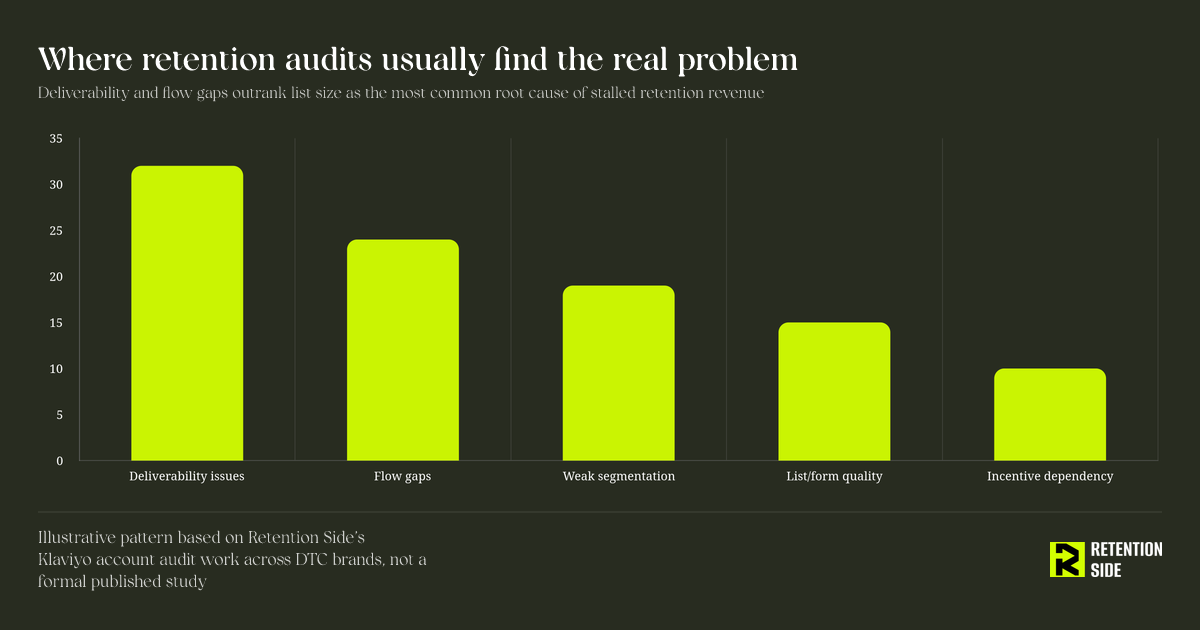
Deliverability and flow gaps tend to outrank list size as the actual blocker, which is exactly why chasing more subscribers before fixing those layers rarely moves revenue the way brands expect.
List quality over list size
Every brand wants a bigger list. Almost none of them ask whether the list they have is worth mailing.
Form submission rate is the metric most teams track, and it’s the wrong one to optimize an audit around. A high-converting popup that captures a 25% discount-seeker who buys once and never returns isn’t building retention value, it’s building acquisition cost disguised as a list-growth win. The number that actually matters is lead-to-customer rate: how many of the people captured on a form actually convert into paying, repeat customers.
When auditing list growth and forms, look at:
- Incentive structure: is the discount deep enough to convert but not so deep it trains every new subscriber to wait for a promo before buying at all?
- Form placement and friction: are forms interrupting the browsing experience in a way that hurts site conversion, even if it helps list growth?
- Post-signup behavior: what percentage of new subscribers actually open the welcome series, and what percentage convert within 30, 60, and 90 days?
- Source quality: subscribers acquired through a giveaway or co-marketing partnership almost always convert and engage worse than subscribers who signed up directly on-site. If a big chunk of the list came from a low-intent source, that explains a lot of “why is engagement so low” conversations before you even get to flows or campaigns.
Campaign cadence and incentive dependency
Once deliverability, flows, and segmentation are in reasonable shape, campaigns are worth auditing on their own terms. The most common issue here isn’t creative quality, it’s cadence and incentive dependency.
If a brand’s campaign calendar is 80% “sale” and 20% everything else, subscribers learn a behavior: wait for the discount. Full-price purchasing declines, average order value gets suppressed by promo codes, and margin erodes slowly enough that it doesn’t show up as an obvious problem until someone finally audits the send history and sees the pattern laid out across twelve months.
A campaign audit should map out:
- Promotional versus value-driven send ratio over the last two or three months, not just the last few weeks.
- Frequency by segment, since highly engaged customers can usually handle more volume than at-risk or newer subscribers.
- A/B testing coverage: is anything actually being tested, subject lines, send times, incentive depth, or is the calendar running on instinct and whatever worked last quarter?
- Revenue attribution by campaign type, separating flow-influenced revenue from pure campaign-driven revenue so the read isn’t distorted.
A/B testing isn’t a one-time project inside an audit, it’s a standing practice the audit should either confirm exists or flag as missing. Brands that test continuously across messaging, timing, incentives, and even flow logic tend to compound small wins in a way that shows up clearly over two or three quarters. Brands that don’t test rarely know why performance moved in either direction.
What retention can’t fix on its own
Part of a good audit is being honest about where the problem actually lives. A drop in email or SMS performance doesn’t always mean the retention system is broken. Sometimes it means:
- Acquisition quality shifted. A new ad channel or influencer partnership brought in lower-intent traffic that converts into subscribers who never really wanted the product.
- Website conversion changed. A site redesign, checkout friction, or page speed issue is suppressing conversion in ways that look like a retention problem downstream.
- Customer behavior shifted seasonally or economically. Category-wide slowdowns show up in retention metrics even when the retention program itself hasn’t changed.
- Cross-channel inconsistency. If paid social messaging, on-site experience, and email tone don’t match, customers notice, even if they can’t articulate why engagement feels off.
This is one of the reasons a retention audit at Retention Side never stops strictly at Klaviyo. Retention doesn’t operate in isolation, and treating it like it does leads to fixing the wrong layer entirely, over-optimizing subject lines when the real issue is that last month’s ad campaign brought in an audience that was never going to be a repeat customer.
Building the fix list in the right order
A finished audit isn’t a document full of observations, it’s a prioritized list ranked by dependency and revenue impact. The order we use, and recommend, generally looks like this:
- Deliverability and sending health. Fix this first because every other layer depends on emails actually reaching the inbox.
- Core flow architecture. Welcome, abandonment, post-purchase, and win-back, checked for gaps, not just copy quality.
- Segmentation foundation. Behavior, product affinity, recency, and predictive fields, since campaigns can’t be evaluated fairly on top of bad segmentation.
- List quality and incentive structure. Form conversion balanced against margin and lead-to-customer rate.
- Campaign cadence and testing practice. Promotional balance, frequency by segment, and whether testing is actually happening.
- Cross-functional context. Acquisition quality, site conversion, and whether retention is being asked to fix a problem that started somewhere else.
Fixing step five before step one is how brands end up rewriting campaign copy for months without moving the number that actually matters. The order isn’t arbitrary, it reflects what each layer depends on to work at all.
Where channel expansion fits
Once the core email and SMS system is actually healthy, an audit should also look at whether the channel mix matches the audience. Email is almost always where retention starts, but it’s rarely where it should end for a brand doing meaningful volume. Depending on audience behavior, communication preferences, and reach potential, that might mean SMS for time-sensitive flows, push notifications for app-based brands, direct mail for high-value customer segments, or WhatsApp and Viber for audiences in regions where those channels dominate over email and SMS.
This is a later-stage audit question, not an early one. Adding SMS or WhatsApp on top of a broken deliverability foundation just adds a second channel with the same underlying problems, more sending, more spend, same leaks. Channel expansion should be a response to a validated need, not a way to compensate for an email program that hasn’t been fixed yet. If you want a deeper breakdown of how to think about which channels actually belong in a retention mix, what channels make a good eCom retention strategy is worth reading alongside this audit framework.
How often to run this audit
A full retention audit isn’t a once-a-year exercise for a brand growing at any real pace. Deliverability standards shift (Gmail and Yahoo’s 2024 requirements are a good example of a change that broke programs overnight for brands that hadn’t kept up). Flows age as product lines and customer behavior shift. Segmentation that worked at $200k a month often needs rebuilding at $500k a month because the customer base has diversified.
A reasonable cadence:
- Deliverability checks: monthly, lightweight, just confirming authentication and complaint rates are still in range.
- Flow audit: quarterly, checking for gaps and outdated logic against current product and customer behavior.
- Segmentation and list health: quarterly, alongside the flow audit since they’re closely linked.
- Full audit including campaigns and cross-functional review: twice a year, or whenever growth stage changes meaningfully (new product line, new market, big shift in acquisition strategy).
Conclusion
An eCommerce retention audit is only useful if it’s ordered correctly. Deliverability first, because nothing else matters if emails aren’t reaching the inbox. Flows next, because they run continuously and compound problems quietly. Segmentation and list quality after that, because campaigns can’t be fairly judged on top of a weak foundation. Campaign cadence and incentive dependency after the foundation is solid. And throughout all of it, an honest look at whether the real problem is even inside retention at all, or whether it’s coming from acquisition, the website, or shifting customer behavior.
Brands that audit in this order fix the right things first and stop wasting cycles polishing subject lines while the actual leak sits underneath, unaddressed. That’s the difference between an audit that produces a document and one that produces measurable revenue from existing customers.