

Most brands running Klaviyo think they are personalizing because a first-name tag shows up in the subject line. That is not personalization. That is a mail merge. Real Klaviyo personalization uses purchase history, browsing behavior, predicted lifetime value, product affinity, and lifecycle stage to change what a customer sees, when they see it, and through which channel. The difference shows up directly in revenue per recipient, and it compounds every month you run it.
We work inside Klaviyo accounts every week for brands doing well past $300k a month, and the pattern is always the same. The accounts with strong personalization are not the ones with the most flows or the fanciest email design. They are the ones where segmentation, data properties, and content logic are built to match how a specific customer actually behaves, not how the average customer behaves.
Key takeaways
- Personalization starts with data structure, not email design. If your Klaviyo properties, custom fields, and event data are messy, no amount of dynamic content will fix it.
- Segmentation is the actual personalization engine. Dynamic content blocks only work as well as the segments and conditional logic feeding them.
- Lifecycle stage matters more than product category for most personalization decisions. A first-time buyer and a fifth-time buyer need different messaging even when they buy the same product.
- Predictive Klaviyo features like CLV, churn risk, and predicted next order date give you personalization triggers that behavior alone cannot.
- Personalization should extend past email. SMS, push, and even direct mail should reflect the same customer data instead of resetting the conversation.
- Over-personalizing without deliverability discipline backfires. Complex conditional logic means nothing if the email lands in spam or promotions.
What we’ll cover
This article walks through how to build a Klaviyo personalization strategy from the data layer up: the foundational data work, segmentation as the real engine behind personalization, when to use dynamic content versus separate flows, lifecycle-based personalization, Klaviyo’s predictive tools, cross-channel consistency, common mistakes, and how to measure whether personalization is actually working.
Why personalization in Klaviyo is not just first-name tags
Klaviyo gives you access to an enormous amount of customer data by default: every product viewed, every cart built and abandoned, every order placed, every category browsed, plus whatever custom properties you push in from your product data, quiz results, loyalty tier, or subscription status. Most of that data sits unused.
The brands that treat Klaviyo as an email tool rather than a customer data platform end up personalizing the wrong layer. They personalize tone and design, but the underlying message stays generic. A customer who bought a men’s running shoe and a customer who bought a women’s yoga mat get the same “shop new arrivals” campaign with a different name swapped in.
Personalization that actually moves revenue changes the substance of the message: which products are shown, which incentive is offered, which flow the customer enters, and how urgently the brand follows up. McKinsey’s research on personalization found that companies excelling at it generate 40 percent more revenue from personalization activities than slower-growing counterparts, with personalization typically driving 10 to 15 percent revenue lift across sectors. That requires building on top of clean data and well-structured segments, which is exactly where most Klaviyo accounts fall short before they ever touch dynamic content.
The personalization foundation: data before design
Before building a single personalized flow, audit what data Klaviyo actually has access to. This means checking:
- Whether product catalog data (category, tags, price tier, collection) is synced correctly so you can reference it in flows and dynamic blocks.
- Whether custom properties like predicted gender, preferred category, loyalty tier, or subscription status are populating reliably, not just for a subset of profiles.
- Whether your event tracking captures the behaviors that actually predict purchase intent, such as “Viewed Product,” “Added to Cart,” “Started Checkout,” and any custom events tied to quizzes, sizing tools, or account activity.
If this foundation is shaky, personalization becomes guesswork. A dynamic content block that references “last viewed category” is worthless if that property is empty for 40% of your list. This is the unglamorous part of Klaviyo personalization, but it is also the part that determines whether everything built on top of it actually works. It ties directly into how you set up Klaviyo email marketing for ecommerce brands in the first place. Personalization is not a feature you bolt on later. It is a natural extension of a properly built account.
Segmentation is the real personalization engine
Dynamic content and conditional logic get most of the attention, but segmentation is what actually determines whether a customer gets the right message at all. You can have beautifully designed dynamic blocks, and they will still fail if the segment feeding them is too broad or built on the wrong signal.
Think about segmentation in terms of intent and stage, not just demographics. A useful Klaviyo segmentation strategy for personalization usually separates customers by:
- Purchase recency and frequency, separating first-time buyers, repeat buyers, and lapsing customers.
- Category or product affinity, based on what they have actually purchased or repeatedly viewed.
- Engagement level, separating highly engaged subscribers from those who open occasionally, since these groups need different frequency and different incentive levels.
- Predicted value, using Klaviyo’s CLV or your own scoring to separate high-value customers who deserve a different experience from low-margin, price-sensitive buyers.
This is the same thinking we lay out in our piece on Klaviyo segmentation strategy for ecommerce, and it applies directly to personalization. If your segmentation only exists as an “engaged 90 days” bucket and a loose VIP list, your personalization ceiling is low no matter how advanced your dynamic content setup looks. Brands that want to go further should look at advanced Klaviyo segmentation built around behavioral scoring and layered conditions, since that is what makes true 1:1 personalization possible at scale instead of just personalization in theory. For brands just starting to think beyond basic list splits, our ecommerce email segmentation guide covers the foundational segments every program needs before attempting anything advanced.
Dynamic content blocks vs separate flows: when to use each
Once segmentation is solid, the next decision is mechanical: do you personalize inside a single flow using dynamic content and conditional splits, or do you build separate flows for separate segments?
Dynamic content blocks make sense when the underlying message and structure stay the same but the specifics change. A post-purchase flow, for example, can use dynamic blocks to swap in category-specific care instructions, cross-sell products, or replenishment timing without needing five separate flow versions.
Separate flows make more sense when the customer’s journey itself is genuinely different, not just the content within it. A first-time buyer welcome flow and a win-back flow for lapsed VIPs should not be variations of the same flow with conditional splits. The timing, tone, and goal are different enough that forcing them into one structure with heavy branching creates a maintenance mess and makes testing nearly impossible to interpret.
A good rule: if you find yourself building more than three or four levels of nested conditional splits inside a single flow to handle personalization, it is usually a sign you actually need two flows, not one overly complicated one. For a broader look at how to structure these automations across the full customer journey, our guide to the best Klaviyo flows for ecommerce covers where each flow type fits and how to avoid the overlap problems that come with running too many parallel sequences.
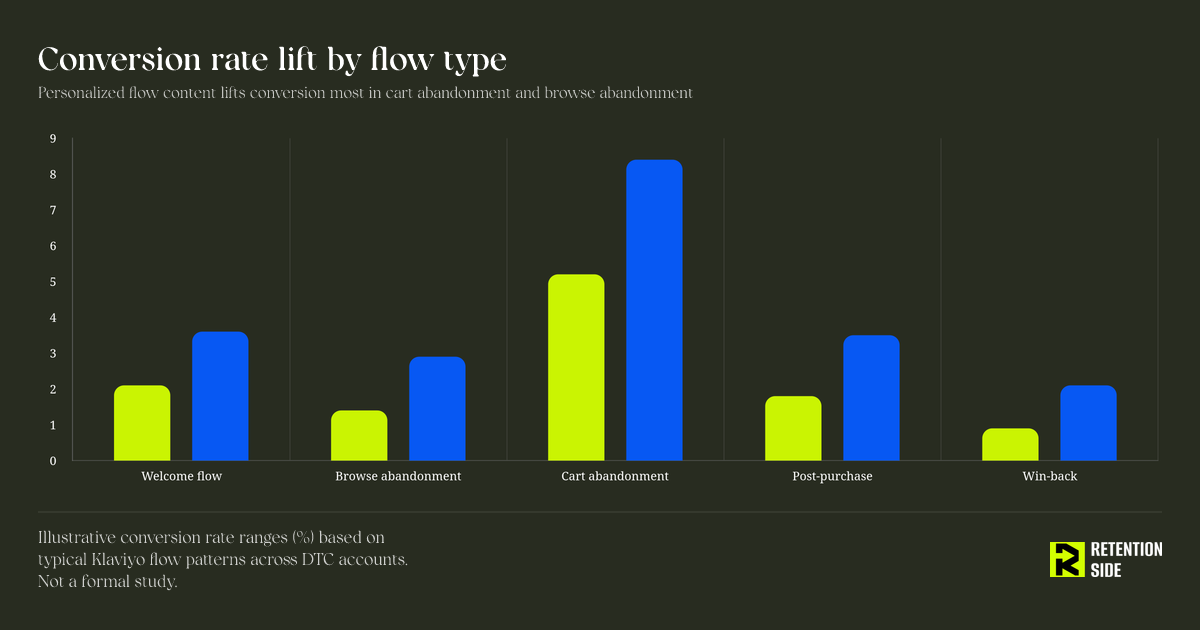
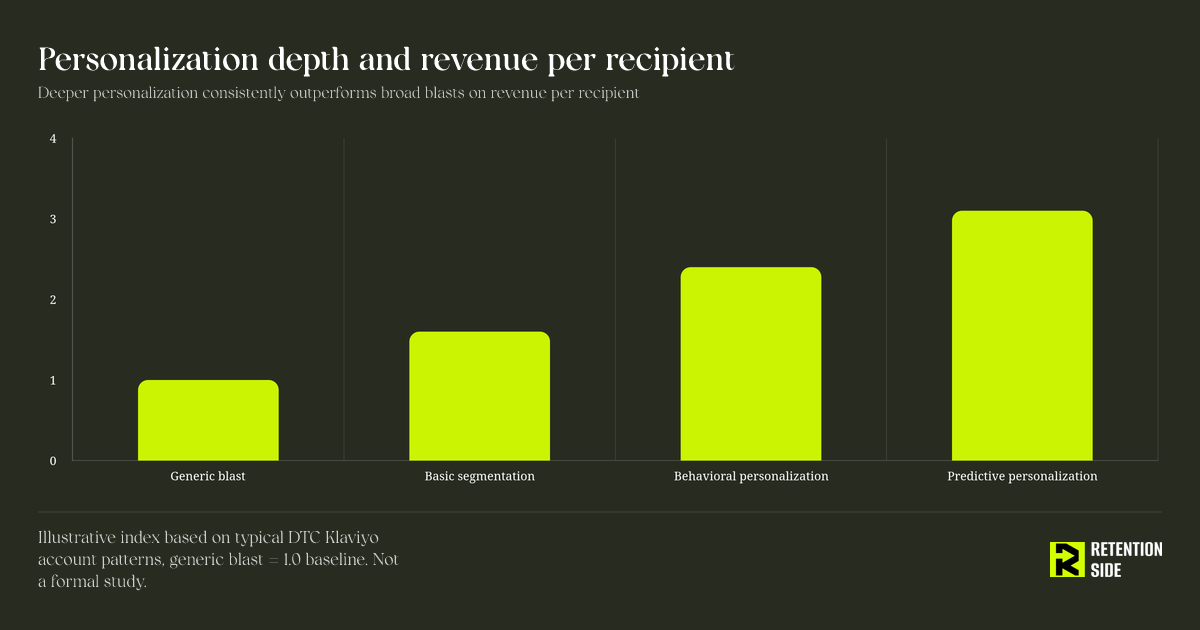
The revenue difference between generic and personalized versions of the same flow type is not subtle. Klaviyo’s own analysis of 2.5 billion emails found nearly 2x the open and click rates and 3x the revenue per recipient on segmented sends compared to blasts. It shows up most clearly in flows tied to strong purchase intent, like cart abandonment, where a personalized reminder referencing the actual product outperforms a generic “you left something behind” email by a wide margin. Klaviyo’s abandoned cart benchmark data puts the average revenue per recipient for abandoned cart flows at $3.65 — the highest RPR of any flow type — which is what makes personalizing within that flow so high-leverage.
Personalizing by lifecycle stage, not just by product
Most brands default to personalizing by product category because it is the easiest data to access. Lifecycle stage personalization is harder to build but usually matters more.
A first-time buyer needs education, trust-building content, and a reason to come back — which is why a well-built welcome email series does far more than deliver a discount code. A second or third-time buyer already trusts the brand and responds better to efficiency: faster paths to reorder, relevant cross-sells, loyalty status. A lapsing customer, someone who used to buy every 60 days and hasn’t ordered in 120, needs a different message entirely, often one that acknowledges the gap rather than pretending it’s a standard promotional touchpoint. That is where a structured win-back email campaign earns its keep — not by blasting a discount, but by matching the reactivation message to how much history the customer actually has with the brand.
Klaviyo makes this possible through predicted next order date and historic order data, which lets you build flows and campaign segments around where someone actually sits in their relationship with the brand, not just what they bought once. This is also where campaign strategy and flow strategy need to work together. If your campaigns only target “engaged 90 days” without layering in lifecycle stage, you end up sending a lapsing high-value customer the same generic sale email as a brand-new subscriber who signed up yesterday, and neither message lands the way it should.
Predictive analytics and Klaviyo’s built-in personalization tools
Klaviyo’s predictive analytics, customer lifetime value, predicted next order date, expected date of next order, and churn risk indicators, give you personalization triggers that pure behavioral data cannot. Behavioral data tells you what someone did. Predictive data tells you what is likely to happen next, which is far more useful for timing personalized outreach.
Understanding customer lifetime value for ecommerce matters here because CLV is not just a dashboard number — it is a segmentation and personalization input that determines how much resource each customer deserves.
Practical ways to use these fields:
- Trigger a replenishment or win-back touchpoint a few days before a customer’s predicted next order date rather than on a fixed 30/60/90 day schedule that ignores individual buying rhythm.
- Route customers with high predicted CLV into a different post-purchase experience, one with more personal service touches and less discount pressure, since discounting high-value customers early often costs more in margin than it returns in incremental revenue.
- Use churn risk scoring to identify customers worth a save attempt (a phone call, a personal email from a founder, a meaningful offer) versus customers where a standard win-back flow is the more efficient choice.
This is where personalization stops being about swapping product images and starts being about resource allocation: deciding which customers deserve more expensive, higher-touch treatment and which are better served by efficient automation.
Cross-sell and post-purchase personalization
Post-purchase is one of the highest-leverage places to personalize because you have the most data at exactly the moment a customer is most receptive to another purchase. Generic “you might also like” blocks based on bestsellers underperform recommendations built from actual purchase patterns, category logic, and timing.
A well-built cross-sell email strategy uses the first purchase to determine not just what to recommend, but when to recommend it. A consumable product justifies a replenishment-timed cross-sell. A durable good justifies an accessory or complementary product recommendation instead, sent once the customer has had enough time to actually use and trust the original purchase. Personalization here isn’t only about the product shown, it’s about matching the offer to the product’s natural repurchase cycle. For the full architecture of how to sequence these touches after the first order, our guide to the post-purchase email flow breaks down the education, cross-sell, review, and second-purchase bridge stages in detail.
Cross-channel personalization: keeping the story consistent
Email is usually the entry point for Klaviyo personalization, but treating it as the only channel creates a disconnect that customers notice. If a customer gets a personalized email referencing their loyalty tier, then receives a generic SMS blast an hour later about a sale that doesn’t apply to them, the brand experience feels disjointed rather than considered.
Strong retention systems extend the same data and logic across SMS, push notifications, and where relevant, direct mail, WhatsApp, or Viber. The channel changes based on urgency, cost, and customer preference, but the underlying personalization logic, who this customer is, what they’ve bought, where they sit in the lifecycle, should stay consistent. A cart abandonment flow might start with a personalized email, escalate to an SMS referencing the specific product if there’s no response, and stop there rather than repeating the same generic message across every channel available.
This is the same thinking that applies to building a retention system for ecommerce: match the channel to the audience’s actual behavior and preferences rather than adding channels because they’re available. If you’re building this out on Shopify specifically, it connects directly to how you structure a broader Shopify email marketing strategy that treats email, SMS, and other channels as one system instead of separate silos each doing their own thing.
Common personalization mistakes that hurt deliverability and revenue
Personalization done poorly creates real problems, not just missed opportunity:
- Over-segmenting to the point of tiny, unstable segments. A segment of 40 people gets statistically meaningless results and wastes the time spent building custom content for it.
- Ignoring deliverability while adding complexity. Highly personalized emails sent to a poor-quality or unengaged list still land in spam. Personalization does not fix a deliverability problem; a strong sender reputation and clean list hygiene do. Delivery and deliverability are not the same thing, and no amount of dynamic content changes whether the message actually reaches the inbox.
- Personalizing content but not incentive strategy. Sending a highly tailored product recommendation with the same generic 10% off code everyone gets undercuts the personalization. High-value or highly engaged customers often don’t need a discount at all; a lapsing price-sensitive customer might need one to come back.
- Treating personalization as a one-time build. Flows built with dynamic content two years ago based on old product data or outdated customer scoring quietly become stale. Personalization logic needs the same ongoing testing and review as any other part of the retention system.
- Assuming more personalization is always better. There’s a point where added complexity produces diminishing returns and makes testing and troubleshooting nearly impossible. Simpler, well-targeted personalization usually outperforms an overengineered system nobody fully understands anymore.
Testing personalization: what to measure beyond open rate
Open rate tells you almost nothing about whether personalization is working, especially with Apple Mail Privacy Protection inflating opens across the board — Litmus reports over 50% of email opens now happen on devices with MPP activated, making open data unreliable as an engagement signal. The metrics that actually indicate personalization is paying off:
- Revenue per recipient, segmented by personalization level, so you can compare a generic version of a flow or campaign against a personalized one on the same audience.
- Click-to-conversion rate, which shows whether the personalized content is actually relevant enough to drive a purchase once someone engages, not just whether it got a click.
- Repeat purchase rate by segment, tracking whether personalized post-purchase and lifecycle flows are actually increasing how often customers come back, not just whether a single flow performed well once.
- Unsubscribe and spam complaint rate by personalization variant, since over-personalized or poorly targeted content (referencing the wrong product, the wrong lifecycle stage) can increase complaints even when it increases short-term clicks.
A/B testing should be continuous here, not a one-time exercise. The same principles that drive Klaviyo flow optimization apply to personalization: test personalized versus generic versions of the same flow on a rolling basis, because what worked a year ago may not hold as your customer base, product mix, or acquisition channels shift. If personalized performance starts dropping, it’s worth checking whether the issue is the personalization logic itself or something upstream: traffic quality, list health, or a shift in who’s actually buying from the brand.
How Retention Side approaches Klaviyo personalization
We start every account the same way: audit the data layer before touching flow logic. Most personalization problems we inherit from brands aren’t creative problems, they’re data structure problems. Custom properties that stopped syncing eighteen months ago. Catalog feeds missing category tags. Predicted CLV never turned on. Fixing that groundwork first is what makes everything downstream, segmentation, dynamic content, cross-channel sequencing, actually work as intended.
From there, we build personalization to match how a specific brand’s customers actually behave, not a generic template applied across every account we touch. A replenishable consumable brand needs personalization built around purchase cycles and predicted next order date. A considered-purchase brand selling durable goods needs personalization built more around education, trust, and post-purchase confidence. The mechanics in Klaviyo are similar across both, but the logic driving them should never be identical. If you want to understand the full scope of what this kind of work involves, our piece on what a Klaviyo email marketing agency actually does covers the audit, build, and optimization process end to end.
Conclusion
Klaviyo personalization strategies work when they’re built on real data structure and genuine segmentation, not surface-level name tags or generic “you might like” blocks. The brands seeing real lift from personalization treat it as a system: clean data feeding meaningful segments, segments driving both flow logic and campaign targeting, and consistency carried across email, SMS, and whichever other channels fit the audience. None of it works in isolation from the rest of retention, and none of it replaces the fundamentals of deliverability and list health that determine whether a personalized message even gets seen.
Treat personalization as an ongoing build, not a project with an end date. Revisit the data feeding it, retest the logic driving it, and keep it tied to how your actual customers behave rather than how you assumed they would behave when you first built the flow.