

Most eCommerce brands treat promotional email as a default. There is a sale coming – send an email. Revenue is slow – add a discount and send an email. BFCM arrives – send seven emails in five days and call it a campaign.
The mechanics are not wrong. Promotional emails do generate revenue. The problem is what happens when they become the entire strategy. Subscribers get conditioned to wait for discounts. Full-price purchase rates drop. List engagement erodes. And because performance looks reasonable during sale periods, nobody questions the model until the list starts burning out.
Building a promotional email strategy that actually works requires more than knowing when to send a discount. It requires understanding when promotion is the right lever, when it is not, and how to make the whole thing sit inside a broader email system that serves retention rather than undermining it.
Key takeaways
- Promotional emails are one tool in a broader campaign strategy. Relying on them as the default cadence trains customers to wait for discounts and erodes full-price purchase behavior over time.
- The four pillars of a strong email program – deliverability, list growth, automation (flows), and campaigns – all need to work together for promotional sends to land with impact.
- The right promotional cadence depends on your niche, your margin structure, and your customer purchase cycle – not on what your competitors are sending.
- Segmentation determines who receives a promotional email, not just who gets excluded. Sending a discount to a customer who just bought at full price is a strategic error, not a neutral send.
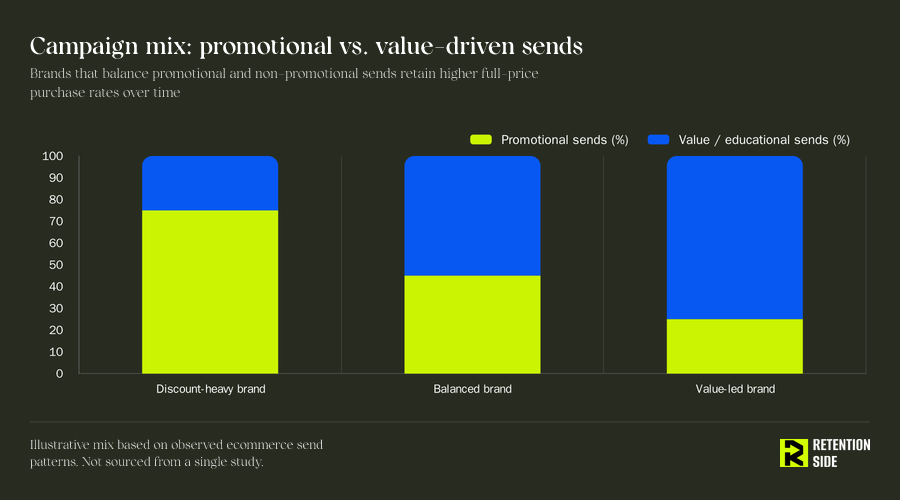
- Promotional campaigns and value-driven campaigns work best together. A list that only hears from you when there is a discount will increasingly only respond when there is a discount.
- Tracking repeat customer rate and revenue attributed to retention channels gives you more useful signal than open rate ever will.
What we will cover
- Why promotional email fails when it becomes the whole strategy
- How the four pillars shape your promotional program
- The campaign types that belong in your send calendar
- How to build a promotional cadence without conditioning your list
- Segmentation logic for promotional sends
- How flows and campaigns interact
- The role of deliverability in whether promotions land
- Metrics that tell you whether your strategy is working
Why promotional email fails when it becomes the whole strategy
A promotional email works because it creates urgency or perceived value around a specific moment. The subscriber either needs what you are selling, or the offer is compelling enough to close the gap. That logic holds for any single send. Where it breaks down is when it becomes the rhythm.
When promotional emails are the majority of what a subscriber receives, a few things happen.
First, they stop reading the non-promotional ones. If nine of your last ten emails contained a discount or sale announcement, subscribers learn that the signal for “worth opening” is “offer inside.” Emails without that signal get deprioritized.
Second, they learn to wait. Customers who have bought from you three or four times exclusively during promotional periods have been trained. They experience a desire for your product and then wait – because the data tells them a discount is coming. Over 12 months, this shows up as lower full-price order frequency and higher discount dependency.
Third, the list fatigues faster. Subscribers who feel a brand is constantly pushing them to buy eventually tune out or unsubscribe. The correlation between heavy promotional cadence and accelerating list churn is something we see consistently across brands we audit.
None of this makes promotional emails the enemy. It makes indiscriminate promotional cadence the enemy. The difference is strategic intent.
How the four pillars shape your promotional program
There are four pillars every strong eCom email program rests on, and your promotional strategy only performs well when the other three are in shape.
Deliverability
This one is upstream of everything. A promotional email that lands in spam is not a promotional email – it is invisible. Deliverability means inbox placement, not just successful transmission. Your sender reputation, authentication setup (SPF, DKIM, DMARC), list hygiene, and engagement health all determine where your emails land.
Heavy promotional sending can actively hurt deliverability if it reaches disengaged segments. Gmail and Yahoo both require bulk senders to authenticate every message with SPF, DKIM, and DMARC and to keep spam complaint rates under 0.3%, and both use engagement signals to sort incoming mail against those thresholds. A subscriber who has not opened your last 20 emails but keeps receiving promotions is a liability to your sender reputation, not a revenue opportunity.
List growth
The subscriber base feeding your promotional campaigns has a quality dimension most brands underestimate. A form that converts traffic at a high rate but attracts primarily discount hunters builds a list that will respond to promotions and ignore everything else.
The real KPI for list growth is not submission rate. It is lead-to-customer rate: the percentage of new subscribers who actually make a purchase. A smaller, higher-intent list will outperform a large, incentive-bloated one on promotional sends – and will respond to non-promotional content too. We saw this pattern directly in our Hedonism Wines engagement: a 100,000+ subscriber list sat underperforming for years and only started converting once hygiene and segmentation were applied together.
Automation (flows)
Flows are behavior-triggered automations that run continuously: welcome sequences, abandoned cart and checkout series, post-purchase onboarding, cross-sell and up-sell sequences, browse abandonment, and winback flows triggered around the time a customer would historically be expected to repurchase. These are distinct from campaigns. They fire based on what a customer does, not based on a date you chose.
The relationship between flows and campaigns matters for promotional strategy. Flows handle the high-intent moments in the customer journey. Campaigns handle the broadcast moments. Neither replaces the other. The mistake is treating promotional campaigns as the primary revenue driver when flows have not been properly built.
Campaigns
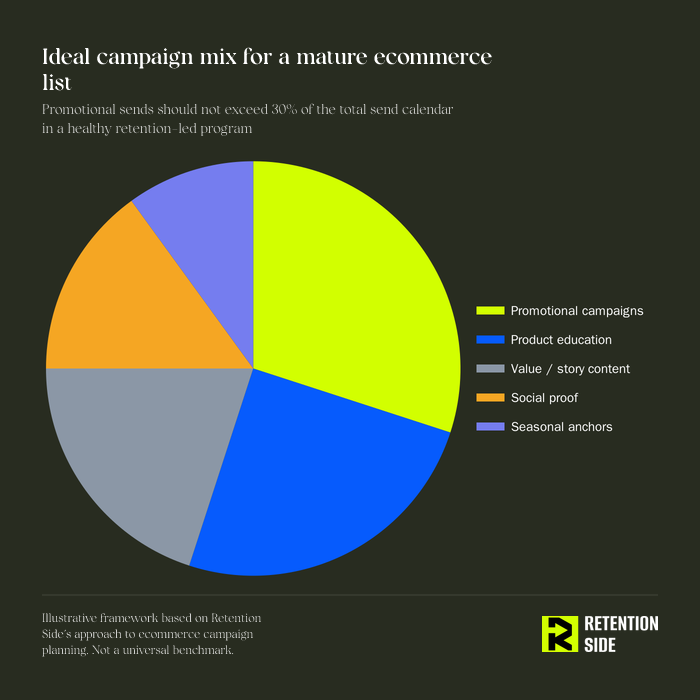
This is where your promotional strategy lives. But campaigns are not just promotional sends. Product launches, educational content, social proof, seasonal relevance, and brand storytelling are all campaign types. Promotional campaigns are one layer of a broader campaign calendar – not the foundation everything else hangs from.
The campaign types that belong in your send calendar
A mature email program has a campaign mix, not a promotional calendar with filler content in between.
Promotional campaigns
These are your discount announcements, flash sales, time-limited offers, bundle deals, and free-shipping thresholds. They work well when the subscriber has not purchased recently and is showing signs of drift, when there is a genuine commercial moment such as a product launch or seasonal relevance, and when the offer is targeted at a segment where it is actually additive.
Promotional campaigns should be a deliberate percentage of your calendar, not the default. The right ratio depends on your category. Apparel brands operate in a different context than supplement or kitchenware brands. Higher-margin categories can absorb more promotional frequency than lower-margin ones, and high-replenishment categories like supplements or skincare can lean into urgency without training customers to wait because the need recurs on its own.
Product launch campaigns
One of the cleanest promotional angles in eCom is a new product. There is no discount required – the novelty itself is the offer. A well-structured launch sequence (tease, early access, launch day, social proof follow-up) can generate significant revenue while reinforcing the brand rather than conditioning the list.
If you have a product roadmap, build your campaign calendar around it. Launches give you recurring promotional moments with a clear reason to exist that is not just “we need revenue this week.”
Educational and value-driven campaigns
These are emails that teach the subscriber something useful or give them practical value relevant to your product category. A skincare brand explaining ingredient synergies. A coffee brand walking through its sourcing process. A fitness equipment brand building a home workout routine.
These sends keep the relationship active between purchase cycles. They maintain engagement and inbox placement health. They build the authority that makes your promotional sends more believable when they arrive. They also prevent the subscriber from learning that the only reason you email is to sell.
The brands with the best long-term email performance mix educational sends into the calendar consistently, not just when they have run out of promotional angles.
Social proof campaigns
Reviews, customer stories, before-and-after results, user-generated content – these are underused campaign types with strong conversion value. Social proof campaigns work especially well after a promotional period, when you want to keep the list engaged without another discount, and in pre-launch warm-up sequences where you are building credibility before asking for a purchase.
Seasonal and lifecycle anchor campaigns
These are the commercial moments already on your customers’ radar: gift-giving periods, back-to-school, new year, summer. They warrant promotional sends because the context already exists. The subscriber is already in buying mode. Your job is to be the obvious choice at the right moment.
The important discipline is not building your entire calendar around these moments. Brands that only show up during peak retail periods see engagement collapse in the gaps between them.
Building a promotional cadence without conditioning your list
Start with the non-promotional sends
The most effective way to break discount dependency is to earn non-discount engagement first. If your list can sustain a weekly cadence with two or three non-promotional sends per month and see acceptable performance, you have a healthy baseline. Promotional sends layered on top of that will outperform promotional sends that are the only thing keeping your engagement alive.
Build the educational, social proof, and product content pipeline before optimizing your promotional calendar. Not because promotions do not matter, but because they land harder when they are not the only thing your list has heard from you.
Anchor promotions to genuine reasons
The strongest promotional emails have a reason beyond “we want revenue.” That reason can be a real inventory situation, a commercial calendar anchor, a product launch or restock, a customer lifecycle milestone like a birthday or purchase anniversary, or a limited production run.
Manufactured urgency works once. The second time, subscribers have seen it before. The tenth time, it is a pattern they have learned to discount.
Vary the offer structure
Discounts are one promotional mechanic. Others include free gift with purchase, bonus loyalty points, bundle deals that preserve per-unit margin while increasing average order value, free shipping thresholds, early access for subscribers, and referral incentives.
Varying the offer type keeps the experience fresher and gives you flexibility on margin. A free shipping threshold over a certain order value often drives as much conversion as a percentage discount while costing significantly less.
Set spacing between promotions
Leaving meaningful space between promotional sends is non-negotiable regardless of category. Consecutive weeks of promotional sends train the list to expect weekly offers. The moment you stop, engagement drops because the pattern was the draw.
As a directional principle: the more you send promotionally, the more important non-promotional sends become. They maintain the subscriber sense that there is value in your emails beyond deals.
Segmentation logic for promotional sends
Segmentation is where promotional strategy gets precise. Sending a 20% discount to your entire list is not a promotional strategy – it is a margin cost distributed equally across customers who did not need the incentive and customers who might have converted without it.
Who needs the push
First-time buyers who have not repurchased yet are a natural target for a well-timed promotional nudge. The incentive can help close the second purchase, which is the most important conversion in the customer lifecycle. Customers who bought once and have not been back in 60-90 days are another segment where a promotional offer has genuine strategic logic.
A customer who ordered two weeks ago at full price does not need a discount. Sending them one confirms they overpaid. That is a trust and perceived-value problem.
Who should be excluded
Excluding recent purchasers from promotional campaigns is basic practice, but there are subtler exclusions worth building in. Subscribers currently inside a post-purchase flow are already receiving targeted communication – a broadcast promotion creates message overlap. Customers approaching a natural replenishment window benefit more from a replenishment reminder than a generic discount. VIP customers on high average order value or high purchase frequency respond to early access and exclusivity better than to standard discounts.
VIP vs. general list treatment
Your highest-value customers deserve a different promotional experience than new subscribers. VIP-tier promotional campaigns typically work better with early access framing than with standard discount mechanics. The incentive is status and exclusivity, which preserves the brand relationship in a way that a blanket percentage discount does not.
RFM-based promotional logic
Recency, Frequency, and Monetary value give you a practical matrix for promotional segmentation. Champions (recent, frequent, high-value buyers) do not need discounts – they need new products and exclusivity. At-risk customers (previous buyers who are drifting) benefit from a promotional incentive because the goal is re-engagement. Dormant subscribers with extended inactivity should be in a reactivation sequence or heading toward suppression, not receiving your standard promotional calendar.
Building promotional campaigns around RFM logic instead of list-wide sends immediately improves both the conversion math and the margin math.
How flows and campaigns interact
The promotional email strategy question is incomplete without understanding how it fits next to your automated flows. They are different layers of the same program, and when one is weak, the other compensates – usually in ways that hurt the overall system.
Flows fire based on behavior. When a customer abandons a cart, the abandoned cart sequence goes out automatically. When they complete a purchase, the post-purchase flow starts. When they cross a replenishment threshold based on their average purchase cycle, a winback flow triggers. These happen independently of your campaign calendar.
Campaigns fire based on your decision. They go to a segment you define, on a date you choose, with a message you write for that moment.
The interaction risk is overlap. A subscriber who just triggered an abandoned cart flow and simultaneously lands on your weekly promotional broadcast is receiving two emails that may contain conflicting incentives. If the cart flow has no discount and the campaign does, you have undermined the flow conversion path and introduced a discount that did not need to be there. Smart skip logic – filtering out subscribers currently in active high-intent flows from receiving broadcast promotions – prevents this.
A strong flow architecture means your promotional campaigns can afford to be less aggressive, because the behavior-triggered automations are already doing the heavy lifting on conversion moments. Brands with underbuilt flows often over-rely on promotional campaigns to compensate – and that is the pattern that leads to discount conditioning.
Cross-sell and up-sell flows deserve specific mention here. These automated sequences, triggered after a purchase when behavioral data tells you which complementary products are most relevant, are among the highest-converting revenue touchpoints in a mature Klaviyo program. They do promotional work – surfacing products, driving incremental purchases – without requiring a calendar promotional send. That frees up your campaign calendar for genuine seasonal moments rather than filling it with cross-sell offers that a flow handles better.
The role of deliverability in whether promotions land
Promotional campaigns are particularly exposed to deliverability risk because they go to larger segments. They are not the tightly filtered behavioral sends that flows produce. They are broadcast sends, often to thousands of subscribers who may include a meaningful percentage of disengaged profiles. Every disengaged subscriber you send to degrades the engagement signal you are sending to Gmail, Yahoo, and Apple Mail. That signal shapes where your emails land.
Your promotional sends should exclude disengaged subscribers by default – not as a nice-to-have, but as a standard filter. Running campaigns against an engaged-only segment protects sender reputation while also improving the performance metrics that actually matter.
One distinction worth making clearly: suppressing disengaged subscribers from promotional sends is not the same as running a sunset flow. Sunset flows are a list hygiene tool – they attempt one last re-engagement before permanently suppressing profiles that have been unresponsive over an extended period. Their purpose is deliverability protection, not revenue generation.
Keeping deliverability healthy is what allows your promotional emails to actually reach the people you are trying to convert. Without it, the best-planned promotional calendar generates nothing.
Metrics that tell you whether your strategy is working
Promotional email performance is often measured against the wrong benchmarks. Open rate and click rate tell you about inbox behavior in the moment. They do not tell you whether your promotional strategy is building a healthy business or eroding it.
Repeat customer rate
This is the most direct signal of whether your email program is building retention or just capturing one-time transaction value. If your promotional strategy is conditioning customers to buy only during sales, you will see this in a repeat customer rate that is acceptable in the fourth quarter and weaker during the rest of the year. Tracking this metric monthly reveals the actual pattern.
Revenue attributed to retention channels
What percentage of your total store revenue is being driven by returning customers across your owned channels? A promotional strategy that is working builds this number over time. A promotional strategy that is burning the list might show strong short-term email revenue while the underlying retention rate is declining.
Lead-to-customer rate
If your promotional emails are attracting subscribers who only convert during promotions, your lead-to-customer rate for non-discount periods will be low. That tells you something important about audience quality that will not show up in any campaign-level report.
Average time between orders
If your promotional calendar is creating urgency that pulls forward purchases but is not increasing overall purchase frequency, this metric exposes it. A well-built promotional strategy, combined with a strong flow architecture, should shorten the average repurchase window over time because customers are more engaged with the brand – not just responsive to individual offers.
What not to track as a KPI
Open rate is not a meaningful promotional performance benchmark. Apple Mail Privacy Protection inflates it for most lists – Apple Mail has accounted for roughly half of all email opens historically, and MPP pre-loads tracking pixels for every recipient on delivery regardless of whether the message is actually opened, so a spike in “opens” often reflects nothing more than inbox placement. Revenue per recipient is particularly dangerous as a promotional strategy metric – it pushes toward optimizing individual sends rather than building a sustainable retention system.
Promotional email as part of the broader retention system
Email is where most eCommerce retention strategies start, and for good reason. It is the widest reach, the lowest cost, and the most versatile channel you own. But promotional email strategy does not exist in a vacuum.
When you add SMS to the mix, the coordination question becomes real. A customer who receives a promotional campaign via email and then gets the same offer via SMS two hours later is not experiencing amplification – they are experiencing repetition. The channels need to play distinct roles. Email for the full-context promotional send; SMS for the time-sensitive nudge when urgency is genuinely high and the window is short.
Loyalty programs change the promotional calculus entirely. A customer with a meaningful points balance or an active tier status has a reason to buy that is not a discount. For these customers, the promotional email might not need a discount at all – surfacing how close they are to a reward, or offering a double-points event, creates conversion incentive without the margin cost.
Direct mail can amplify your highest-stakes promotional moments. A physical mailer for a VIP early-access offer or a major product launch sits in a mailbox rather than an inbox, reduces the noise, and creates a different kind of brand impression. It is the most expensive channel in the retention mix on a per-unit basis, so it belongs in high-value targeted scenarios – not broad promotional calendar sends.
As a brand’s retention system matures, the promotional email strategy becomes less about maximizing extraction from each send and more about knowing which moments in the customer journey warrant a promotional message and which ones are better served by a different kind of communication.
Conclusion
A promotional email strategy is not about finding the most effective way to discount. It is about understanding when promotional incentives create genuine value in the customer relationship and when they erode it.
The brands that build sustainable email revenue do not send fewer promotional emails than average – they send more intentional ones. They know which segments need a push and which do not. They anchor promotions to real reasons rather than manufactured urgency. They build educational and value-driven sends into the calendar so that promotional moments land in a context of trust rather than noise. And they measure what actually matters – repeat customer rate, retention revenue, time between orders – rather than optimizing for the metrics that look good on a dashboard.
The four pillars of a strong email program – deliverability, list growth, flows, and campaigns – all have to be working for promotional strategy to deliver real returns. Campaigns, including promotional ones, are the surface layer. The system underneath is what determines whether they compound over time or just extract one-time value.
At Retention Side, this is the approach we bring to every brand we work with. Email is the starting point. But the goal is a retention system that makes each promotional send more effective – because the brand equity and audience quality behind it are strong enough to carry the message.