

Most ecommerce brands understand upselling as a concept. Fewer have a systematic approach to delivering it through email at the right moment in the customer lifecycle. The difference between the two is measurable in average order value, repeat purchase rate, and long-term customer LTV.
Upsell emails are not about pushing more products at customers who just bought. When built well, they are a natural continuation of the customer relationship – presenting a relevant upgrade, premium tier, or complementary product at the precise moment when the customer is most receptive. The commercial intent is real, but the execution should feel like genuine helpfulness.
This guide covers what upsell emails actually are in an ecommerce context, how they differ from cross-sell emails, where they fit inside a retention system, and how to write and sequence them for maximum impact. We also answer the most common questions brands ask about email campaign strategy, list value, and content balance.
Key takeaways
- Upsell emails target customers who have already purchased and present an upgrade or premium alternative. Cross-sell emails introduce complementary products. Both are valuable – the strategy behind each is different.
- The most powerful upsell window opens in the days immediately following a purchase, when purchase intent is still warm and the customer’s relationship with the brand is at peak engagement.
- Upsell emails belong inside a post-purchase flow architecture, not in isolation. The sequence context changes how customers receive the message.
- Timing is the single biggest variable in upsell performance. An upsell sent at the wrong stage of the customer lifecycle will underperform no matter how strong the creative is.
- The metric that tells you whether upsell emails are working is not open rate. It is revenue from the upsell offer and the downstream impact on repeat purchase rate.
- The 60/40 rule in email marketing is a content-balance principle with real relevance to upsell strategy – brands that send only promotional emails train their lists to tune them out.
- An email list’s commercial value depends entirely on who is on it, how they were acquired, and what the brand’s repurchase economics look like. There is no single answer to what 1,000 subscribers are worth.
What you’ll cover
- What upsell emails are – and how they differ from cross-sell
- Where upsell emails fit inside a retention system
- How to write an upsell email that converts
- Real upselling examples across ecommerce categories
- The 60/40 rule explained for ecommerce email
- How much a 1,000-subscriber email list is worth
- The metrics that actually matter for upsell performance
- FAQ answers
What upsell emails are – and how they differ from cross-sell
The terms “upsell” and “cross-sell” are often used interchangeably in ecommerce marketing conversations. They are not the same thing, and conflating them leads to confused email architecture.
An upsell email presents the customer with a premium or higher-value version of something they have already purchased or are considering. The logic is vertical: move the customer up within a product or category. A customer who bought a starter skincare set gets an email about the full professional system. A customer who subscribed to a monthly product gets an email about the annual subscription with a cost-saving framing. A customer who bought a base model gets an introduction to the pro version.
A cross-sell email introduces a different, complementary product that adds value alongside what was already purchased. The logic is horizontal: expand the customer’s footprint across the catalog. A customer who bought a camera body gets an email about lenses or a carry case. A customer who bought a supplement gets an email about a product that stacks with it. A customer who bought one item in a kit gets an email about the rest of the set.
The distinction matters strategically because the two mechanics work differently. Cross-sell depends on catalog depth and purchase pattern analysis – you are presenting something the customer does not yet have but logically might want. Upsell depends on perceived value – you are presenting a better version of something they already chose, which means the framing needs to make the upgrade feel like an obvious next step rather than an unnecessary spend.
Both belong in a fully built retention email program. Neither replaces the other.
When each applies
For consumable categories – supplements, skincare, haircare, food – replenishment is often the most valuable form of upsell. The customer bought once; the upsell is a subscription or bundle offer that locks in reorder behavior at better unit economics for the customer. This is technically a subscription upgrade, but it functions as an upsell in the lifecycle.
For durable goods, fashion, and home goods, the upsell is more likely to be a premium tier, a complementary upgrade, or an accessory that meaningfully extends the value of the original purchase.
For software or digital products embedded in physical ecommerce (warranty, care plans, premium support), the upsell window is often immediately post-purchase, when the customer’s confidence in their decision is highest.
Where upsell emails fit inside a retention system
Upsell emails do not live in isolation. They are part of a post-purchase architecture that begins the moment an order is placed and extends through the full lifecycle of the customer relationship.
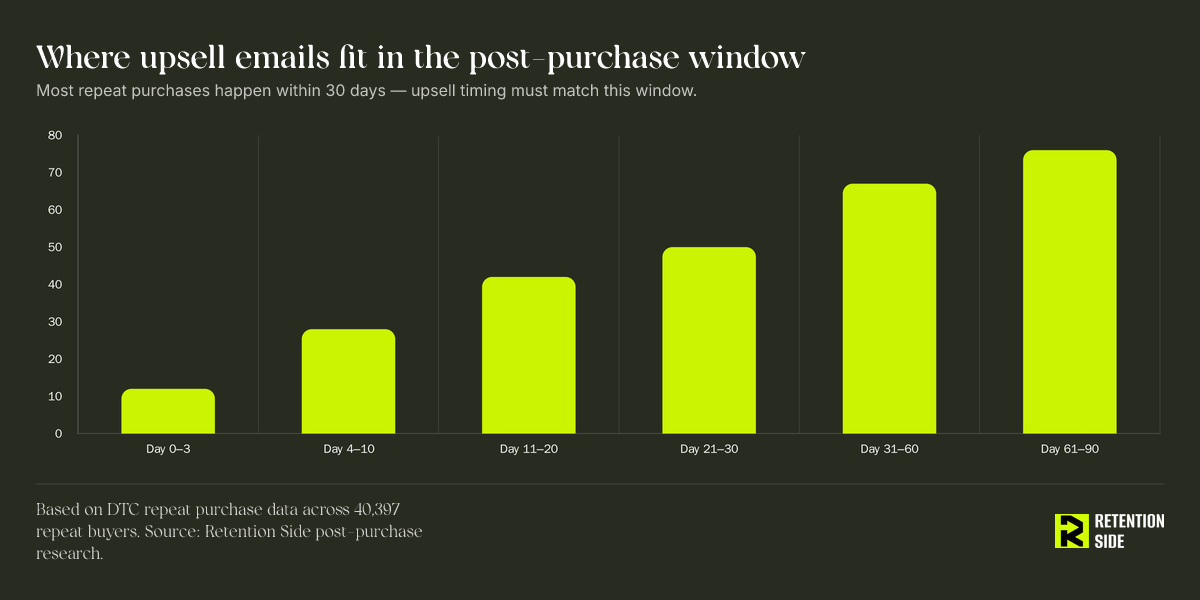
The post-purchase window is the highest-leverage moment in ecommerce. DTC data across 40,397 repeat buyers shows that 50.3% of second purchases happen within 30 days of the first order, and 76.4% happen within 90 days. This means the upsell window is considerably narrower than most brands assume, and the sequencing of emails within that window determines whether an upsell lands or gets ignored.
A properly built post-purchase flow covers several sequential objectives before the upsell conversation even starts:
- Reinforce the purchase decision and build confidence in what was bought
- Deliver genuine product education that helps the customer get real value
- Introduce the upsell or cross-sell recommendation in context
- Collect a review at the right moment
- Bridge toward the second purchase
The upsell email belongs in step three – typically 7 to 14 days after purchase, after the customer has had the product in hand and had time to engage with it. An upsell email fired on day one, before the product has even arrived, is asking a customer to buy more before they have received proof of the value of what they already bought. That sequence rarely converts well and often damages trust.
For brands building in Klaviyo, the post-purchase flow is the structural home for upsell automation. Triggered by the “Placed Order” event, the flow segments based on purchase history (first-time vs. returning buyer), product purchased, and catalog behavior, then serves upsell recommendations with relevant specificity rather than generic “you might also like” modules.
A dedicated cross-sell/upsell flow – separate from the general post-purchase sequence – is worth building for brands with catalogs deep enough to support it. The in-sequence upsell captures the early engagement window. A dedicated flow extends the upsell arc over a longer timeline with product-specific logic tuned to actual purchase behavior patterns in the data. For a detailed look at how these flows are structured alongside the full lifecycle architecture, the Klaviyo flows guide for ecommerce brands covers the cross-sell and upsell flow mechanics in depth.
How to write an upsell email that converts
The mechanics of a high-performing upsell email are not complicated, but they depend on getting several variables right simultaneously: the right product recommendation, the right timing, the right framing, and a clear, low-friction path to purchase.
Start with the recommendation logic
The upsell product selection needs to come from data, not instinct. For established brands on Klaviyo, Shopify purchase history surfaces real patterns: which products are consistently purchased together, what customers who bought Product A tend to buy within 60 days, which product tiers attract returning customers versus first-time buyers. These patterns should drive the upsell selection, not a manually curated “bestsellers” grid.
The recommendation also needs to be contextually relevant to the specific product that triggered the flow. A generic product recommendation email that ignores what the customer actually bought will always underperform a specific recommendation that acknowledges the original purchase and builds on it logically.
Structure and copy
A upsell email that works is built around a clear value proposition – not a hard sell. The structure typically follows this logic:
1. Acknowledge what they bought. Reference the original purchase specifically. This signals personalization and creates a logical bridge to the upsell. It does not need to be elaborate – a single line is enough. “You’ve been using [Product X] for a couple of weeks now – here’s what a lot of our customers discover next.”
2. Establish the upgrade value. Explain what the premium version or next product does that their current choice doesn’t, in terms of the specific outcome they are after. Do not list features. Present results. “Most customers notice [result] within [timeframe]” is more persuasive than a feature spec sheet.
3. Add social proof. A review or testimonial that speaks to the upsell product – ideally from a customer who made the same progression – reduces the perceived risk of upgrading. For premium-tier upsells, one strong testimonial with specific, believable language will consistently outperform a generic star rating.
4. Make the offer clear. If the upsell includes an incentive, present it simply and without artificial urgency. A modest offer on a genuinely valuable upgrade performs better than a manufactured countdown timer. If there is no incentive, the recommendation itself should carry enough product context and social proof to motivate action without a discount.
5. Single, clear CTA. One call to action. Not three buttons. Not “shop all products.” The email should have one job, and the CTA should execute that job without confusion.
Subject lines
The subject line is where upsell emails most commonly underperform. Generic lines like “You’ll love these products” or “Complete your collection” do not give the customer a reason to open. More effective approaches:
- Reference the original purchase directly: “The next step after [Product]”
- Frame the upgrade as something other customers discovered: “Most people add this after [Product X]”
- Use a result-focused hook: “Get better results from [Product X] with this”
- For subscription upsells: “Save [X]% – switch to annual”
The subject line is not the place for hype. It is the place for a specific, relevant reason to open.
Incentives in upsell flows
Upsell flows are a context where a modest incentive can be appropriate, even for brands that generally protect full-price positioning. The reason is structural: unlike a broadcast promotional campaign that trains your entire list to expect discounts, a flow-based incentive is triggered only for the small percentage of customers who enter that specific flow. The audience pool is limited, which limits the conditioning effect.
That said, incentives should not be reflexive. A well-framed upsell recommendation – specific to the customer’s purchase, presented with strong social proof and genuine product context – should not need a discount to convert. Test with and without incentives. The lift data will tell you what the audience actually needs to act.
Real upselling examples across ecommerce categories
Good upsell email strategy looks different depending on the product category, the customer’s relationship with the brand, and the catalog structure. These examples illustrate how the mechanics translate to real execution.
Supplements and health products
A customer bought a single-bottle supplement. The upsell is a three-month bundle at a per-unit saving, framed around product efficacy and the timeframe required to see meaningful results. The email arrives at day 7-10, after the customer has started using the product but is not yet committed to a long-term routine. Copy acknowledges the early stage of use, presents what results typically emerge over a 90-day window, and frames the bundle as the economically sensible path to those results. This is simultaneously a subscription upsell and a replenishment strategy.
Premium apparel
A customer bought a core wardrobe item at mid-range price. The upsell is the premium tier – the same style in a limited-edition material or a higher-quality version. The email focuses not on specs but on the experience: how the premium version feels, wears, and ages differently. A customer testimonial comparing both versions adds the social proof that makes the upgrade feel validated rather than marketed.
Kitchen and home equipment
A customer bought an entry-level version of a product line (a base model coffee grinder, for example). The upsell is not a discount on the premium version – it is an education-first email that demonstrates what the premium model does that the entry model cannot. Often, the most effective approach here is to show customers who started with the entry-level model and upgraded, using their language to describe the moment they realised the upgrade was worth it.
Skincare and beauty
A customer bought a standalone product. The upsell is a regimen or system upgrade – a bundle that incorporates the product they already have alongside complementary products from the same line. Framing matters: the upgrade should feel like unlocking a complete routine, not like being pressured to spend more. Showing the specific skin concern the complete system addresses, with real customer outcomes, is more persuasive than a bundle discount alone.
Subscription upgrade (any category)
For brands with subscription offerings, the single most effective upsell is often the simplest: a one-email pitch explaining the per-unit or per-delivery cost difference between monthly and annual subscriptions. The customer is already committed to the product – the upsell is purely about locking in the relationship at better economics for both sides. Personalize with their actual purchase data (“You’ve ordered 3 times in the last 4 months – you’re already effectively on a 45-day cycle”) and the conversion logic becomes very direct.
The 60/40 rule in ecommerce email marketing
The 60/40 rule in email marketing is a content-balance principle: 60% of your email communication should provide educational or genuinely useful value, while 40% can be promotional in intent. The specific ratio varies across contexts – some practitioners use 80/20 for opt-in marketing lists, with 60/40 more common in cold outreach frameworks – but the underlying logic applies directly to ecommerce email strategy.
For ecommerce brands, the implications are practical and strategic.
A campaign calendar built entirely around promotional sends does two things over time, both harmful. It trains subscribers to engage only when there is a discount attached – eroding the commercial value of any non-promotional send. And it signals to inbox providers that your emails are only relevant during sale periods, which compounds deliverability risk as engagement between promotional windows drops.
The fix is not fewer promotional campaigns. It is a content mix that provides genuine value between commercial sends. A product education email, a behind-the-scenes story, a guide to getting better results from what customers already bought, a recipe or tutorial or use case spotlight – these sends maintain engagement through periods when there is no promotion running. That engagement is what protects deliverability and makes the next promotional campaign land.
This is especially relevant to upsell emails. An upsell email landing inside a program that has been educating and informing the customer since their first purchase converts at a meaningfully higher rate than the same upsell landing inside a program that has only sent discount codes. The value balance across the program earns the right to make commercial asks.
For brands building in Klaviyo, the 60/40 principle should be visible in the campaign calendar as a deliberate mix – not as a formula applied mechanically, but as a guiding instinct that asks: “What is the non-commercial reason a customer would want to open this email?” If the only answer is “there’s a discount in it,” the program is out of balance.
One important nuance for ecommerce
The 60/40 rule originated in cold outreach and content marketing contexts, where the challenge is building trust with an audience that has no prior relationship with you. In ecommerce email, the situation is different: most of your list has already purchased or expressed strong purchase intent. The balance does not need to be as conservative as it would be for cold prospecting.
The principle still applies – pure promotional bombardment kills engagement – but the ratio can lean more commercial in replenishment categories with high purchase frequency, or in post-purchase flows where commercial intent is contextually expected. The key is that even within a commercial email, there should be genuine value: context, education, social proof, or usefulness that makes the email worth reading independent of whether the customer takes the offer. For a deeper breakdown of how the content-balance principle plays out in send frequency decisions, the guide on how often ecommerce brands should send emails covers the 60/40, 70/30, and 80/20 frameworks and when each applies.
How much is a 1,000 email list worth?
This is one of the most common questions brands ask about email marketing, and it is also one of the most poorly framed. “How much is a 1,000 email list worth?” has no single answer because the value depends almost entirely on who is on the list, how they were acquired, and what the brand’s purchase economics look like.
The meaningful question is: “What will this list generate in revenue over its lifetime?” – and the answer to that depends on a set of factors that are specific to each brand.
The variables that determine list value
Acquisition source. An organically built list – where every subscriber opted in because they were genuinely interested in the brand or product – converts at a fundamentally different rate than a list inflated by giveaways, low-intent social campaigns, or purchased contacts. The subscriber count is the same; the commercial value is not. A 1,000-person list with strong purchase intent is worth far more than a 10,000-person list built on discount hunters who signed up for a coupon and never bought.
Subscriber quality. The lead-to-customer rate – what percentage of subscribers actually make a purchase – is a more useful metric than list size. A list of 1,000 subscribers converting at 8% within 30 days generates 80 customers. A list of 3,000 subscribers converting at 1.5% generates 45. The smaller list is doing more commercial work.
Product economics. Average order value and repurchase frequency determine how much revenue a single customer generates. A 1,000-subscriber list for a brand with a $180 AOV and a 60-day repurchase cycle will generate substantially more revenue than the same list for a brand with a $35 AOV and annual repurchase behavior.
List health. A list that has never been properly maintained – inactive subscribers never suppressed, old addresses still included, deliverability signals deteriorating – is not an asset of its face-count value. The active, engaged portion of the list is the asset. Everything else adds cost and deliverability risk without adding commercial return.
Category. E-commerce lists in high-replenishment categories (supplements, skincare, pet food) naturally generate more repeat revenue per subscriber than categories with infrequent purchase cycles. A 1,000-subscriber list for a specialty supplement brand operates under completely different economics than a 1,000-subscriber list for a furniture brand.
What a 1,000-subscriber ecommerce list actually produces
For a well-built, organically acquired ecommerce list in a specialty or mid-to-premium category, rough annual value benchmarks based on actual DTC program data look something like this:
- Specialty/high-end ecommerce (AOV $100-$300): approximately $15,000 to $40,000 per 1,000 engaged subscribers annually
- Commodity or discount ecommerce (AOV $25-$60): approximately $3,000 to $8,000 per 1,000 engaged subscribers annually
These are not figures to hold as precise targets – they vary by execution quality, list health, and program maturity. The more useful frame: every time you add a high-quality subscriber from genuine purchase intent traffic, you are adding measurable economic value to an asset you own without ongoing acquisition cost.
The key implication for upsell strategy is this: a well-run upsell program increases the average revenue per customer, which means it increases the effective value of every subscriber on the list. An upsell email that converts 8% of customers to a higher-value purchase or subscription adds to the cumulative LTV of the entire list – not just the customers who clicked.
What makes a list lose value
A list loses value when it is poorly maintained – inactive subscribers left in place, deliverability compromised, engagement signals deteriorating. Inbox providers track disengagement at the list level. Sending regularly to people who never open accumulates negative signals that affect inbox placement for everyone on the list, including the genuinely engaged subscribers.
The practical implication: list size is not the asset. List quality is. A sunset flow that suppresses chronically disengaged subscribers is not losing value – it is protecting it.
The metrics that actually matter for upsell email performance
When evaluating whether an upsell email program is working, most brands look at the wrong signals. Open rate tells you whether the subject line was compelling enough to get a tap. Click rate tells you whether the layout and CTA were clear. Neither tells you whether the upsell program is actually building the business.
The metrics that connect upsell email performance to commercial outcomes:
Upsell conversion rate. What percentage of customers who receive the upsell email make the recommended purchase? This is the direct measure of whether the recommendation, timing, and framing are working. Low conversion despite reasonable engagement usually signals a product selection or value framing problem – the offer is not compelling enough given the context.
Average order value trend. If upsell emails are working at scale, AOV for returning customers should trend upward over time as customers move up the product tier or add components to their purchase. This is the most practical macro-level signal.
Repeat customer rate. Upsell emails are part of the post-purchase architecture that drives second and third purchases. A well-built upsell program should contribute to an improving returning customer rate over rolling 3-6 month windows. If the rate is flat or declining, the program is not generating the retention lift it should.
Time between first and second order. If upsell and post-purchase flows are working, the average gap between first and second purchase should shorten over time. This acceleration is one of the clearest behavioral signals that the post-purchase email system is doing its job.
Revenue attributed to retention flows. In Klaviyo, the flows dashboard surfaces the revenue contribution of each automated sequence. The upsell/cross-sell flow should have a clear and growing revenue line that reflects cumulative conversions over time.
What to deliberately avoid tracking as a primary KPI: open rate, click rate, and revenue per recipient. These are diagnostic signals – useful for identifying execution problems within a specific email – but they do not measure whether the upsell program is building the business. A high click rate on an upsell email that does not convert means the email created curiosity but not enough confidence. That is a framing problem, not a success.
Building upsell email logic in Klaviyo
For ecommerce brands on Klaviyo, upsell email architecture lives at the intersection of flow logic and behavioral data. The platform’s event tracking – which captures product views, purchases, and behavioral signals from Shopify in near real-time – makes product-specific upsell automation possible in ways that generic email platforms cannot replicate.
The core structural decisions:
Flow trigger. The upsell flow should be triggered by a Placed Order event, with entry filters that check the specific product or product category purchased. A customer who bought Product A enters Path A with Product B as the upsell. A customer who bought Product C enters Path C with the corresponding upsell recommendation. This is product-specific relevance, not generic “related products.”
Conditional splits for purchase history. A first-time buyer and a returning customer in the same upsell flow should not receive identical emails. A first-time buyer needs more trust-building context before a commercial ask. A returning customer already has brand relationship equity and can receive a more direct recommendation. A conditional split at the entry point of the flow, checking the number of previous orders, separates these paths cleanly.
Timing logic. In most categories, the upsell email should be delayed until after the customer has had the product for at least 5-10 days. If your Klaviyo integration with Shopify includes fulfilled order events, trigger the delay from delivery confirmation rather than order placement – this ensures the upsell arrives when the customer physically has the product, not before.
Incentive logic. If you are testing incentives in the upsell flow, use Klaviyo’s A/B testing functionality to run a clean with/without comparison before defaulting to a discount. Some product categories and price points convert at equivalent rates with and without an offer. Others show a meaningful lift with a modest incentive. The data should determine the approach.
Flow suppression. Ensure that customers currently active in an abandoned cart flow or receiving another promotional campaign do not simultaneously receive an upsell email. Overlapping automations create disjointed experiences and dilute the credibility of both messages. Klaviyo’s flow filters and campaign exclusion segments allow for deliberate suppression logic when designed intentionally.
The Klaviyo email marketing setup guide for ecommerce brands covers the technical architecture behind conditional splits and flow suppression in detail, including how to structure the branching logic for first-time vs. returning buyer paths.
Common mistakes that make upsell emails underperform
Even brands that understand upsell strategy in principle make execution errors that undercut the performance of their programs.
Sending too early. An upsell email sent on day one or two after purchase, before the product has been delivered, is not an upsell – it is a continuation of the buying session that most customers are not ready for. The timing needs to reflect where the customer is in their relationship with the product, not when the email is easiest to schedule.
Generic product recommendations. A recommendation engine that serves “you might also like” based on aggregate catalog data rather than specific purchase patterns will always underperform a recommendation built from actual purchase behavior in your own customer data. The difference between “here are our popular products” and “customers who bought X specifically tend to also buy Y within 60 days” is the difference between a generic email and a relevant one.
Over-discounting. Reflexive incentive inclusion in upsell flows trains customers to expect discounts before upgrading, which erodes full-price purchasing and conditions the audience for a perpetual promotional cycle. Test incentive-free upsell emails first. If conversion is insufficient, test a modest offer. Do not default to 20% off every time.
Single-email upsell attempts. One email rarely captures the full conversion opportunity in a upsell arc. A customer who received the upsell email, read it, but did not convert in the moment may be open to the recommendation a week later, framed differently. A two-email upsell sequence – initial recommendation followed by a value-add follow-up that addresses the most common hesitations – consistently outperforms a single email, provided the second email adds something genuinely new rather than just repeating the first.
Ignoring non-purchasers. Customers who received an upsell email and engaged with it but did not convert are a meaningful segment. In Klaviyo, this audience – identified by opening or clicking the upsell email without purchasing – can be segmented out for a retargeted message with a different angle. They have already demonstrated interest; the barrier is something in the framing or timing, not in the product itself.
FAQ
How do you write an upsell email?
An upsell email that converts is built on four foundations: the right product recommendation, the right timing, a value-focused frame, and a clear path to purchase.
Start with the recommendation logic. Use actual purchase behavior data from your store to identify which products customers who bought the triggering product tend to add within 30-60 days. That pattern – not a guess or a manually curated bestseller list – should determine what you recommend.
Time the email after the customer has had the product for enough time to engage with it – typically 7 to 14 days post-delivery, depending on category. An upsell for a skincare product that takes three weeks to show results should not arrive at day five.
Write the email around the outcome, not the product features. Frame the upgrade as what it enables the customer to achieve, not what it includes in the box. Reference the original purchase to establish relevance. Use social proof – specifically from customers who made the same transition – to validate the recommendation without overselling.
Close with a single, unambiguous CTA that goes directly to the product or upgrade option. Do not send customers to a homepage and expect them to find it.
Structurally: keep the email short. Two to four short sections is enough. A well-framed upsell does not need a long email – it needs the right message at the right moment.
What is the 60/40 rule for email?
The 60/40 rule is a content-balance principle in email marketing that recommends allocating approximately 60% of your email communication to value-driven, educational, or useful content, and 40% to promotional or commercial asks.
The ratio has different origins in different contexts. In cold outreach, 60/40 is used as a deliverability safeguard: value emails generate positive engagement signals (opens, replies) that protect sender reputation before promotional emails make commercial asks. In opt-in email marketing for ecommerce, the principle applies differently but the underlying logic is the same – a list that only hears from a brand during promotions will disengage between promotional windows, which degrades deliverability over time and erodes the commercial value of the list.
For ecommerce brands, the 60/40 rule translates to a campaign calendar that balances promotional sends (seasonal sales, product launches, flash offers) with non-promotional sends (product education, usage guides, behind-the-brand content, customer stories, how-to content). The non-promotional sends maintain engagement, protect inbox placement, and – importantly – make the promotional sends more effective when they arrive, because the audience is conditioned to open and read, not just scan for discount codes.
In the context of individual upsell emails, the 60/40 principle suggests that even a commercial email should earn its open by delivering genuine value. An upsell email that is entirely a sales pitch – product image, price, CTA – will outperform nothing in the inbox. An upsell email that begins with a useful insight, addresses a real outcome the customer cares about, and then presents the upgrade as the logical next step is a 60/40 email that happens to have a commercial objective.
It is worth noting that the specific 60/40 ratio is a heuristic, not a hard rule. The right balance depends on category, list quality, and program maturity. High-replenishment categories with frequent purchasers can lean more commercial. Low-frequency categories with longer decision cycles need more value-building between commercial asks.
How much is a 1,000 email list worth?
There is no single answer to this question, and any marketer who gives you a flat number without asking about your specific context is guessing.
The value of a 1,000-subscriber ecommerce email list depends on the following:
Who is on it and how they got there. A list of 1,000 subscribers who came from high-intent organic traffic – product pages, educational content, direct brand search – converts at a fundamentally different rate than a list of 1,000 subscribers built through discount-driven giveaways or broad paid social campaigns targeting low-intent audiences. The mechanics of acquisition determine subscriber quality, and subscriber quality determines commercial output.
Your product economics. A 1,000-subscriber list for a supplements brand with a $65 monthly subscription and a 6-month average customer lifetime generates substantially more revenue than the same list for a one-time purchase home goods brand with a $45 AOV. The repurchase cycle is the multiplier that turns a one-time conversion into long-term list value.
List health. A well-maintained list of 1,000 engaged subscribers is a fundamentally different asset from a 1,000-subscriber list that includes 400 inactive addresses who have not opened in over a year. The latter has lower effective reach, worse deliverability signals, and higher ESP costs relative to its commercial output.
Execution quality. The same list in different programs will produce different results. A brand with a properly built post-purchase flow, relevant upsell sequences, and a campaign calendar that balances value and promotion will extract more revenue from 1,000 subscribers than a brand running a discount email once a month to an unsegmented list.
As a rough directional benchmark for ecommerce – not a universal rule – a well-built list in a specialty or mid-to-premium category tends to generate $15 to $40 per engaged subscriber annually. A commodity or discount-oriented ecommerce list tends to generate $3 to $8 per subscriber. The practical implication: a healthy, organically built 1,000-subscriber ecommerce list is worth somewhere between $3,000 and $40,000 in annual revenue, depending on your category and program quality.
What this means for upsell strategy is direct: the better your upsell email program, the higher the per-subscriber value of your list. Upsell emails that successfully move customers to higher-value purchases or subscription tiers increase the effective commercial output of every subscriber you already have – without requiring a single additional acquisition.
What are some good upselling examples?
The most effective upsell examples in ecommerce share a structural characteristic: they are specific to the customer’s existing purchase, they present a clear upgrade value, and they feel like a natural progression rather than a new sales attempt.
Bundle or subscription upgrade (supplements/consumables). A customer buys a single unit of a supplement. The upsell is a three-pack bundle at a per-unit savings, timed 7-10 days after purchase and framed around efficacy timing: “Most customers see the best results after 90 days – here’s how to get there at a lower per-day cost.” This is simultaneously a product upsell and a subscription/replenishment play.
Complete the system (skincare/beauty). A customer buys a single product from a multi-step routine. The upsell is the complete regimen, with the purchased product highlighted as already covered and the remaining products presented as the unlock for the full result. The framing is “you already have step one” not “here are four more things to buy.”
Premium tier upgrade (apparel/home goods). A customer buys an entry-level version of a product. The upsell is the premium version – same use case, better materials or finish. The email focuses on customer language about the upgrade experience, not on feature specifications. One or two customer testimonials comparing the two versions often convert better than any amount of brand-generated copy.
Annual subscription (any subscription category). A customer who has made two or three recurring purchases gets an email presenting the annual plan alongside the math on their actual spend: “You’ve ordered 3 times in the last 5 months. At your current pace, annual works out to [X] per order vs. [Y] per order right now.” The personalization makes the value calculation impossible to ignore.
Add-on accessory (electronics/outdoor/home equipment). A customer buys a main product. The upsell is the accessory or add-on that meaningfully extends what the product can do. The email is framed not as “here’s something else to buy” but as “here’s what most people wish they had ordered at the same time.” A “most frequently purchased together” data point, if genuine, works as compelling social proof.
What unites these examples is that they are specific, contextual, and additive in value – not generic, and not opportunistic.
Upsell emails inside the broader retention system
A common misframe in how ecommerce brands think about upsell emails is treating them as a standalone tactic – an email you send when you want to drive additional revenue from existing customers. In a well-built retention system, upsell emails are one layer of an interconnected architecture that includes the welcome series, post-purchase flow, cross-sell automation, win-back sequencing, and campaign strategy.
The commercial performance of upsell emails is partly a function of the health of the entire system around them. A customer who received a genuinely useful welcome series, who was educated about the product in the post-purchase flow, and who has experienced consistent, valuable communication from the brand is far more receptive to an upsell recommendation than a customer who has only received transactional logistics and occasional discount codes.
This is why building the retention system correctly before focusing narrowly on upsell conversion is the right sequence. Email deliverability needs to be solid – upsell emails that land in spam have no chance. List growth mechanics need to be attracting subscribers with genuine purchase intent – a list built on low-intent acquisition will produce low upsell conversion regardless of how well the emails are written. The post-purchase sequence needs to educate and build trust before it asks for an upgrade.
This dynamic is well-supported by the broader research on customer retention economics. Research from Bain & Company’s Frederick Reichheld, published in the Harvard Business Review, found that increasing customer retention rates by just 5% can increase profits by 25% to 95%. The upsell email is one of the clearest levers for retention-driven profit growth – but only when the customer relationship preceding it has been built with care.
At Retention Side, upsell and cross-sell flows are built as part of the broader lifecycle architecture – not as isolated automations, but as stages in a customer journey that begins with the first signup and extends through repeat purchase, loyalty, and long-term brand relationship. The systems that produce the strongest upsell performance are almost always the systems that also produce the strongest returning customer rates, because the customer experience that earns upsell conversion is the same customer experience that produces loyalty.
Brands that want to improve upsell performance should audit the full post-purchase sequence first. In the majority of cases, the underperformance of upsell emails is not a copywriting problem – it is a timing problem, a trust-building gap in the early post-purchase sequence, or a product recommendation problem rooted in shallow catalog data. Fix the foundation, and upsell conversion improves as a natural consequence.
Conclusion
Upsell emails are one of the highest-ROI tools in an ecommerce email program when they are built correctly – specific product recommendations, well-timed relative to purchase and delivery, framed around genuine upgrade value, and integrated into a post-purchase architecture that has already built trust before making a commercial ask.
The principles behind effective upsell emails connect directly to the broader disciplines of retention marketing: understanding where customers are in their lifecycle, communicating with relevance and context rather than broadcasting to segments, and building systems that compound over time rather than one-off campaigns that capture a moment and leave nothing behind.
The 60/40 content balance principle is a useful mental model for the campaign environment in which upsell emails operate. An email program dominated by promotions trains customers to disengage between discount windows – which is the environment that makes upsell emails fail. A program that delivers consistent value makes commercial asks land.
And the question of list value comes back to the same structural truth: subscriber count is a vanity metric. What matters is subscriber quality, list health, product economics, and execution quality – and all of those variables are within a brand’s control.
If your post-purchase sequence is currently limited to a shipping confirmation and a thank-you email, building a proper upsell architecture starts with the architecture of the whole post-purchase flow. That is where the highest-leverage improvements live – and the upsell email is the step that, done well, turns a satisfied first-time buyer into a customer who is worth multiples of what they initially spent.