


Most Shopify brands running email marketing have the same experience at some point: campaigns are going out, flows are technically live, the Klaviyo dashboard shows revenue being attributed – and yet the repeat customer rate is not moving. The list keeps growing but conversions stay flat. A new product launch lands with a whimper instead of a spike.
The instinct is usually to change the creative, test a new subject line, or send more often. Those are rarely the real problem. The real problems tend to be structural – buried in the setup, the flow architecture, the segmentation logic, or the metrics being used to evaluate what is working.
This article covers the Shopify email marketing mistakes that are most likely draining revenue quietly, and what it actually takes to fix them. Not surface-level errors like your subject lines are too long – the kind of structural and strategic mistakes that keep a program stuck even when the visible metrics look acceptable.
Key takeaways
- Deliverability problems are often invisible until serious damage is done – delivery rate is not the same as deliverability
- Growing a subscriber list without tracking subscriber quality is one of the most common ways to stall a program
- Flows and campaigns serve different purposes in the customer lifecycle – underbuilding either one creates gaps that cost revenue
- Tracking vanity metrics like open rate and revenue per recipient causes brands to optimize for the wrong things
- A drop in email performance is often a symptom of a problem outside email – traffic quality, acquisition source, or website conversion
- Shopify email marketing does not operate in isolation; what happens at the acquisition layer shapes what is possible at the retention layer
Mistake 1: Confusing delivery with deliverability
This is the most foundational mistake in Shopify email marketing, and the reason it is so damaging is that it is invisible. Your ESP shows 99% delivery rate. Everything looks healthy. Meanwhile, 20-30% of your emails are landing in spam or the Promotions tab, and you have no idea.
Delivery means the recipient’s mail server accepted the email. It did not bounce. That is all it means. Deliverability is about where the email ends up after delivery – in the primary inbox, the Promotions tab, or the spam folder. A 99% delivery rate and a 30% spam placement rate are entirely compatible. The dashboard just does not show you both.
For Shopify brands using Klaviyo, the deliverability picture depends on a few interconnected factors.
Sending infrastructure: If you are still on Klaviyo’s default shared sending domain, your sender reputation is partially determined by the behavior of every other brand on that shared domain. Their spam complaint rates, engagement drops, and poor list hygiene affect yours. Setting up a dedicated custom sending domain gives you control over your own reputation.
Authentication: SPF, DKIM, and DMARC are non-negotiable in 2026. Gmail and Yahoo require all three for bulk senders. Not having DMARC configured is a slow-building liability.
Engagement ratios: Inbox providers use engagement signals to decide where future emails from your domain land. Sending campaigns to your full list regardless of recency or engagement steadily erodes these signals. Over time, even your best subscribers start seeing your emails in Promotions or spam because your domain’s engagement profile looks poor.
The operational fix is to segment your sends by engagement tier before anything else. Regular campaign sends should go to genuinely active subscribers. Reserve broader sends for high-stakes moments where the incremental reach justifies the reputational cost.
Mistake 2: Growing the list without caring about subscriber quality
List growth is real marketing work. But the way most Shopify brands approach it creates a structural problem that compounds over time.
The common version of this mistake: a brand runs a 15% discount pop-up, captures thousands of emails, watches the list grow, and reports this as a success. Six months later, the email program has a 12% engagement rate, deliverability is degrading, and revenue from email is stuck because almost none of those subscribers are converting to customers.
The issue is that form submission rate is not a meaningful KPI. The real number is lead-to-customer rate – what percentage of people who subscribed through a given form actually made a purchase within a reasonable timeframe.
A form that converts 4% of traffic into subscribers but produces a 15% lead-to-customer rate is worth far more than a form converting 9% of traffic with a 3% lead-to-customer rate. The second one grows your list faster. The first one grows your business faster.
This changes how you should think about list growth mechanics. The quality of the incentive, the placement of the form, and the traffic source all affect who enters the list. A high-intent visitor arriving from organic search, who subscribes through an embedded form below a product comparison article, is a fundamentally different subscriber than someone arriving from a broad interest ad who signs up for a discount pop-up during their first five seconds on the site.
Both can be valuable. But they require different welcome experiences, different flow logic, and different expectations about conversion windows. Treating them identically is how you end up with a large list that generates very little revenue.
Practically: track lead-to-customer rate per form, per traffic source, and per incentive. Build your welcome flow to serve the quality of subscriber you are actually attracting, not a theoretical engaged buyer.
Mistake 3: Underbuilding the flow layer
Flows are time-sensitive, behavior-triggered automations. They fire because a specific customer did a specific thing – viewed a product, added to cart, made their first purchase, went silent for 60 days. That behavioral trigger is what makes them high-intent and, when built properly, highly effective.
The mistake most Shopify brands make is not skipping flows entirely. It is underbuilding them. The welcome series gets set up. Maybe abandoned cart too. Then the program stalls.
Here is what a complete flow architecture actually needs to cover across the customer lifecycle.
Welcome series: Not just a discount delivery mechanism. It is the first structured conversation with a new subscriber. Done well, it introduces the brand, earns trust, handles objections, and gives the subscriber multiple reasons to buy – not just a coupon code.
Abandoned cart: Still one of the most consistently effective flows, but only when the logic is smart. The message a first-time visitor gets for a $200 cart should not be the same message a repeat buyer gets for a $40 replenishment cart.
Browse abandonment: One of the most commonly missing flows in underperforming Shopify programs. A visitor who spent time on a product page is signaling buying intent. A timely follow-up can capture revenue that would otherwise be invisible.
Post-purchase sequence: The most underbuilt category across Shopify email programs. The window immediately after a purchase is the highest-engagement moment in the customer relationship. A mature post-purchase flow covers product education, cross-sell recommendations, review requests, and a path toward the second purchase – which is the strongest predictor of long-term customer retention.
Cross-sell and upsell flows: For brands with multi-SKU catalogs, these flows identify natural adjacencies and time follow-up communication around them.
Winback flow: The goal is to re-engage before the customer has fully lapsed, not after. For most eCommerce brands, the repurchase window is well under 90 days.
Sunset flow: Removes chronically unengaged subscribers from active sends to protect sender reputation and keep reporting metrics accurate.
Flows are never finished. Each one should be tested, iterated, and improved over time.
Mistake 4: Running a campaign strategy that only shows up for discounts
Campaigns are manual sends – promotional emails, content-led sends, product launches, seasonal pushes.
The most common campaign mistake: the brand only communicates when there is a sale. Every email in the subscriber’s inbox is a discount announcement. No editorial content, no product education, no brand story, no reason to stay subscribed beyond hunting for deals.
The consequence is predictable. Subscribers are trained to wait for promotions before buying. Full-price purchasing drops. Engagement outside sale periods falls. The list becomes increasingly discount-dependent, and the margin impact compounds over time.
A healthy campaign strategy balances promotional and non-promotional sends. Product education, customer stories, behind-the-scenes content, and category expertise content all give the subscriber a reason to be on the list beyond wanting a coupon.
Campaigns should not go to the entire list by default. Sending to engagement-tiered segments for regular campaigns, and expanding to broader segments only for high-value moments, protects deliverability and the subscriber experience.
Mistake 5: Tracking the wrong metrics
This is the mistake most likely to cause you to optimize in the wrong direction without knowing it.
Open rate is not a reliable performance signal. Apple Mail Privacy Protection inflates opens from iOS users. Bot traffic inflates opens further. The only scenario where open rate is genuinely diagnostic is when it is unusually low – which can signal deliverability problems worth investigating.
Revenue per recipient leads to poor decisions at the account level. Not every email exists to drive immediate purchases. Onboarding emails educate. Post-purchase content builds loyalty. Judging every send by its immediate revenue output encourages brands to cut the relationship-building content that actually supports long-term retention.
The metrics that actually reflect whether a Shopify email program is working:
- Returning customer rate – the share of customers who purchase more than once in a given period. The headline retention metric.
- Revenue attributed to email – total, across campaigns and flows.
- Lead-to-customer rate – whether list growth is producing buyers, not just subscribers.
- Deliverability indicators – inbox placement rate, spam complaint rate, bounce rate.
- Flow-specific conversion metrics – what percentage of people who trigger a given flow complete the target action.
Mistake 6: Treating email as an isolated channel
Email marketing does not operate in a vacuum. What you can achieve through email is directly shaped by the quality of traffic your acquisition channels send to your site, and the quality of your website’s conversion experience.
A brand with a strong Klaviyo setup but low-quality acquisition traffic will have a weak list, a low lead-to-customer rate, and a poor welcome series conversion rate. None of those problems are fixable inside Klaviyo. The problem is upstream.
When engagement drops or conversion rates fall, the first question should be: what changed? Did acquisition channels shift? Did a website change affect conversion?
The right time to add a channel is when there is clear evidence it would reach customers not being reached effectively by email. It is not about stacking channels for the sake of it.
Mistake 7: Skipping account setup in the rush to start sending
This is common with Shopify brands new to Klaviyo, or where email was set up by someone who got it running without building it properly. A proper Klaviyo setup covers the infrastructure and authentication layers before a single campaign goes out.
The symptoms show up later: flows that fire on the wrong triggers, events that do not track correctly, segmentation built on bad data, no custom sending domain, missing or incorrectly configured DNS records.
The setup elements most often skipped:
Custom sending domain: This is the difference between your sender reputation being yours to control versus being partially determined by hundreds of other accounts.
DNS authentication: SPF and DKIM get set up. DMARC gets skipped. But DMARC is now required by Gmail and Yahoo for bulk senders.
Domain warm-up: A new sending domain has no reputation history. Start with your most engaged subscribers and scale over two to four weeks.
Suppression logic: Recent buyers, customers who already purchased cross-sold items, and subscribers who marked previous emails as spam all need to be suppressed appropriately.
Getting the foundation right before focusing on creative or send frequency is the precondition for everything else working.
Mistake 8: Building a program once and considering it done
The final mistake is a mindset one, and it shows up most clearly in brands that built a solid email program at some point and have barely touched it since.
Flows are not set and forget. The welcome series built eighteen months ago may have the wrong incentive structure for your current acquisition strategy. The segmentation that was meaningful at 10,000 subscribers may be too coarse for a list of 80,000.
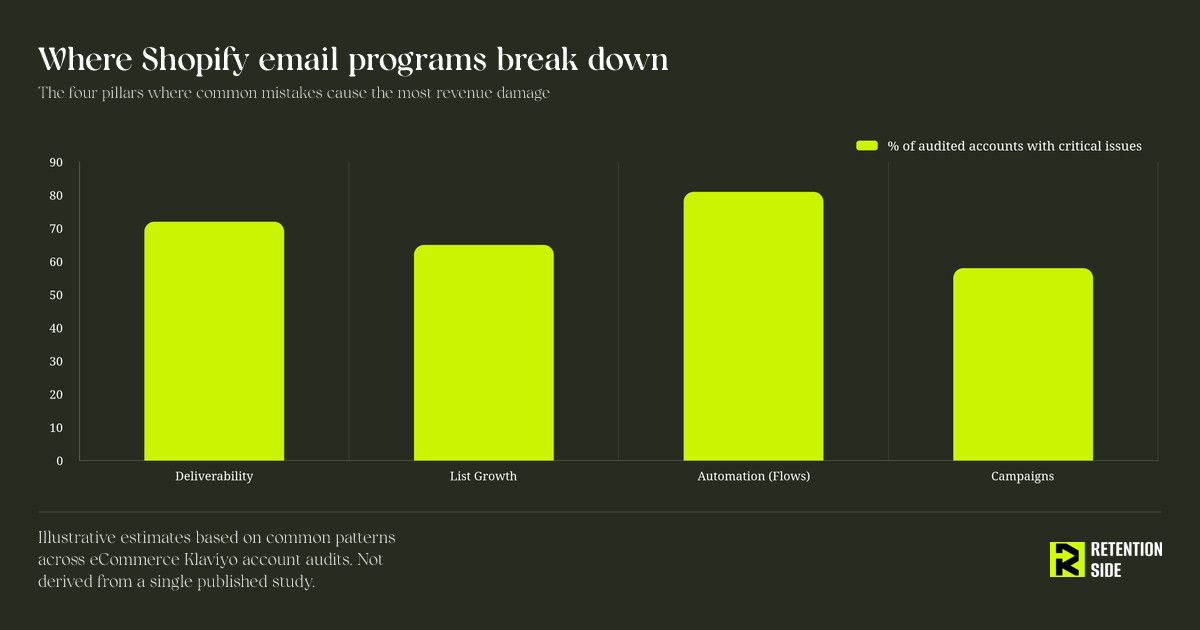
The email channel requires ongoing attention across all four foundational pillars:
Deliverability – Problems compound quickly and quietly. Monitor Google Postmaster Tools, Klaviyo’s Deliverability Hub, bounce rates, and spam complaint rates continuously.
List growth – Lead-to-customer rate by form, by source, by incentive. The forms working well a year ago may not be working well now if traffic composition has changed.
Flows – Subject line tests, timing tests, incentive structure tests. The flows performing well are performing well for now, not forever.
Campaigns – The balance between promotional, educational, and relationship-building sends needs to be managed actively.
The brands that treat email as a living system rather than an infrastructure project they finished get compounding returns from it over time. That compounding effect is what makes retention-focused email the highest-leverage channel in eCommerce.
Conclusion
The mistakes that hold Shopify email programs back rarely look dramatic from the outside. Campaigns are going out. Revenue is being attributed. The Klaviyo dashboard shows numbers that seem fine. But underneath that surface, deliverability is eroding, subscriber quality is declining, flows are incomplete, and the program is running on inertia rather than systematic improvement.
At Retention Side, our entry point with every Shopify brand is an honest audit of all four pillars: deliverability, list growth, flow architecture, and campaign strategy. Not to sell a bigger retainer, but because that is the only way to know what is actually broken and what the highest-leverage fixes are. Email is the most reliable retention channel available to an eCommerce brand – but only when the foundation is built correctly and maintained over time.
If your program is running but not compounding, the problem is almost certainly structural. And structural problems do not fix themselves.