
Most ecommerce brands treat email copy as a production task. Someone on the team writes it, a designer drops it into a template, and the send button gets pressed. The thinking starts and ends with “what are we promoting this week?”
That approach produces generic emails. Generic emails produce subscribers who stop opening. And subscribers who stop opening eventually drag down deliverability for the rest of the list.
Email copywriting for ecommerce is not a creative flourish layered on top of a working program. It is a functional part of the system. The words in an email determine whether a subscriber engages or ignores, whether a customer clicks or scrolls past, whether a first-time buyer comes back or drifts away. Every email in every flow and every campaign either strengthens or weakens the relationship with that subscriber – one send at a time.
This article is about how to write ecommerce emails that do the job they are meant to do: move customers forward in their lifecycle, build trust with each send, and convert at meaningful rates across flows and campaigns alike.
What you will learn
- Why ecommerce email copy is a strategic function, not a content task
- How to write subject lines that earn opens without burning trust
- What different flows demand from copy – and why the same voice does not work across all of them
- How to write campaign copy that balances promotion with genuine value
- The copy mistakes that quietly destroy retention over time
- How deliverability and copy quality are more connected than most brands realize
Why copy is the variable most brands underinvest in
When an email program underperforms, the instinct is usually to look at send frequency, segmentation, or flow architecture. Those things matter. But if the underlying copy is weak, none of the structural improvements will produce the results they should.
Copy is the variable that determines whether a well-timed, well-targeted email actually converts. A subscriber who receives the right email at the right moment – but reads copy that feels generic, rushed, or disconnected from why they bought in the first place – will not click. And a subscriber who consistently does not click is on their way to becoming a subscriber who never opens at all.
The strategic implication is that email copy deserves the same rigour as flow architecture or segmentation logic. Not just creative attention – strategic thinking. What job is this email trying to do? What does the customer need to hear right now? What is the single most important thing this email should communicate, and is the copy actually doing that?
That thinking needs to happen before anyone writes a word.
The four pillars and where copy fits in each
Ecommerce email marketing rests on four interconnected pillars: deliverability, list growth, automated flows, and campaigns. Copy plays a different role in each one – and understanding those differences is where most brands start going wrong.
Deliverability
Most people do not think of copy as a deliverability variable. But it is.
Spam trigger words in subject lines, aggressive promotional language used too consistently, or sending the same batch-and-blast message to your entire list regardless of engagement level – these are all copy decisions that affect inbox placement. Gmail’s filtering logic, shaped increasingly by engagement signals, evaluates whether your emails are wanted by the people receiving them. If your copy feels like noise to a large portion of your list, it will eventually be treated like noise at the infrastructure level – first routing more sends to Promotions, then, if the trend continues, to spam.
The practical implication: copy that speaks to distinct audience segments, reflects where those segments are in their lifecycle, and earns engagement rather than just blasting for attention is not just better marketing. It is better for long-term deliverability.
List growth
The copy in your signup forms and welcome sequence is the first real editorial impression your brand makes on a new subscriber. A form with a strong value proposition and clear language will convert better than one that says “subscribe for exclusive offers” – which is what most forms say, because it is the default.
More importantly, the copy in your welcome series sets the tone for every future email. Subscribers who receive a welcome sequence that is genuinely useful, clearly written, and feels like it was crafted for them will engage at higher rates throughout their time on your list. Those who receive a generic sequence will start tuning out within the first two weeks – and once that habit forms, it is very hard to reverse.
The lead-to-customer rate from new subscribers is heavily influenced by how good the welcome copy is. It is not just about getting someone onto the list. It is about making them want to stay.
Automated flows
Flows are where the highest-stakes copy decisions happen in ecommerce email. Each flow fires at a specific moment in the customer lifecycle – a moment when the subscriber’s attention and intent are shaped by something they just did. The copy needs to be calibrated to that moment, not to a general promotional message the brand wants to deliver.
If you want to understand how flows and campaigns divide the strategic work across the lifecycle, the flows vs. campaigns breakdown covers the operational distinctions in detail.
The abandoned cart email addresses a customer who added a product and left without buying. The most effective copy does not open with a discount. It opens by acknowledging the product – specifically, by name, if possible – and helping the customer feel confident in the decision they were close to making. Urgency is a tool to be added later in the sequence, not the opening move.
The post-purchase email fires after a customer has bought. The copy here is not promotional. It is relational – educational, warm, helpful. A customer who just gave you money does not need to be sold to again in the next 24 hours. They need to be reassured, informed, and made to feel the purchase was the right call. That is the copy job in that specific window.
The cross-sell or upsell flow, which is distinct from the general post-purchase sequence, recommends a product based on what was bought. The copy here needs to feel like a genuine recommendation – based on what similar customers have bought, or what naturally complements the purchase – not like a second sales push. The framing “customers who bought X also love Y” works because it borrows social proof. A flat “here’s another product you might like” does not convert at the same rate because it does not give the customer a reason to believe the recommendation is relevant. For a full treatment of how to structure this, the upsell emails guide covers framing and sequence logic in detail.
Win-back copy operates under different constraints. A customer who has not purchased in longer than their expected repurchase cycle is drifting. The copy needs to re-establish relevance without being dramatic or guilt-inducing. The “we miss you” subject line is tired – most subscribers have seen it dozens of times from dozens of brands. What works better is specificity: something that references what they bought, what they might need now, or what has genuinely changed since they last engaged.
Campaigns
Campaign copy is where many brands fall into the discount trap. If every campaign email is a promotional send – X% off, last chance, BFCM sale, exclusive member discount – subscribers learn to only open when they expect a deal. That conditioning is hard to undo, and it has two serious downstream effects: full-price conversion rates fall, and deliverability degrades outside of promotional windows because engagement drops whenever you send without an offer.
The solution is not to stop running promotions. It is to balance promotional sends with campaigns that earn attention for reasons other than a discount. Education about a product category, a customer story, a behind-the-scenes look at how something is made, a thoughtful seasonal send that connects the product to a moment in the subscriber’s life – these emails build the relationship that makes promotional emails more effective when they do land.
Writing subject lines that earn the open
The subject line is not just an opener. It is a commitment. Whatever the subject line implies, the email body needs to deliver – and if there is a gap between the two, trust erodes a little each time.
That said, subject line craft matters enormously. An email with the right timing, the right message, and the right audience will still fail to convert if the subject line does not earn the open in the first place.
A few principles that hold across ecommerce contexts:
Specificity beats cleverness. “Your cart expires at midnight” outperforms “Don’t miss out” because it is anchored in something the customer did and something concrete that is happening. Clever subject lines require the reader to do interpretive work. Specific ones do not.
Curiosity has to be earned, not manufactured. “You won’t believe what’s back” sounds like clickbait because it is. Curiosity-gap subject lines work when the gap is real – when the reader genuinely does not know what the email is about and has a reason to want to find out. They fail when the gap is manufactured to get opens regardless of relevance. Analysis of 4,000+ DTC campaigns found that question-based subject lines win opens but actively lose on revenue – a useful reminder that optimising for opens and optimising for conversion are not the same thing.
Personalisation is not the same as inserting a first name. Using a subscriber’s first name in a subject line when everything else about the email is generic does not feel personal – it feels like automation that has been dressed up as personal. Real personalisation in subject lines uses purchase history (“Back to restock on [product]?”), behavioral signals (“Still deciding? We made it easier”), or lifecycle context to make the email feel like it was written for that specific person. Research by Mailchimp found that campaigns with personalised product recommendations drove 31% more revenue per open compared to non-personalised campaigns – a meaningful signal for how far genuine personalisation moves the needle beyond first-name insertion.
Short versus long is a false binary. Subject lines should be as short as they need to be. Some high-converting subject lines are four words. Others are twelve. The right length is the one that communicates the most relevant information without excess. Mobile truncation is a real constraint – front-load the most important element – but cutting subject lines for their own sake often removes the context that makes them compelling.
The preheader is part of the subject line system. Preview text visible in the inbox alongside the subject line should extend or complement the subject line, not repeat it. Two subject lines that say the same thing waste the real estate. A subject line that creates a question and a preheader that begins the answer is a stronger combination.
The opening hook: the most overlooked line in ecommerce email
The subject line gets the open. The first line of the email body determines whether the subscriber keeps reading.
Most ecommerce emails open with the logo, a hero image, and then a headline – by which point the subscriber has scrolled past the beginning of the copy without encountering a reason to keep going. The actual first line of text, when it appears, often says something like “We’re thrilled to announce…” or restates the subject line in slightly different words.
Neither of these opens does the job.
A strong opening hook in an ecommerce email does one thing quickly: it gives the subscriber a reason to care about the next line. That might be a surprising fact, a direct statement of value, a question that mirrors something the subscriber is likely thinking, or a short observation that connects the email’s subject to something real in the customer’s experience.
The test is simple: if you read the first two sentences and do not feel compelled to read the third, the hook needs to be rewritten.
This matters more in flows than in campaigns, because flow emails often arrive without the built-in expectation of a promotion. A subscriber who opens an abandoned cart email is not in “reading an email” mode – they are glancing at an inbox item that caught their attention. The opening hook is what determines whether they stay or scroll past.
Writing for different flows: the voice shifts, the job does not
One of the most common copy errors in ecommerce email programs is using the same voice and structure across all flows. The brand voice should be consistent – tone, vocabulary, the feel of the writing – but the approach needs to shift based on what the flow is trying to accomplish.
Welcome series copy
The welcome series is the highest-engagement window a subscriber will ever be in. They are new, they opted in, and they are paying more attention than they will at almost any other point in their time on your list. The copy job here is not to sell – it is to make the subscriber feel like they made the right decision by signing up.
That means the welcome series should not read like a catalogue. It should sound like the beginning of a relationship: a genuine introduction to what the brand is, why the product matters, and what the subscriber can expect from being on this list. Use zero-party data collected at signup to personalize where possible – if someone indicated they are interested in a specific product category, lead with that. If they shared a skin type or a dietary preference or a style preference, acknowledge it.
The offer, if there is one, should be present but not the centrepiece of every email. Subscribers who joined the list for a 15% discount and get nothing but escalating urgency around that discount have learned that the brand’s email program is just a coupon delivery system. That is not the foundation you want to build the rest of the relationship on.
Abandoned cart copy
Abandoned cart emails need to acknowledge the specific product, not just the abstract fact of an abandoned cart. “You left something behind” is fine as a subject line. An email that opens with “We noticed you were looking at our running shoes” is better because it names the thing the customer was considering.
The first abandoned cart email should not lead with an incentive. The customer may have left for any number of reasons – distraction, interruption, price comparison, wanting to think about it – and assuming the barrier is price means you are potentially training customers to abandon carts specifically to receive discount emails. Research by Decodo tracking 1,500 products across 120 retailers found that discount timing in recovery flows has become so predictable that shoppers increasingly anticipate when the best offer will arrive – a pattern that erodes the value of the discount entirely. The first email is a simple, friendly reminder with a clear return-to-cart CTA.
The second email in the sequence is where you can address objections – social proof, return policy, shipping details, frequently asked questions about the product. This is the email that reduces friction, not with a discount, but with information that removes the reason not to buy.
The third email, if the sequence includes one, is where a modest incentive is appropriate for first-time visitors who have not purchased before – but the incentive should be framed as a genuine nudge, not a desperation move.
Post-purchase copy
Post-purchase email copy has one overriding principle: the customer just trusted you with their money. Do not spend that trust on another sales push.
The first post-purchase email should be warm and unhurried. It confirms the purchase decision was a good one, sets clear expectations about what is coming, and establishes the brand as attentive. The copy should sound like a person, not a system. Short sentences. Direct language. A tone that says “we’re glad you bought, and we’ve got you.”
The education emails that follow should be genuinely useful. Usage instructions, care guidance, tips for getting the best results, or context that deepens the customer’s appreciation of what they bought. The test for whether post-purchase education copy is doing its job is simple: if a customer read this email and acted on what it said, would they get more value from the product? If the answer is yes, the copy is right. If the email is just a narrative paragraph that says “here’s why we love this product,” the copy is missing the point.
The cross-sell recommendation email within the post-purchase flow should frame the recommendation as the natural next step, not as a commercial interruption. “Customers who bought X consistently add Y within a few weeks” is a framing built on observation, not on a sales goal. That framing works because it is true and because it transfers the credibility of other customers’ behaviour to the recommendation.
Win-back copy
Win-back copy is operating under two constraints simultaneously: the customer has disengaged, which means they are not actively looking for a reason to come back, and the brand has a limited number of touchpoints left before the subscriber should be moved into sunset territory to protect deliverability.
That combination requires precision. Win-back emails should be short. They should not be dramatic (“We’ve missed you so much and we really hope you’ll give us another chance”) – that kind of copy is uncomfortable to read and feels unearned. They should be specific – referencing what the customer bought, what might be relevant to them now, or what is genuinely new or improved since they last engaged.
The incentive in a win-back flow is often appropriate because the alternative – losing the customer’s engagement permanently – is more costly than the discount. But the incentive should be framed around value, not desperation. “Here’s 15% off because we think you’ll love what we’ve added” is a different message than “We’re offering you 15% off because you haven’t come back.”
Campaign copy: building a relationship between promotions
The most sustainable campaign programs are ones where promotional emails land well because the relationship between promotions is healthy. That relationship is built through campaign copy that earns attention without relying on a discount to justify the send.
What does a non-promotional campaign email actually look like? A few formats that work in practice:
Product education: An email that goes deep on one product – the sourcing, the ingredients, the manufacturing decision, the problem it was built to solve. Not a catalogue overview. An editorial story about a specific thing. Customers who understand why a product exists and how it was made buy it with more conviction and are more likely to return for it.
Category context: For brands in health, fitness, skincare, nutrition, or similar categories, an email that helps the subscriber understand a concept relevant to what they bought – without being preachy or science-heavy – builds authority. Subscribers who trust the brand’s knowledge in their category will consider that brand first when they are ready to buy again.
Customer stories: Real accounts from customers about what the product did for them. Not a testimonial block – a narrative. The subscriber reading it sees themselves in the customer’s situation and draws their own conclusion. That kind of conversion does not require a CTA.
Seasonal or contextual sends: An email that acknowledges a moment in the subscriber’s life – the start of a new season, a common life transition, a cultural event – and connects the brand to it in a natural way. Not forced relevance, but genuine fit. These emails do not always drive direct conversions. They maintain presence and signal that the brand pays attention.
The ratio of promotional to non-promotional sends is not universal – it depends on your category, your audience, and your send frequency. But if your campaign calendar contains only promotional sends, and every email is anchored to a discount or urgency window, the list will eventually stop engaging outside those windows. That is a slow erosion of what makes email valuable. The ecommerce email marketing benchmarks guide covers how to diagnose when this pattern has taken hold – and what to do about it.
The copy mistakes that quietly kill retention
Some copy errors are immediately visible. Others accumulate slowly and show up in declining engagement trends before anyone diagnoses them.
Discount conditioning. If every email the brand sends either is a promotion or is building toward one, subscribers learn that the only reason to open is when there is a deal. Full-price conversion rate declines, and the program becomes reliant on margin-eroding offers to produce revenue. This is a structural problem caused by cumulative copy decisions.
Generic personalisation. Inserting a subscriber’s first name in a subject line while the email body makes no reference to their purchase history, product preferences, or lifecycle stage is not personalisation. It is a database query pretending to be a relationship. Subscribers have seen enough of this that it no longer creates the impression it was designed to create.
Inconsistent brand voice. When a brand’s campaigns sound one way and its flows sound another – or when flows written 18 months ago use a voice the brand has since outgrown – the subscriber experience is fragmented. Each email should feel like it came from the same source, even if the content and tone shift to match the moment.
Ignoring what the customer just did. A customer who just placed their third order should not receive a welcome-style email. A customer who is in the middle of an abandoned cart flow should not receive a campaign that ignores the cart they left behind. Flow suppression and campaign logic need to be managed together, and copy needs to reflect where the customer actually is in their lifecycle. This is one of the most common structural gaps in programs that struggle with increasing repeat purchases.
Copying the format without the thinking. Templates are useful starting points. But a brand that builds its welcome series by copying a template without understanding the strategic logic behind each email will produce a flow that looks right but does not do the work. The copy that converts is written with a clear answer to one question: what does this specific customer need to hear right now, to move forward?
Copy, frequency, and the deliverability connection
There is a practical relationship between copy quality and deliverability that most brand-side email operators do not fully account for.
When copy is generic, irrelevant, or structurally identical across sends, engagement drops. Not all at once – gradually, as subscribers learn that the emails from this brand are not usually worth opening. That gradual disengagement is registered by Gmail and other inbox providers as a signal that the emails are not wanted. According to Google’s own guidance, spam complaint rates above 0.10% trigger bulk sender enforcement – but the engagement erosion that eventually leads there starts well before any threshold is breached, in the form of emails quietly deleted or scrolled past. Over time, that signal affects inbox placement.
The brands that maintain strong deliverability over time are not the ones that happen to avoid spam trigger words. They are the ones whose subscribers consistently engage because the emails are actually good. Copy quality is a long-term deliverability investment.
This also means that sending less to better-engaged segments is often a better deliverability strategy than sending more to a broader, less-engaged list. Segmenting campaign sends by engagement level – with tighter, more relevant copy for highly engaged subscribers, and more deliberate, re-engagement-oriented copy for less active ones – protects the sender reputation that every other part of the program depends on.
Testing copy: what to test and how to think about it
A/B testing in ecommerce email is most valuable when it is systematic and when the variable being tested is isolated. Testing a subject line at the same time as a different CTA button colour and a different offer structure produces results that cannot be attributed to any single change.
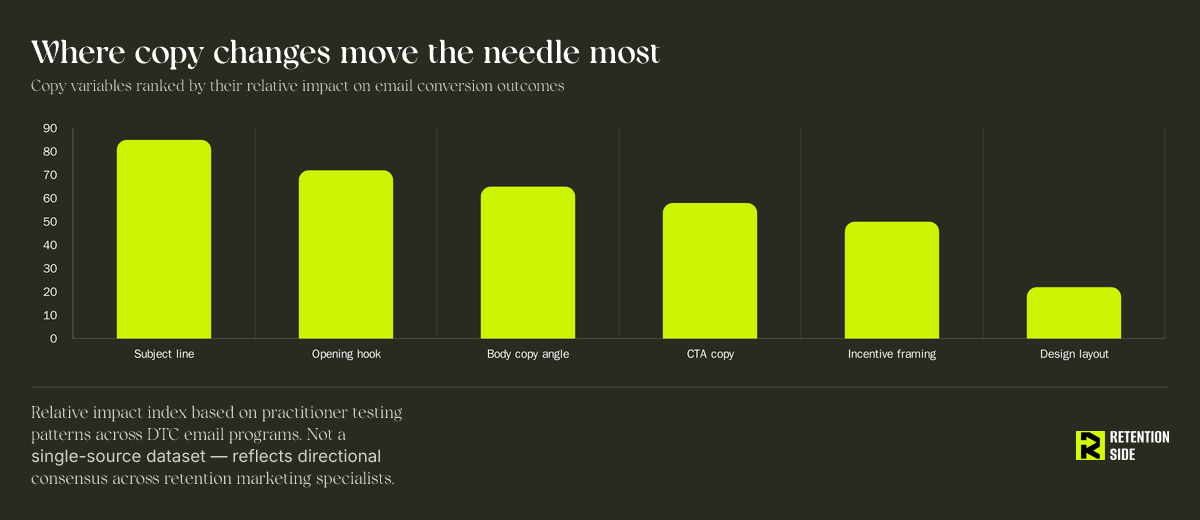
The variables worth testing in order of leverage:
Subject lines are the highest-leverage test because they affect whether the email is opened at all. Test different angles – curiosity versus specificity, direct versus narrative, personalised versus general – and do it with enough volume to reach significance before drawing conclusions. One useful frame from Dotdigital’s analysis of subject line performance: the patterns that drive opens are often the opposite of those that drive clicks and revenue, which is why testing for open rate alone can lead programs in the wrong direction.
Opening hooks affect whether the email is read after it is opened. This is the least-tested high-leverage variable in most email programs. A systematic test of the first two sentences of a flow email can produce substantial improvements in the downstream conversion rate.
Incentive framing – not the discount amount, but how the incentive is described – affects conversion rate in ways that are often surprising. “Save 15%” and “Get 15% off your next order” and “Here’s £/$ toward your second order” can produce materially different results from the same underlying offer. The framing that works depends on the customer segment and the point in their lifecycle.
CTA copy is the most commonly tested variable and often the least significant on its own. “Shop now” versus “Claim your offer” versus “Get the look” – these differences matter, but they matter less than whether the subscriber was engaged enough by the subject line and body copy to click in the first place.
One note on testing and metrics: the right metric for flow copy tests is the conversion action the flow is designed to produce – a purchase, a review submission, a cross-sell click – not open rate. Testing for open rate improvements while ignoring what happens after the open measures the wrong thing. The goal of email copywriting is not more opens. It is more customers buying again.
Where ecommerce email copy fits in the broader retention system
Email copy does not operate independently of the rest of the customer experience. The message in an email creates expectations. When the subscriber clicks through to a landing page that does not match the email’s tone, offer, or visual register, the experience breaks down. McKinsey research has highlighted that customised landing pages aligned to the email’s offer can produce conversion rate uplifts of 25% or more – a signal of how much value leaks when the email and the destination are misaligned. When an SMS message contradicts the framing of an email sent the same day, the customer feels the inconsistency even if they cannot articulate it.
At Retention Side, we think about copy as one layer of a retention system that includes email, SMS, push notifications, direct mail, loyalty programs, WhatsApp, and Viber – each with its own copy conventions, character constraints, and relationship to the customer. An SMS message is not a short email. A push notification is not a truncated campaign. Each channel has its own logic, and the copy that works in one does not automatically translate to another. For a practical view of how Shopify lifecycle marketing ties these channels together across customer stages, that piece covers the full architecture.
What does translate across channels is the underlying clarity of what the brand is trying to communicate and the quality of the relationship the copy is trying to build. Brands that invest in that clarity across every channel find that the sum of the system is more than the individual parts – because the customer experiences a coherent brand at every touchpoint, not a brand that sounds different depending on where they encounter it.
The ecommerce brands that extract the most from email – and from the retention system more broadly – are the ones that treat copy as a strategic function rather than a production task. They audit their flows for stale language. They test subject lines systematically rather than going with instinct. They build campaign calendars that balance promotion with genuine value. And they make sure every email, from the first welcome message to the final win-back attempt, is asking and answering one question clearly: why does this customer need to hear this right now?
That question, asked consistently, is the difference between an email program that sends emails and one that builds a relationship with the customers who make repeat purchase the norm rather than the exception.
Conclusion
Ecommerce email copywriting is not about finding the right subject line formula or the perfect CTA button. It is about understanding what each email in a retention system is trying to accomplish, writing to that specific objective, and doing it in a way that earns the subscriber’s attention rather than simply demanding it.
The four pillars of a strong email program – deliverability, list growth, automated flows, and campaigns – each make different demands of the copy layer. Subject lines that earn opens without creating expectation gaps. Welcome copy that builds a relationship rather than just delivering a coupon. Flow copy that speaks to the lifecycle moment the customer is actually in. Campaign copy that balances promotion with the kind of content that makes subscribers value being on the list in the first place.
Getting this right is not a one-time exercise. Flows go stale. Brand voice evolves. Subscriber expectations shift. The copy discipline that produces compounding retention results is one that treats every email as a hypothesis to test and every send as an opportunity to do better than the last one.
If the email program at your brand is producing sends but not strengthening the relationship with your customers over time, the copy layer is usually where the gap lives. That is exactly the kind of structural issue Retention Side was built to find and fix.