
Jewelry & luxury
email marketing
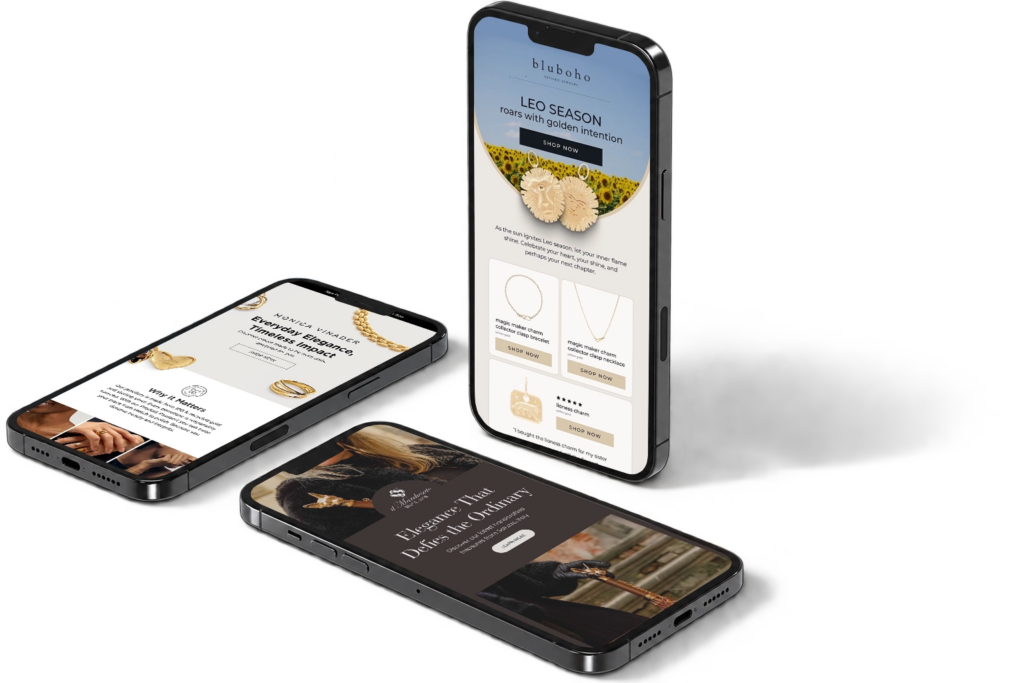
Build confidence before purchase and lasting affinity afterward with considered communication, product care, and relevant gifting moments.








your biggest
challenges
HIGH-CONSIDERATION PURCHASES
Considered purchases carry unanswered questions. Materials, sizing, delivery, and returns all affect the decision. Uncertainty at checkout can delay a meaningful purchase even when the customer likes the piece.
GIFT BUYERS ARE NOT ALWAYS WEARERS
Gift orders can misrepresent the buyer’s own style. A necklace chosen for someone else does not establish the purchaser’s preferences. Follow-up built on that assumption can miss both the next gift and the buyer’s personal interest.
PROMOTIONS CAN ERODE POSITIONING
Frequent discounts can weaken premium positioning. Buyers learn that waiting may produce a better price. Full-price demand and contribution margin suffer when promotions become the main reason to purchase.
LONG GAPS BETWEEN OCCASIONS
Long gaps separate genuine occasions. A satisfied customer may have no immediate need for another piece. Lack of a new occasion or styling context can limit purchase frequency without indicating dissatisfaction.
We Solved
This Before
For Olive & Piper, we reported an additional $250,000 in revenue over 120 days after fixing deliverability and flows. The result is published in our client-results overview. It connects the work on email reach and automated customer journeys with a commercial outcome, rather than presenting a design as the result.
Separately, the jewelry account screenshot below records $144,634.60 in email/SMS-attributed revenue for September 2025: $61,223.83 from flows and $83,410.77 from campaigns. That dated account example shows both parts of a retention program contributing. Full-price repeat purchases and contribution margin show how that channel activity supports the longer customer relationship.
our Process
Research & Discovery
Find what helps buyers commit.
We separate collection interest, gifting intent, consideration time, and purchase history. Service questions about sizing, delivery, and materials are reviewed alongside the points where buyers leave the journey.
The audit establishes which preferences are declared, which product relationships are reliable, and how long customers take to return. Its output is a prioritized evidence brief for purchase confidence, gifting, and full-price repeat demand. See our email marketing service for the delivery scope.
Activities
Collection & Positioning Review
Gifting Intent Data Audit
Consideration Window Analysis
Materials & Sizing Content
Occasion Purchase Analysis
Service Experience Review
Deliverability & Data Audit
Outputs
A clear view of gifting and self-purchase behavior.
Identified gaps in materials, sizing, and purchase reassurance.
A map of relevant occasions and collection interests.
A retention roadmap aligned with the brand's positioning.
Customer Journey Workshops
Separate the wearer from the gift buyer.
We work through a self-purchase, a deadline-sensitive gift, a sizing question, and a later occasion. Each scenario identifies the next useful answer and whether it belongs in an automated journey, a campaign, or a service conversation.
The workshop assigns ownership of delivery promises, product details, and client-service handoffs. A decision map makes the role of each touchpoint explicit before the team writes creative or sets eligibility rules.
Activities
Gift vs Self-Purchase Paths
Purchase Confidence Mapping
Sizing & Delivery Friction
Unboxing & Care Journey
Customer-Selected Occasions
Client Service Handoffs
Outputs
Separate journeys for the purchaser and the intended recipient.
Mapped moments for advice, service, and delivery reassurance.
A plan for care and styling between purchases.
Optional occasion communication based on customer preferences.
Implementation & Execution
Build an educational calendar around real occasions.
Styling emails can show how to pair pieces with a work outfit, wedding look, or evening wardrobe. Product stories explain materials and craftsmanship; post-purchase messages cover care and complementary pieces. We use shared occasion preferences and collection interests to time recommendations. Promotional offers support the calendar while useful styling gives customers a reason to buy at full price.
Before launch, we check that the recommended pieces, outfit examples, and service information fit the collection being promoted. Email journeys and campaigns then work together to build confidence from first discovery through gifting, care, and a later occasion.
Activities
Gifting Preference Capture
Consideration & Cart Flows
Care & Styling Journeys
Occasion Reminder Planning
Collection & VIP Segmentation
Client Value Tracking
Outputs
Consideration flows that answer real purchase questions.
Care and styling journeys for the products customers own.
Gifting and collection segments with useful service touchpoints.
A baseline for repeat purchases, client value, and margin.
Continuous Optimization
Learn which content earns full-price demand.
We compare styling, gifting, and collection stories by repeat purchases, full-price revenue, and contribution margin. Consideration time and customer questions help refine the next message, especially for higher-value pieces.
We also review whether customers return for complementary pieces or only during offers. That distinction helps shape the educational calendar, giving useful styling and product stories time to build demand without making every send a price-led event.
Activities
Occasion Timing Tests
Craftsmanship Content Review
Premium Offer Experiments
Gift-Buyer Segment Analysis
Service & Repeat Cohort Review
Margin & LTV Tracking
Outputs
Evidence on content that creates confidence without constant incentives.
More relevant occasion and collection communication.
Clear decisions on client segments and service improvements.
A test plan that balances repeat revenue with premium positioning.
JEWELRY & LUXURY
CUSTOMER LIFECYCLE MAP
Separate the purchaser from the wearer at the first decision. A gift order moves through delivery reassurance and recipient care; a self-purchase moves through fit, first wear, and styling. A later occasion or collection interest starts a new consideration stage instead of repeating the original purchase sequence.
Explore customer re-engagement around the next relevant occasion.
BEEN THERE DONE THAT
Why should
you care?
Full-price repeat demand matters more than a calendar full of discounts.
What commercial progress looks like
F1-to-F2 conversion
A second purchase within a realistic occasion-led window.
Purchase frequency
Repeat orders by collection and gifting intent.
Customer lifetime value
Customer value across occasions and personal purchases.
Contribution margin
Full-price and discounted order value after fulfillment and returns.
The next jewelry purchase may follow an occasion months after the first. The value of retention lies in remaining part of that decision while protecting the reason the customer chose the brand, rather than generating another order through routine price cuts.
Gift buyers and self-purchasers do not represent the same future demand. Comparing their F1-to-F2 conversion and purchase frequency over an appropriate window reveals whether repeat revenue is coming from a lasting customer relationship or a sequence of unrelated gifting occasions. Customer lifetime value adds the longer view across collections.
Full-price repeat demand protects the value of a premium brand. Contribution margin shows what is left after product costs, fulfillment, returns, and incentives. Relevant styling and service can support that demand, while cart recovery resolves a specific purchase hesitation instead of automatically discounting the piece.
What commercial progress looks like
F1-to-F2 conversion
A second purchase within a realistic occasion-led window.
Purchase frequency
Repeat orders by collection and gifting intent.
Customer lifetime value
Customer value across occasions and personal purchases.
Contribution margin
Full-price and discounted order value after fulfillment and returns.
ECOMMERCE
CLIENT RESULTS
We measure repeat purchase rate, conversion from the first order to the second, customer lifetime value, purchase frequency, and contribution margin. Our client reporting connects those business outcomes with campaign and lifecycle-flow performance, rather than judging success by opens or clicks alone.

Who this is/ISN’t for
Jewelry and luxury retention works best when the team can translate product expertise, styling, and service into a considered customer experience.
STRONG FIT
1. BRANDS WITH A PROVEN ACQUISITION ENGINE
You have customers choosing your pieces and a clear position in the market. Existing collection interest, gifting orders, and repeat purchases give us evidence for building a useful communication plan.
2. WILLING TO IMPROVE THE FULL FUNNEL
You are willing to improve material details, sizing help, gifting information, and delivery reassurance alongside email. Each message should lead to a purchase experience that maintains the same level of confidence.
3. TEAMS THAT KEEP CHALLENGING THEMSELVES
Your team can contribute styling knowledge and test educational content over time. We review full-price buying, repeat behavior, and margin rather than judging every message by immediate promotional sales.
NOT A FIT
1. RETENTION BEFORE ACQUISITION
If shoppers do not yet understand why they should choose your brand, positioning and acquisition need attention first. More follow-up emails cannot substitute for a compelling product proposition.
2. SET-AND-FORGET MENTALITY
Styling, collections, and gifting needs evolve. This work requires current product information and regular editorial input, rather than a sequence that repeats the same offer indefinitely.
3. COMFORT OVER PROGRESS
If every campaign must lead with a discount and useful content has no space in the calendar, reducing promotion dependency will be difficult. We need room to build reasons to buy beyond price.
Before working with Retention Side, most of our growth came from paid ads. When ads were performing, things looked good. When they weren’t, cash flow got tight pretty quickly. Over the past months, our repeat customer rate moved close to 40%, and that changed how the business feels. Revenue is still seasonal, but it’s far less stressful.

Founder · Beauty & Skincare
Nevena Komazec
Frequently Asked Questions
How can jewelry email marketing work between infrequent purchases?
Answer the objection closest to the decision. If the customer is reviewing a ring, sizing information and an accessible service route matter more than another broad collection email. Delivery deadlines belong in a gift journey; material and care details belong with the piece being considered. The first incentive should not replace those answers.
How do you distinguish gift buyers from customers shopping for themselves?
Capture gifting intent where it helps the experience and combine it with order information. Avoid assuming a gift reflects the purchaser’s own style or size. Follow-up should offer relevant gifting service or invite the customer to set preferences.
Can luxury retention work without frequent discounting?
Yes. Build tests around product confidence, craftsmanship, service, collection relevance, and customer-selected occasions. Evaluate profitable repeat buying and brand positioning rather than treating a coupon as the default reason to return.
What should a post-purchase jewelry journey include?
Delivery reassurance, product-specific care, relevant sizing or service information, and styling ideas. A later review or feedback request should follow a suitable ownership period. Any next-product recommendation should fit the purchase context.
How do you judge results when jewelry buying cycles are long?
Use realistic purchase windows and distinguish gift, self-purchase, and collection cohorts. Review repeat revenue, margin, service engagement, and the next relevant order instead of applying a consumables-style monthly reorder target.
Build your next stage of
customer growth.
Build your next stage of
customer growth.
Bring your customer journey, account data, and commercial goals. We’ll identify the retention opportunities that fit your products and buying cycle.