

Most ecommerce brands launch a loyalty program the same way: install an app, turn on points, add a widget to the site, and call it a retention strategy. Six months later, enrollment looks fine, redemption is flat, and the program has quietly become another line item that doesn’t move the P&L.
That’s not a loyalty problem. It’s a strategy problem. A loyalty program is not a feature you bolt onto your store. It’s a retention mechanism that has to be designed around your repeat purchase economics, your customer data, and the rest of your lifecycle system, especially email and SMS. When we build loyalty strategy at Retention Side, we treat it the same way we treat flows and segmentation: as a system that either reinforces the rest of retention or works against it.
This article covers how to think about loyalty program strategy for ecommerce brands doing meaningful volume, not the beginner version of “what is a loyalty program.”
Key takeaways
- Loyalty program design should match your category’s repeat purchase economics. A points program built for a consumables brand will underperform for a low-frequency, high-ticket category, and vice versa.
- Points-based programs work best as a habit-forming layer. Tiered/VIP programs work best as a status and spend-concentration layer. Most mature brands eventually run both.
- A loyalty program only becomes personalization-ready once its data (points balance, tier, redemption history) flows into your email and SMS platform, typically Klaviyo, as events and profile properties.
- Loyalty flows need to be built the same way you build any other lifecycle flow: mapped to specific behavior triggers, not just a generic “welcome to the program” email.
- The real risk of a poorly designed loyalty program isn’t low enrollment. It’s training your best customers to wait for discounts, which erodes full-price purchasing over time.
- Enrollment rate and points issued are vanity metrics. The KPIs that matter are repeat purchase rate among members, revenue share from the program, and tier-to-tier progression.
Why loyalty programs are a retention system decision, not a marketing add-on
A loyalty program touches almost every part of your retention system at once. It changes what your welcome flow says. It changes how your post-purchase flow is sequenced. It changes what segments you can build for campaigns. It changes the math on your discounting strategy. Treating it as an isolated project, something the ops team sets up once and marketing occasionally emails about, is why so many loyalty programs plateau.
The brands that get real value out of loyalty treat it as connective tissue between acquisition, retention, and lifetime value. The program has to answer a specific question: what behavior are we trying to reinforce, and what data do we need to reinforce it? For a consumables brand, that behavior is reorder cadence. For a fashion brand, it’s full-price purchase frequency and reduced return rate. For a high-ticket brand, it might be referral generation rather than repeat purchase at all, since repeat purchase itself is structurally rare.
This is also why loyalty strategy should never be handed to a single-purpose vendor without a plan for connecting it back into your core lifecycle channels. A loyalty app that sits in isolation from Klaviyo is a database, not a strategy.
Match your loyalty program design to your repeat purchase economics
Before choosing a loyalty model, you need an honest read on your category’s natural repurchase behavior. Repeat purchase rate varies enormously by vertical, and that variance should directly shape how aggressive, how frequent, and how discount-heavy your loyalty mechanics are.
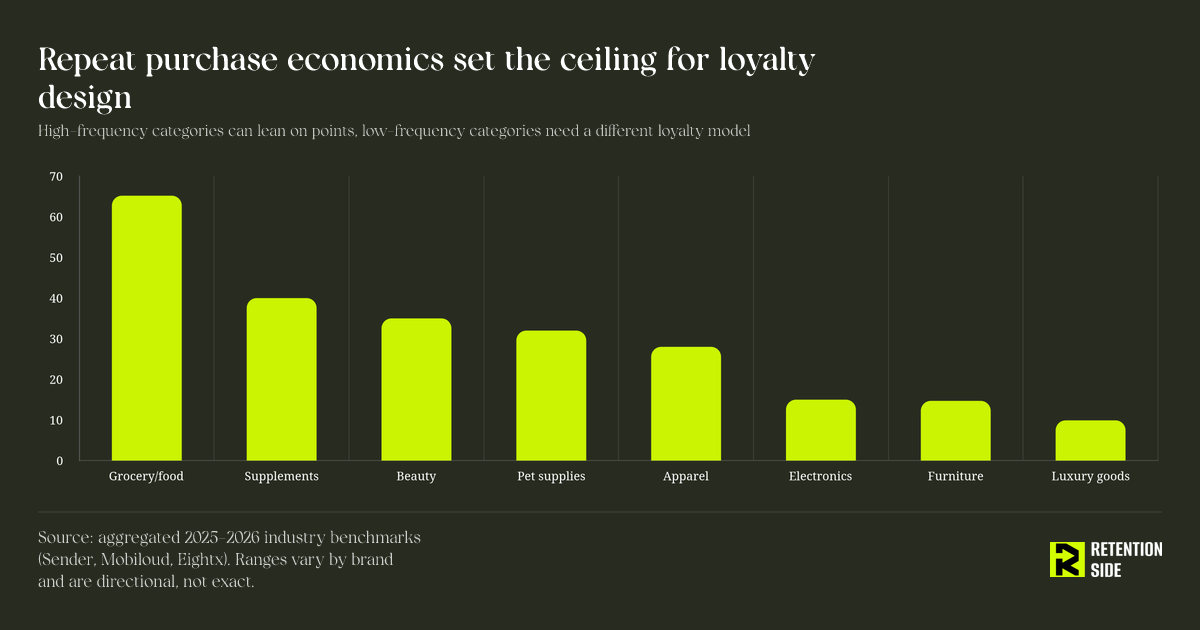
Grocery, supplements, and beauty brands sit in categories where customers are already inclined to come back on a predictable cycle. A points program works well here because there are enough transactions for points to accumulate and feel meaningful. Furniture, electronics, and luxury goods sit at the other end. Customers might buy once every one to three years, so a points system with a 12-month expiration is functionally useless to them. For these categories, loyalty strategy should lean toward referral mechanics, VIP status for high-AOV buyers, or long-cycle nurture that keeps the brand top of mind for the next purchase occasion, rather than a redemption loop.
The mistake we see most often is a brand copying a loyalty structure from a case study in a completely different category. A skincare brand’s points program and a furniture brand’s loyalty program should not look the same, because the underlying purchase behavior they’re built to reinforce isn’t the same.
The three loyalty models, and what each one is actually good at
There are three loyalty models worth taking seriously for ecommerce: points-based, tiered/VIP, and paid membership. Each rewards a different behavior, and each has a different failure mode.
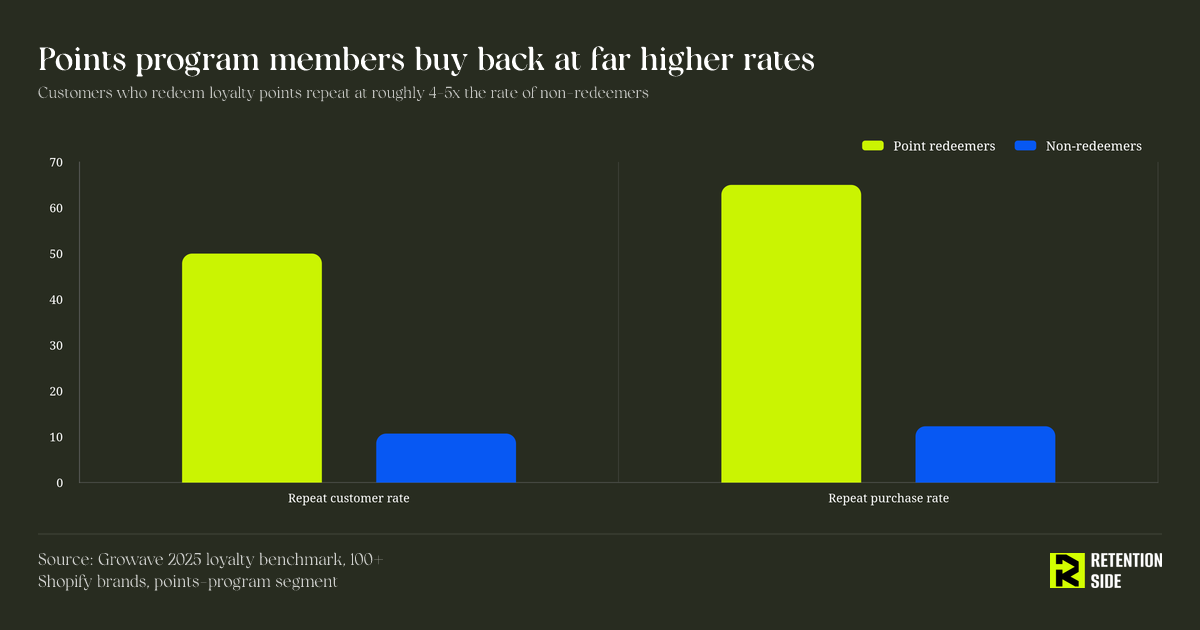
Points-based programs reward transactional behavior: purchases, reviews, referrals, social follows. They’re a low barrier to entry and work well as a habit-forming layer, especially for mid-price, frequently-purchased categories. The data backs this up clearly. Across a 2025 benchmark of more than 100 Shopify brands, customers who actively redeemed points repeat-purchased at dramatically higher rates than non-redeemers.
The failure mode with points programs is setting the earn-to-redeem ratio too far out. If it takes $500 of spend to unlock a $5 reward, most customers will never bother engaging, and the program becomes invisible. The ratio should let a customer feel progress within their second or third purchase, not their tenth.
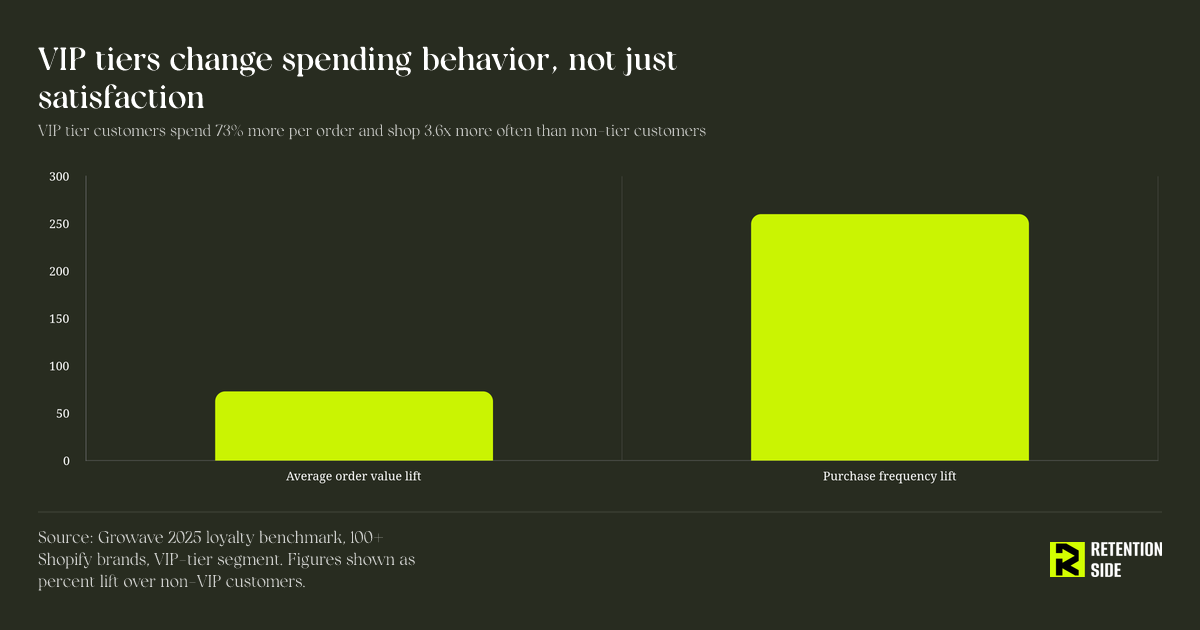
Tiered (VIP) programs reward status and spend concentration rather than individual transactions. They tap into loss aversion (nobody wants to drop from Gold back to Silver) and the goal gradient effect (“you’re $87 away from VIP status” is one of the more effective lines in retention marketing because it creates a visible finish line). Tiered programs consistently outperform flat points programs on revenue concentration, because they’re explicitly designed to reward your highest-value customers with meaningfully better treatment, not just marginally better discounts.
The failure mode here is building tiers around spend thresholds that don’t reflect your actual customer distribution. If your top 1% of customers and your top 20% both land in the same “Gold” bucket, the tier isn’t doing its job of concentrating attention and reward on the customers who deserve it most.
Paid/subscription membership (a flat annual or monthly fee for perks like free shipping, early access, or a standing discount) works when the perceived value clearly exceeds the fee and when purchase frequency is high enough to make the math obvious to the customer. It’s a smaller-fit model for most DTC brands, but it’s worth testing once you have enough repeat purchase data to know the fee will pay for itself within a customer’s first few reorders.
Most mature ecommerce brands eventually run a hybrid: points for everyday engagement, tiers layered on top for the customers who matter most financially. That combination lets you reward frequency and reward concentration at the same time, rather than picking one lever.
Connecting loyalty to Klaviyo: the data flow that makes personalization possible
A loyalty program only becomes strategically useful once its data leaves the loyalty app and starts informing your email and SMS decisions. This is the part brands skip, and it’s the part that actually determines ROI.
Loyalty platforms sync into Klaviyo (or whichever ESP you run) in two forms: events and profile properties. Events are things that happen, like “points earned,” “points redeemed,” “tier upgraded,” or “reward expiring.” Profile properties are the current state, like points balance, tier name, or lifetime spend. Once that data is in Klaviyo, it stops being loyalty-app trivia and becomes a segmentation and personalization asset.
This is where the deeper retention thinking comes in. A “points expiring” event isn’t just a redemption reminder, it’s a reactivation trigger for customers who’ve gone quiet. A “tier upgraded” event isn’t just a congratulations email, it’s an opportunity to reset expectations for what that customer should now experience from your brand. If your loyalty data sits in a separate dashboard that your email team checks occasionally, you’re leaving most of the value on the table. The program has to be wired into the same system that runs your flows and campaigns, or it functions as a rewards ledger instead of a retention lever.
Loyalty flows every ecommerce brand should build
Loyalty flows are behavior-triggered like any other flow in your account. They shouldn’t be treated as a single “welcome to our program” automation and left alone. At minimum, a properly built loyalty program supports:
- Program enrollment flow. Confirms sign-up, explains how to earn and redeem, and sets expectations for tier structure if you have one. This is an education flow, not a sales flow.
- Points earned flow. Confirms the points, shows the running balance, and nudges toward the next redeemable threshold.
- Points expiring flow. A time-sensitive reminder, ideally sequenced 30 and 7 days before expiration, that gives customers a real reason to come back and redeem rather than losing value silently.
- Tier upgrade flow. Congratulates the customer and clearly states what changed: new perks, new discount rate, new access. This flow does more for retention than most people expect because it validates the customer’s decision to keep buying from you.
- Tier at-risk / downgrade flow. For brands with annual tier resets, this flow nudges customers who are close to losing status, similar to a win-back flow but framed around loss aversion instead of a generic discount.
- Referral flow. Distinct from the loyalty program itself but often tied to the same point structure, this rewards customers for bringing in new buyers rather than just purchasing again themselves.
- Redemption confirmation flow. Confirms the reward was applied and reinforces the value delivered, which closes the loop psychologically and encourages the next earn cycle.
None of these flows are “finished” once they’re built. Like every flow in your Klaviyo account, they should be tested on subject lines, timing, and incentive framing over time. A loyalty flow that converts well in year one can flatten out as your audience becomes more familiar with the mechanics, which is a normal sign that it needs refreshed creative or a revised trigger, not proof that loyalty doesn’t work.
Why loyalty should reduce, not increase, discount dependency
This is the point where loyalty strategy and campaign strategy have to be discussed together, because they’re easy to get backwards. A loyalty program that’s built purely around percentage-off rewards trains your best customers to expect a discount every time they buy, which is the opposite of what you want from your highest-value segment.
The stronger approach treats discounts as one reward type among several, not the default. Early access, exclusive products, free shipping thresholds, birthday perks, and experiential rewards (events, priority support, personal styling, sneak peeks) all reinforce loyalty without teaching customers to wait for a percentage off before they buy. This matters more as a brand scales, because margin erosion from an over-discounted loyalty program compounds across your highest-frequency buyers, the exact customers you can least afford to train into discount-only behavior.
It also connects back to a broader principle in retention marketing: if your subscribers, loyalty members included, only hear from you during promotions, both engagement and full-price purchasing decline over time. A loyalty program with a healthy mix of status, access, and occasional discount protects against that pattern instead of accelerating it.
Measuring loyalty program performance beyond enrollment
Enrollment rate and total points issued are the two most commonly reported loyalty metrics, and they’re both close to meaningless on their own. A brand can have 60% program enrollment and almost no incremental revenue from it if members aren’t actually engaging with earn-and-redeem mechanics.
The KPIs that actually indicate a working program:
- Repeat purchase rate among members vs. non-members. This is the clearest signal the program is doing its job. If members and non-members repeat-purchase at similar rates, the program isn’t changing behavior.
- Revenue share from loyalty members. What percentage of total revenue comes from enrolled, engaged members. Strong programs often see this climb into the 20-30%+ range over time as more of your repeat base gets captured.
- Redemption rate. The share of earned points or rewards that actually get redeemed. Low redemption usually points to a reward structure that’s out of reach or a communication gap, not a lack of interest.
- Tier progression rate. For tiered programs, how many members move from entry tier to the next tier within a defined period. Stagnant tier movement usually means the spend thresholds are miscalibrated.
- AOV and purchase frequency lift. Comparable to what you’d track for any segment, measured specifically for loyalty members against a non-member control group.
If you’re only reporting sign-ups and points balances to leadership, you’re reporting activity, not impact. Tie the program back to the same revenue and retention metrics you already use to evaluate flows and campaigns, so it lives inside your regular retention reporting instead of existing as a separate loyalty dashboard nobody checks after the launch quarter.
Where loyalty fits inside a broader retention channel mix
Loyalty doesn’t have to live only in email. The programs that perform best treat loyalty status as data that can activate across whichever channels your customers actually respond to, not just the inbox. A VIP tier upgrade is a natural trigger for an SMS notification given how time-sensitive and personal that moment feels. Points-expiring reminders can work well as push notifications for customers who’ve installed your app. For brands with a loyal, high-touch customer base, a physical rewards card or a direct mail piece for top-tier members can create a tangibility that email and SMS can’t replicate. International brands using WhatsApp or Viber for customer service can extend loyalty updates into those same threads rather than forcing customers into a separate channel.
This is consistent with how we think about retention generally at Retention Side: email is almost always the starting point because it’s the most cost-efficient and data-rich channel, but the strongest retention systems expand into the channel mix that matches actual customer behavior and preference, not the channel mix that’s easiest to set up. Loyalty data is some of the richest signal you have for deciding which customers deserve an SMS touch, which deserve a direct mail piece, and which are perfectly well served by email alone.
Common loyalty program mistakes we see in ecommerce accounts
A few patterns show up repeatedly when we audit loyalty programs for new clients:
The reward ratio is too far out of reach. Customers need to feel progress within two or three purchases. If your program requires a year of purchasing to unlock a meaningful reward, most customers will never engage past enrollment.
The program was never connected to Klaviyo (or the ESP) in any meaningful way. Points balances and tier status exist in the loyalty app’s dashboard but never make it into segmentation or flow logic. This is the single biggest source of wasted loyalty investment we see.
Every reward is a percentage discount. No status, no access, no experiential value, just recurring markdowns that compress margin and normalize discount-seeking behavior among the customers who should be your most profitable segment.
Tiers are copied from a competitor without checking spend distribution. If your actual top spenders don’t cleanly separate into the tier thresholds you’ve set, the “VIP” tier ends up too crowded to feel exclusive or too empty to matter.
The program launched and was never revisited. Like flows and campaigns, loyalty mechanics need ongoing testing: reward types, point values, tier thresholds, and messaging cadence should all be reviewed against actual redemption and repeat purchase data at least twice a year.
Loyalty is judged in isolation from everything else happening in the account. If loyalty-driven revenue dips, it’s worth checking whether that’s a program design issue or a downstream effect of acquisition quality, website friction, or broader engagement decline, the same diagnostic questions we’d ask about any other retention metric drop.
Conclusion
A loyalty program works when it’s designed around how your specific customers actually behave, not around a generic points-and-badges template. That means starting with your category’s repeat purchase economics, choosing a model (or a hybrid of models) that reinforces the right behavior, and then making sure the resulting data actually reaches your email and SMS system so it can inform segmentation, flows, and campaigns instead of sitting in a separate dashboard.
The brands that get real revenue out of loyalty treat it the way they treat every other part of the retention system: something to build deliberately, connect across channels, measure against real KPIs, and keep refining. Enrollment is the easy part. Turning that enrollment into repeat purchase behavior, tier progression, and reduced discount dependency is the actual strategy, and it’s where most of the durable value sits.