


A customer buys a pair of trail boots, a bike or a tent. They love it. Then nothing happens for two years, because nothing needs to. The product works, the season ends, and your brand slips out of their head.
That is the core problem in sporting goods customer retention. Your customers are not disloyal. Your category just gives them very few natural reasons to come back. If your retention program only activates when someone is ready to buy, you will miss most of the relationship.
This guide is for established sports and outdoor brands that already understand funnels and flows. It focuses on what changes when the product is durable, the season is short and the buying cycle is long.
Key takeaways
- Long gear cycles mean the relationship is built or lost in the gaps, so the work happens in flows, segmentation and cadence rather than in the sale itself.
- Durables and consumables need different post-purchase logic. Treating them the same wastes the early window after a first order.
- Winback timing should come from your own repurchase data, not a default 90-day cutoff.
- Sports loyalty programs trail cross-sector averages on points usage, so design around progress, community and referrals before discounts.
- Measure first-to-second order conversion and reactivation, not just overall retention rate.
Why the gap between purchases is where retention is decided
Bluecore’s 2025 Customer Growth Benchmarks Report draws on more than 100 retailers across seven verticals, using the full 2024 calendar year. Overall reactivation rates rose 10.6% from 2023 to 2024. Sports and hobbies was the only one of the seven verticals that did not see year-over-year growth in reactivation rate. These are Bluecore’s own retail benchmarks, not an audit of any single store, but the direction matters for this category.
The same report puts a number on the cost of ignoring the gap. Retailers focused on channel-led growth average a three-year customer retention rate of 22%. Retail leaders that have embraced what Bluecore calls customer movement average 59%. Bluecore also reports that nearly three-quarters of a retailer’s customers are one-time buyers, and that only 6% of new customers are still buying three years later.
Read that through a sporting goods lens. If you sell a $400 jacket or a $1,200 bike, most lifetime value is decided between purchases. The sale itself is a single event. What you do across the next 18 months decides whether the customer buys the helmet, the maintenance kit, the next season’s layers or the replacement bike from you or from someone else.

The gap between purchases is quiet for the customer, but it does not have to be quiet for the brand: small touchpoints across the seasons are what decide who the customer turns to next.
Why sporting goods behaves differently from other categories
Practitioner guides such as JeriCommerce’s sports and outdoor retention piece describe the category as a mix of two rhythms: long cycles for big-ticket gear like boots, bikes and tents, and frequent purchases of consumables like nutrition, maintenance products and apparel. That framing is qualitative, but it matches what we see in real accounts. Most sports brands run both rhythms at once, often inside the same customer.
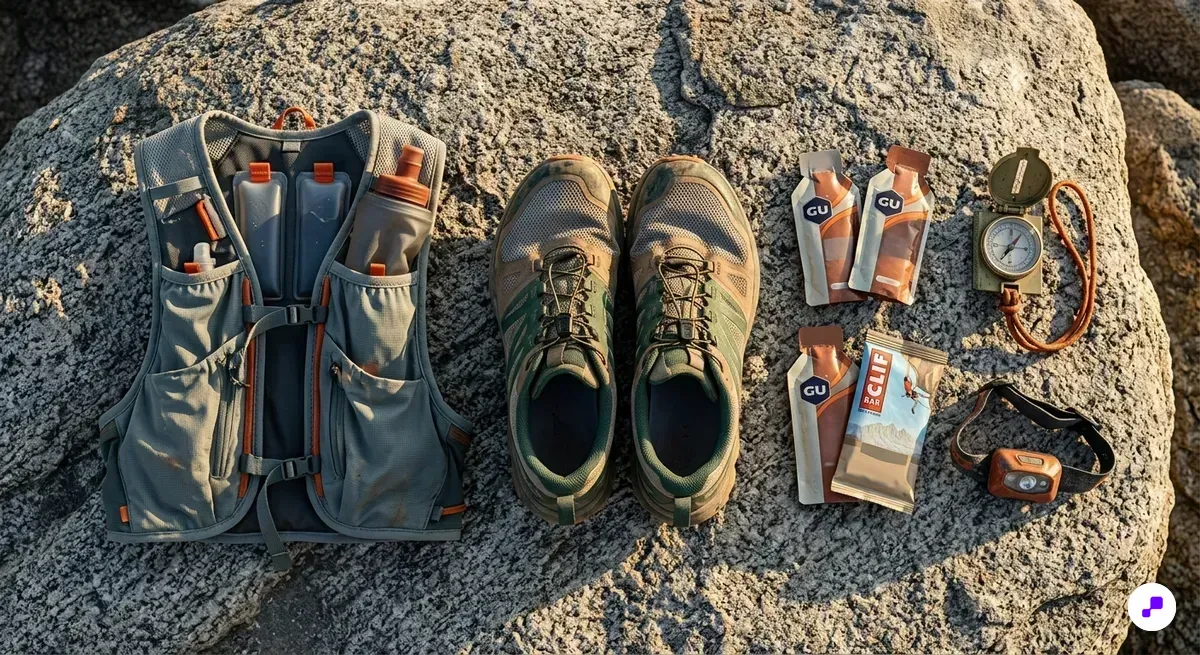
Gear brands run the two rhythms side by side, so one retention program has to carry long-cycle durables and frequent consumables at the same time. Image credit: JeriCommerce.
This matters because retention mechanics should follow category economics. Short-cycle categories suit points programs because transactions come often enough for points to accumulate and feel meaningful. Long-cycle categories do not. If a customer buys big-ticket gear once every couple of years, a points program with near-term expiry is functionally useless to them. For that part of your catalog, lean toward referral mechanics, VIP status for high-AOV buyers and long-cycle nurture that keeps the brand present until the next purchase occasion.
Benchmarks carry the same caveat. The same repeat purchase rate can be reasonable in one category and a serious problem in another, because consumables have a built-in replenishment cycle and durables do not. Compare yourself to your own history and your own mix of products before comparing to a headline number.
Flows that carry the relationship between gear purchases
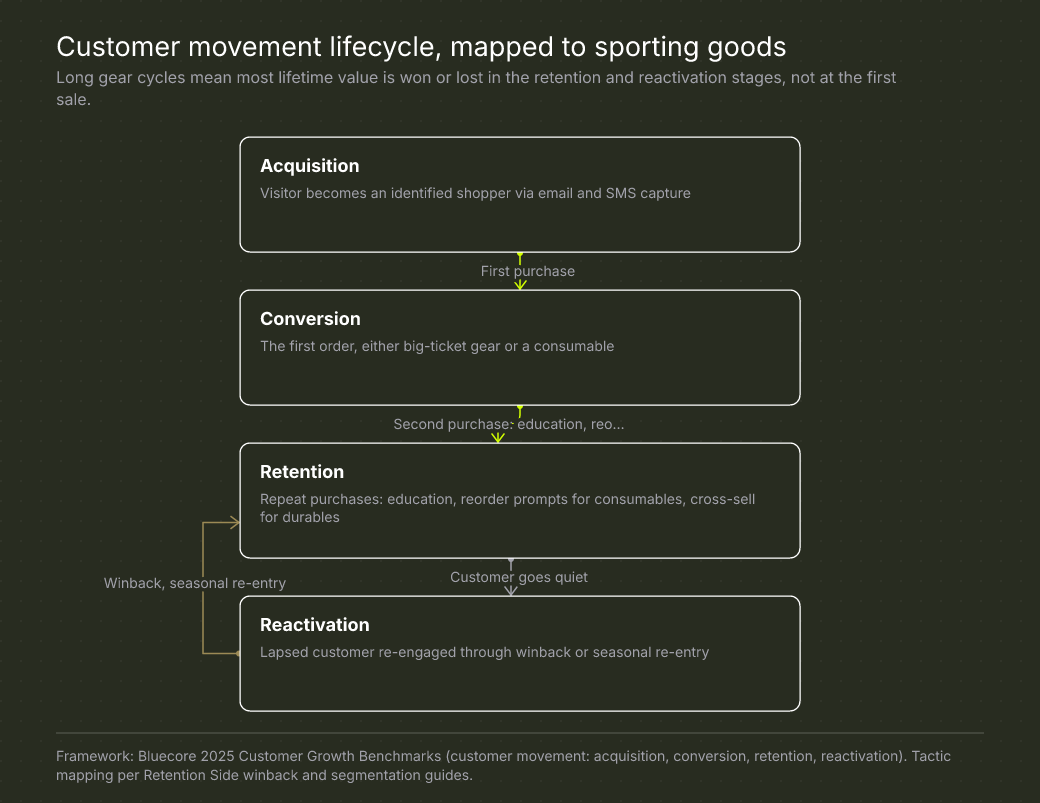
Think of the customer path as a loop rather than a funnel. Bluecore’s customer-movement framework moves from acquisition to conversion to retention and then reactivation, with lapsed customers re-entering retention. Mapped to a sports brand, it looks like this:
- Acquisition: a visitor becomes an identified shopper through email and SMS capture.
- Conversion: the first purchase, either gear or a consumable.
- Retention: repeat purchases, supported by education, reorder prompts for consumables and cross-sell for durables.
- Reactivation: a customer who has gone quiet is re-engaged through winback or a seasonal re-entry point.
Split post-purchase logic by product type
Repeat buyers most often purchase the same product again rather than a cross-sell. That pattern is strongest in consumables, where a replenishment prompt beats a curated product grid in the early post-purchase window. For durables, cross-sell is the primary early play: the person who bought the tent needs a footprint, a repair kit and a better sleeping pad.
Review requests need the same discipline. Ask once the customer has had enough time to use the product, not when the parcel lands. A review request for hiking boots sent three days after delivery gets you a review of your shipping speed.
Calibrate winback to your real repurchase window
Define “lapsed” by your actual average repurchase window. A customer on a short reorder cycle for supplements can be lapsed well before a generic cutoff closes. A long gap without a second order may be completely normal for someone who bought a backpacking tent. A default window gets both wrong.
Structure the sequence so the first email gives a relevant, low-pressure reason to return and carries no discount. Earn the incentive later in the sequence. Bring in SMS only after the email sequence has run without response, not in parallel. Customers who still open email can be reached through content and offers. Those who have been unengaged for a long time should move toward a sunset segment to protect deliverability, because inbox placement is the foundation everything else rests on.
Winback often underperforms not because the idea is wrong but because it gets less optimization attention than flows closer to acquisition. In a category where Bluecore’s data shows reactivation stalling, that neglect is expensive.
Ask for the sport early
Sport-based segmentation is the cheapest personalization available to you. A trail runner, a climber and a cyclist should not receive the same lifecycle content, and you do not need to guess. Ask for sport and discipline at welcome, store it as zero-party data and let it drive flow content, campaign targeting and off-season cross-sport recommendations.
Loyalty design that fits sports audiences
Loyoly publishes a sports loyalty and referral benchmark based on the ecommerce brands on its own platform. It is platform-reported data, not an industry census, and it was last updated on October 19, 2026. Even so, the pattern is instructive:
- Sports participation rate: 3.4% versus a cross-sector average of 5.1%.
- Points usage rate: 8.4% versus 10.7%.
- Rewards redemption rate: 33.4% versus 37.7%.
- Referral conversion rate: 34.8% versus 31.2%, the one KPI where sports programs beat the average.
- New customer rate from referrals: 0.57% versus 0.60%.
Loyoly defines referral conversion as the share of referrals that make a first purchase. So people in this category are comparatively good at pulling friends in, even though they engage less with points. That fits a category where people ride, run and climb together. Points-first design is not what wins these customers.
Design for progress, not just points
The earn-to-redeem ratio should let a customer feel progress within the second or third purchase, not the tenth. This matters because customers who actively redeem rewards repeat-purchase at much higher rates than those who do not. For long-cycle buyers, that means building status, early access to new product, referral rewards and experiential perks (events, priority support, sneak peeks) rather than relying on points alone.
Be careful with discount-only rewards. They train your best customers to wait for markdowns and erode margin among your highest-frequency buyers. Treat a discount as one reward type among several. Early access, exclusive product and free-shipping thresholds reinforce loyalty without conditioning.
Wire loyalty data into the rest of the stack
Loyalty data needs to reach your email platform. A points-expiring event is a reactivation trigger for a quiet customer. A tier upgrade resets expectations and deserves its own message. From there, activate across channels: SMS for tier upgrades, push for points-expiring reminders, direct mail or a physical rewards card for top tiers. If you want the wider logic of how to choose among those channels, we walk through it in what channels make a good eCom retention strategy.
Campaigns and cadence between drops
Flows handle behavior. Campaigns handle the calendar, and sports has one of the strongest calendars in retail. Practitioner tactics from JeriCommerce include pre-season gear-check campaigns ahead of each major season, replacement reminders matched to product wear, off-season cross-sport recommendations and end-of-season trade-in programs that award loyalty points. Community activities such as group runs and ambassador programs give customers a reason to stay connected when they are not shopping.
The risk is a promo-only calendar. If subscribers only hear from you during sales, engagement and full-price purchasing decline over time. Balance seasonal and lifecycle anchor campaigns with educational, value-driven sends: how to care for gear, how to prepare for a season, how to pick the next piece. Retention Side’s own analysis of post-purchase programs points the same way. Generic early percentage-off sends tend to train discount-waiting and depress repeat rate, while well-timed first-to-second-order flows lift it.
Email usually comes first, but it should not carry the whole relationship. Add SMS, push, direct mail and community touchpoints according to audience behavior, cost and customer preference, not because a channel exists.
Measuring sporting goods customer retention
Shopify’s customer retention rate guide defines retention rate as the percentage of customers who continue doing business with a company over a period of time. It also lists repeat purchase rate, churn rate, customer lifetime value and customer satisfaction as companion KPIs. For a long-cycle category, a single annual retention percentage hides too much, so build a measurement set instead:
- Returning customer rate: your primary accountability metric for the program. Define the window clearly so the number means something.
- First-to-second order conversion: the leverage point. Early repeat behavior is a more reliable signal of long-term value than AOV or site conversion.
- Reactivation rate by segment, plus the repeat purchase rate of reactivated cohorts after their return order. A winback that brings people back for one discounted order is not a win.
- Average time between orders: if it shortens, your post-purchase and cross-sell sequences are working.
- Revenue from retention channels: relative to investment.
The second purchase compounds. Retention Side’s published post-purchase analysis finds that getting a customer to a second order nearly doubles their likelihood of placing a third. Bluecore separately reports that once someone buys twice, the likelihood of a third purchase goes up by 95%. These come from different datasets with different methods, so treat them as two sources pointing in the same direction rather than one confirmed figure.
Finally, a small minority of customers usually generates a disproportionate share of lifetime revenue. Identify that group first, then protect it with VIP communication, tiered rewards, personalized outreach and direct mail when they go quiet across digital channels. Their behavior should also feed acquisition targeting and onboarding.
Frequently asked questions
What is a reasonable customer retention rate?
It depends on the category. Consumables and durables retain on different rhythms, so a universal number misleads. Bluecore’s benchmark shows how wide the range can be: 22% three-year retention for channel-led retailers versus 59% for customer-movement leaders. Benchmark against your own prior periods and your own product mix, and define the measurement window before you compare anything.
How long should a sporting goods brand wait before sending a winback email?
Use your own repurchase data rather than a default window. A customer buying nutrition products may be overdue within weeks, while a customer who bought a tent may be perfectly normal at a much longer gap. Make the first email a low-pressure reason to return with no discount.
Do loyalty programs make sense for big-ticket gear brands?
Yes, when they are designed for the long cycle. Points that expire before the next natural purchase do little. Referral mechanics, VIP status for high-AOV buyers, experiential rewards and long-cycle nurture fit better, and Loyoly’s sports data shows referral conversion is where this category over-indexes.
Does the 80/20 rule apply to customer retention?
Treat it as shorthand rather than a law. What holds in practice is that a small minority of customers generates a disproportionate share of lifetime revenue. Look at your own distribution, identify that group and build VIP and personalized retention around it.
Treat retention as a system, not a send schedule
Sporting goods retention does not come from one clever flow or a points program copied from a beauty brand. It comes from matching each mechanic to the way your customers actually buy: reorder logic for consumables, cross-sell and education for durables, winback timed to real repurchase windows, loyalty built around progress and referrals, and a calendar that gives people reasons to care outside of sales.
That is how we approach it at Retention Side. We treat deliverability, list quality, segmentation, lifecycle flows, campaigns and loyalty as parts of one retention system, with Klaviyo as the usual starting point and SMS, push, direct mail and loyalty added where the audience and economics justify them. If your sports or outdoor brand is strong at acquisition but quiet between gear purchases, that is the system worth auditing first.