

Most retention advice assumes a consumption cycle. A supplement runs out in 30 days, a skincare serum in 60, a coffee bag in three weeks, and the brand builds a flow around that math. Jewelry doesn’t work that way. Nobody runs out of a necklace. There is no replenishment moment, no “you’re probably running low” trigger, no natural 30/60/90-day cadence to automate against.
That’s exactly why so many jewelry brands misjudge their own retention performance. They benchmark against DTC averages built for consumable categories, see a flat repeat-purchase number, and assume something is broken. Usually nothing is broken. The category just runs on a different clock, and the clock is occasion-based, not consumption-based.
This article is about building your retention system around that reality: what actually drives a second jewelry purchase, how to capture the data that predicts it, and which flows, campaigns, and loyalty mechanics replace the replenishment logic that doesn’t apply to you.
What you’ll learn
- Why standard repeat-purchase benchmarks mislead jewelry brands, and what to measure instead
- How gifting, self-purchase, and milestone occasions actually drive jewelry demand
- How to build an occasion map with relationship, personal, and calendar triggers
- How to capture occasion data through zero-party inputs instead of guessing
- What flows, loyalty mechanics, and campaign mix look like for a 12 to 36 month purchase cycle
Why jewelry retention breaks when you copy replenishment playbooks
Jewelry and luxury goods do not replenish. The purchase cycle typically runs 12 to 36 months, which means the standard 90-day repeat purchase window that works for consumables tells you almost nothing useful about a jewelry brand’s health. Retention Side’s own ecommerce benchmark data puts the cross-vertical 90-day repeat purchase rate around 25 to 30 percent, with top consumable performers reaching 40 to 55 percent. Judge a jewelry brand against that number and it will look like it’s failing. It isn’t. It’s running on a different cycle entirely.
External data confirms the gap. Returning-customer rates for jewelry and accessories stores average around 15 percent, roughly 10 points below the 25.5 percent cross-industry average, according to an aggregated Shopify benchmark analysis. Luxury DTC brands post a repeat purchase rate near 9.9 percent, the lowest of any DTC category, yet they carry the highest LTV to CAC ratio in DTC at roughly 5.2 to 1, because high average order value compensates for low frequency. One outlier source claims a 38 percent jewelry repeat rate against a 28.5 percent ecommerce average, but that figure contradicts every other benchmark study we reviewed and should be treated as an anomaly, not a target.
The real risk isn’t the low repeat number. It’s what brands do in response to it. Teams that see weak 90-day RPR often panic and discount, training their list to wait for markdowns instead of buying on the occasion cycle that actually drives jewelry demand. That’s margin erosion disguised as a retention fix. Jewelry customer retention has to be measured and managed on its own terms, not against a consumables benchmark that was never built for a considered, infrequent purchase.
The occasion is the unit of demand
If replenishment doesn’t drive the next jewelry purchase, what does? An occasion does. The data backs this up clearly, and it’s shifting in a direction that matters for retention strategy.
Engagement and wedding purchases, long assumed to be the core of the category, now make up only 25 percent of overall US natural diamond demand according to De Beers’ 2026 Diamond Report, based on a study of 18,500 US women. Gifting and self-purchase are now the largest channels and the primary growth drivers, and Gen Z buyers already spend nearly double what Baby Boomers spend on average.
On the self-purchase side, birthdays and holidays are the single biggest trigger, cited by 67 percent of self-purchasers in a Jewelers Mutual survey. Job changes and promotions account for another 29 percent, and personal achievements add 14 percent. Roughly 80 percent of American adults now buy fine jewelry for themselves at some point, per a nationwide BriteCo survey, with Millennials leading at 86 percent.
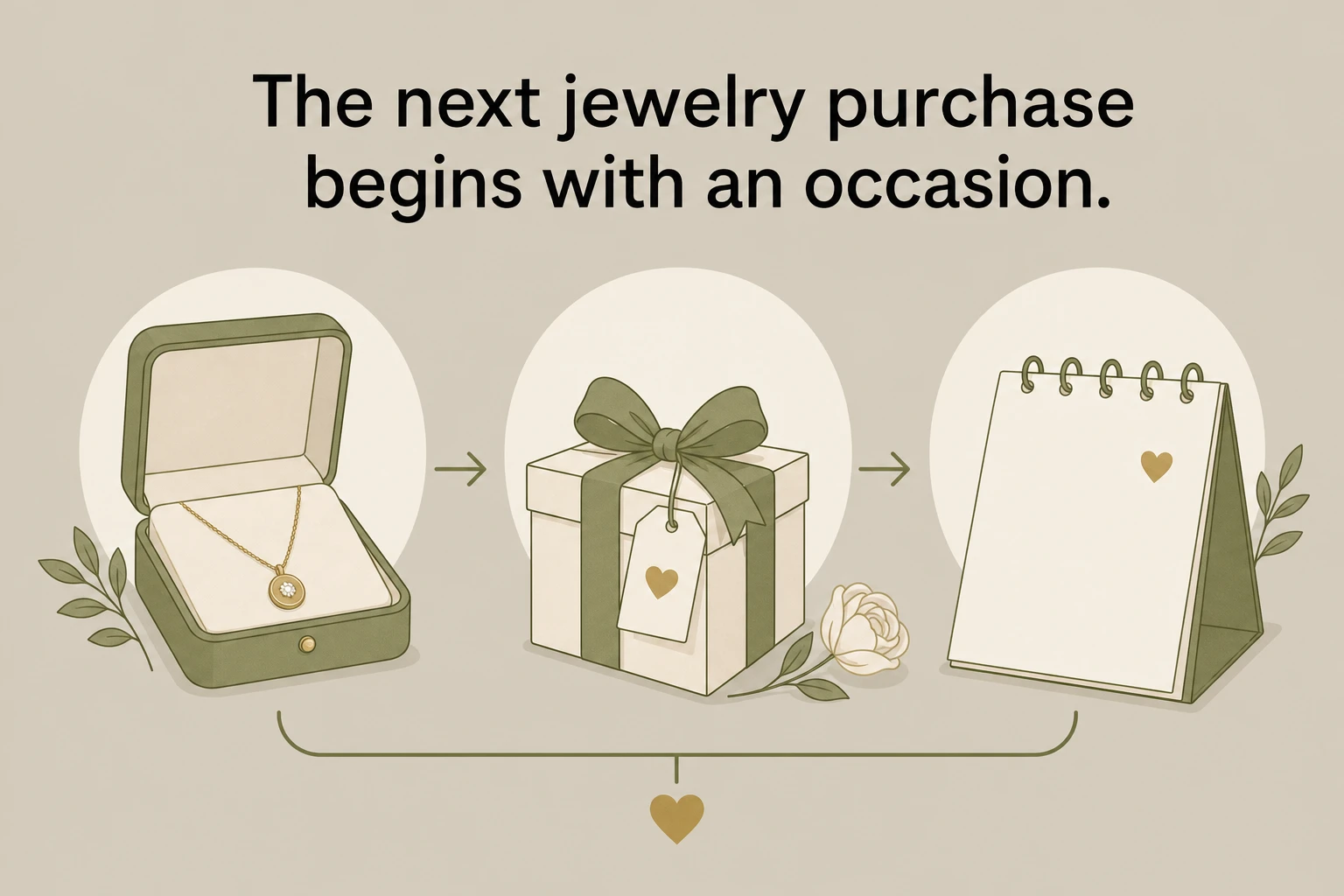
This is the mental shift jewelry brands need to make: your customer’s repurchase clock is a calendar, not a consumption cycle. They’re not going to need a new piece of jewelry. They’re going to have a reason to want one, and that reason has a date attached to it.
Build the occasion map: three trigger layers
Once you accept that occasions drive demand, the practical work is mapping which occasions matter to your specific customer base and building triggers around them. There are three layers worth separating.
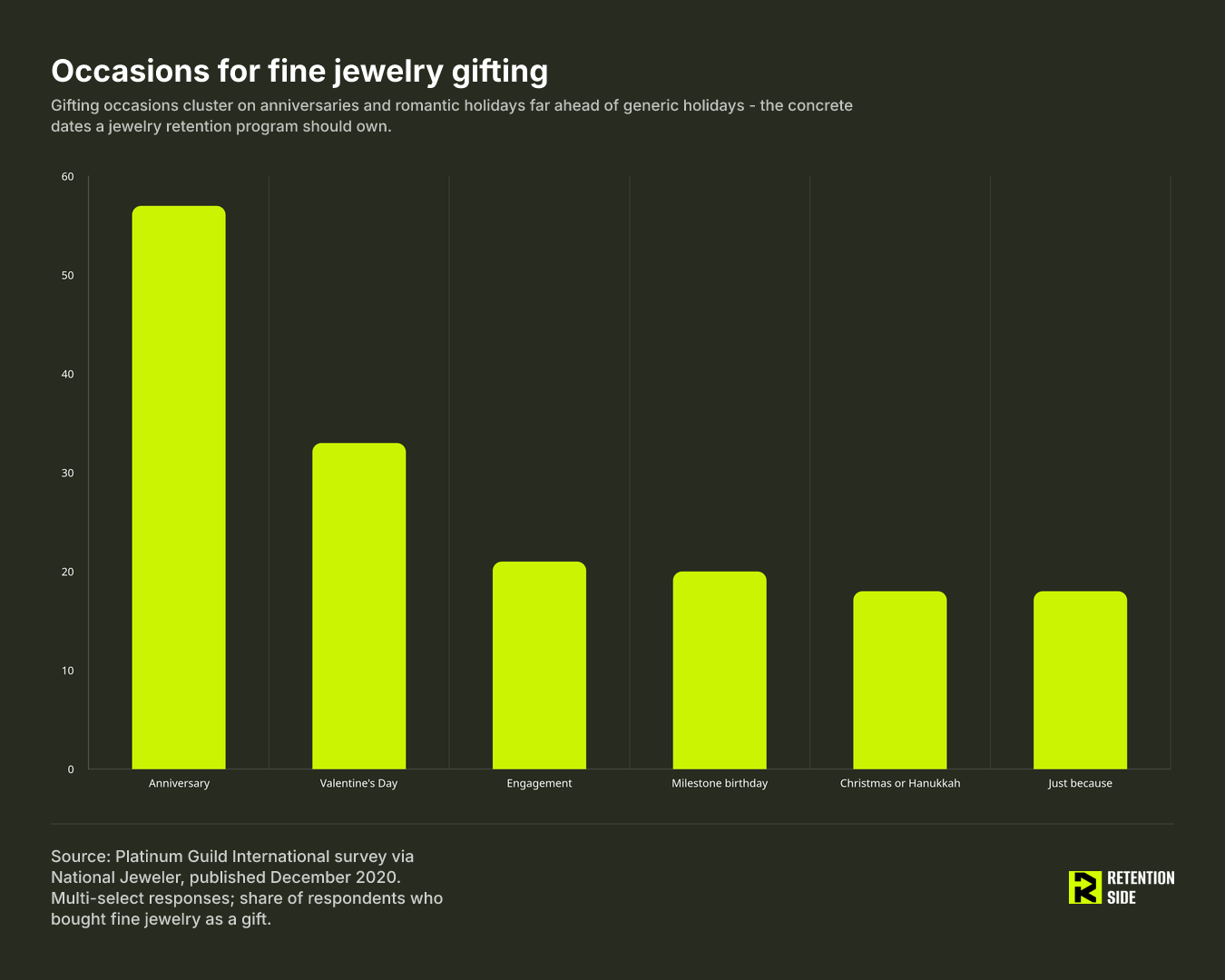
Relationship occasions are the traditional gifting drivers: anniversaries, engagements, weddings. When Platinum Guild International surveyed people who bought jewelry as a gift, anniversaries led at 57 percent, followed by Valentine’s Day at 33 percent, engagement at 21 percent, milestone birthdays at 20 percent, and Christmas or Hanukkah and “just because” purchases tied at 18 percent each. That ranking alone should reorder how you prioritize occasion-based campaigns. Anniversary reminders deserve more weight than generic holiday pushes.
Personal occasions cover the self-purchase segment, and this segment is large and growing. Half of PGI’s respondents had bought jewelry for themselves in the prior two years, and of those, 47 percent cited “just because” and 32 percent cited a milestone birthday. Gen Z self-purchases at 63 percent, well above older cohorts. Millennial women lead the self-purchase category broadly, with research showing 51 percent of millennial women earning $75,000 or more buy jewelry for themselves.
Calendar peaks are the predictable seasonal windows: Valentine’s Day, Mother’s Day, graduation season, and Q4 holidays. These matter, but they carry a risk. If your only communication rhythm is built around calendar peaks, you end up looking like every other retailer running a holiday sale, and you train your list to associate your brand with discounting rather than meaning. Layer calendar peaks on top of relationship and personal occasions, but don’t let them be the whole strategy.
Capture occasions as data, not guesses
None of this works if you’re guessing at occasion timing. The retention system has to actually know when a customer’s anniversary is, whether a purchase was a gift or a self-purchase, and who the recipient was if it wasn’t the buyer.
This means treating zero-party data collection as core infrastructure, not a nice-to-have. Post-purchase flows and welcome flows are the two best moments to ask: was this a gift, who was it for, when is the occasion, is there a recurring date worth remembering. Retention Side’s ecommerce email segmentation framework treats this kind of declared-intent data as a distinct segmentation layer, sitting alongside behavioral segments like new subscribers, engaged buyers, VIPs, and lapsed customers.
There’s also a mindset signal worth capturing. Jewelers Mutual found that roughly 60 percent of self-purchasers consider themselves collectors, meaning they see jewelry acquisition as an ongoing identity, not a one-time need. That’s a segment worth tagging and speaking to differently than a one-time gift buyer. A collector responds to new-arrival alerts and styling content. A gift buyer responds to occasion reminders and recipient-focused messaging. Treating them the same way flattens two very different motivations into one generic campaign.
Flows for a long cycle: what replaces the replenishment flow
If there’s no replenishment flow to build, what fills that automation slot? Four things, mapped to the actual customer journey rather than a fixed calendar.
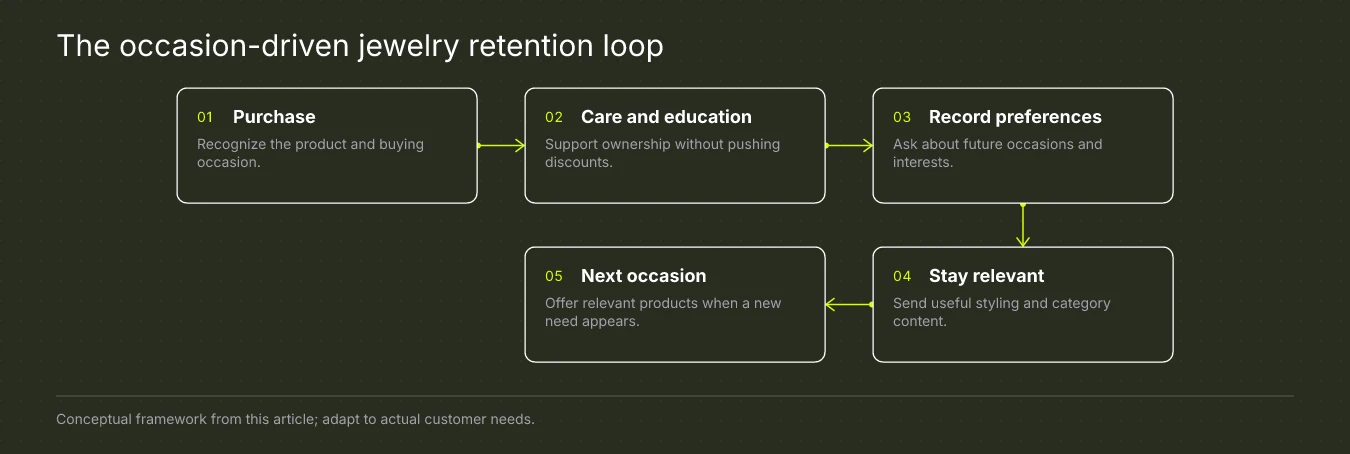
Post-purchase sequences do the early work: care and maintenance education, styling guidance, and review requests timed to when the customer has actually worn the piece enough to have an opinion. This is the bridge between purchase one and purchase two, and it’s worth building deliberately rather than defaulting to a single thank-you email.
Occasion reminders are the second layer, triggered off the declared dates you captured earlier: anniversary approaching, a past gift recipient’s birthday coming up, a self-purchase pattern suggesting the customer is due for another “just because” moment. These flows only work if the data behind them is real, which is why the capture step above isn’t optional.
Win-back flows need a different clock entirely. A 90-day lapsed trigger makes no sense for a customer whose realistic repurchase window is 12 to 36 months. Retention Side’s segmentation research is explicit on this: win-back timing has to follow each brand’s actual repurchase window, not a generic default. Sending a “we miss you” email to a jewelry customer at day 90 isn’t a nudge, it’s noise, and it risks training the customer to tune your brand out before their real occasion even arrives.
Referral and review asks belong at service moments rather than generic post-purchase windows: after a cleaning or resizing, after a positive support interaction, after a piece has clearly become part of someone’s regular rotation. These are natural points where a customer is already thinking positively about the brand, which makes the ask feel earned rather than transactional.
Loyalty without points math
Standard points-based loyalty programs assume frequent purchases to accumulate and redeem points against. That math falls apart in a 12 to 36 month cycle. Points that expire in 12 months are functionally useless to a customer who might not buy again for two years, and a program built entirely around points will feel irrelevant most of the time.
Retention Side’s loyalty research for long-cycle categories points toward a different mix: VIP status tiers based on lifetime spend rather than transaction count, early access to new collections, service perks like complimentary cleaning or inspection, and referral mechanics that reward advocacy rather than repurchase frequency. The goal of loyalty in this category isn’t to drive the next transaction next week. It’s to keep the brand top of mind for whenever the next occasion actually lands, whether that’s next month or in two years.
The collector segment mentioned earlier is a natural fit for this kind of program. A customer who identifies as a collector isn’t waiting for a discount, they’re waiting to be shown something worth adding to what they already have. VIP access and early previews speak directly to that motivation in a way a points balance never will.
Campaigns and channel mix between occasions
The long gap between purchases doesn’t mean silence between purchases. It means the content mix between transactional moments matters more, not less. If every campaign in that gap is promotional, you’ll train your list to wait for a sale, which undercuts full-price purchasing exactly when an occasion does arrive.
Balance promotional sends with content that has nothing to do with buying right now: styling guidance, care education, brand story, gift-giving guides tied to upcoming occasions on the calendar. Email carries most of this weight as the backbone channel, but the timing-sensitive layer benefits from faster channels. SMS and push notifications work well for date-specific reminders that need to land close to the actual occasion. Direct mail earns its cost for high-AOV VIP moments, where a physical touchpoint reinforces the premium positioning that email alone can’t convey.
Occasion-driven timing works only if the underlying channel mix is deliberate, matched to how time-sensitive the message actually is and how much the customer is worth.
What to measure instead of 90-day RPR
Given everything above, the KPI set for jewelry retention should look different from a consumables dashboard. Four numbers matter more than 90-day repeat purchase rate.
Returning customer rate still matters, but track it as a trend over a longer window (annually, not quarterly) rather than judging it against a 90-day snapshot. Second-purchase AOV tells you whether occasion-based nurture is working, since a customer buying again after an anniversary reminder often buys at a higher value than their first purchase. Referral rate matters more in jewelry than in most categories because gifting inherently exposes your brand to new potential buyers. Occasion-triggered revenue, meaning revenue specifically attributable to date-based flows and reminders, is the clearest proof that your occasion map is actually working rather than just looking good on paper.
If you’re only reporting 90-day RPR to leadership, you’re measuring the wrong cycle and will keep drawing the wrong conclusions about whether retention is working.
Frequently asked questions
What is the 2:1:1 rule in jewelry?
The 2:1:1 rule is a styling guideline, not a marketing or retention framework. It suggests wearing two pieces on the hands or wrists, one piece at the neck, and one pair at the ears, creating a balanced visual triangle rather than overloading any single area. It’s a useful reference if you’re producing styling content or gift guides, but there’s no established industry version of this as a marketing ratio, so treat any connection between “2:1:1” and campaign or content mix as an analogy rather than a standard.
What are the 8 C’s of customer retention?
There isn’t one agreed-upon version of this framework, and the versions that circulate genuinely conflict with each other. One commonly cited list includes Customization, Communication, Care, Community, Convenience, Character, Culture, and Commitment. Another version swaps in Consistency, Competence, and Credibility in place of several of those terms. A third list uses Cultivation and Choice instead. None of these is more “official” than the others; they’re all frameworks published by different marketing sources, not an industry standard.
For jewelry brands specifically, we’d point you toward the operational pillars that actually predict retention performance in this category: deliverability (getting occasion reminders into the inbox), list quality and zero-party data capture, occasion-triggered flows, and disciplined campaign strategy that doesn’t over-rely on discounting. That’s a practical framework, not a mnemonic, and it maps directly to how a long-cycle purchase category actually behaves.
What demographic buys the most jewelry?
Several data points converge here. Women aged 35 to 54 have historically been the demographic most likely to purchase fine jewelry, according to Freedonia Group research. By income, households earning $200,000 or more spend roughly $1,657 per year on jewelry and watches, about 2.7 times the average household, based on Bureau of Labor Statistics consumer expenditure data. On the self-purchase side specifically, Millennials lead at 86 percent having bought fine jewelry for themselves, ahead of Gen X at 81 percent, and millennial women with household income above $75,000 stand out as a particularly strong self-purchase segment, with over half buying jewelry for themselves and the vast majority researching a brand before buying. There’s no single answer, but the pattern is consistent: higher-income women in the 35 to 54 range remain the core buyer, while Millennials are the fastest-growing self-purchase segment.
How to attract customers to your jewellery business?
Start from the fact that shopping behavior in this category is genuinely omnichannel, with in-store and online preference nearly split (42 percent versus 40 percent) and the ability to try a piece on before buying cited as the top reason people still shop in person, according to YouGov research. That means your acquisition strategy needs a strong digital presence even if a meaningful share of purchases eventually close in a physical location.
Beyond channel presence, the occasion data throughout this article is itself an acquisition lever. Nearly 80 percent of adults now self-purchase fine jewelry, and 91 percent of millennial female buyers research a brand before purchasing. That means visibility, brand story, and social proof matter before the purchase decision even starts. New customer acquisition and retention aren’t separate problems in this category. The same occasion-based content that keeps existing customers engaged (gift guides, styling advice, milestone-tied campaigns) is also what earns new customers’ attention in the research phase, because it gives them a reason to engage with your brand that has nothing to do with a discount code.
The takeaway
Jewelry retention isn’t a weaker version of consumables retention, it’s a structurally different problem that needs its own logic. The brands that get this right stop measuring themselves against 90-day RPR, build real infrastructure to capture occasion data, and design flows, loyalty mechanics, and campaigns around a calendar of dates rather than a consumption cycle that doesn’t exist in this category.
That’s the same system-level thinking Retention Side applies across the retention programs we build for established eCommerce and DTC brands, jewelry and luxury included. Occasion capture feeds segmentation, segmentation feeds flows and campaigns, and loyalty mechanics tie the whole loop together so the next purchase has somewhere to land when the occasion actually arrives.