

Baby brands have one of the most predictable customer lifecycles in eCommerce, and most of them still email as if every subscriber were a generic shopper. The customer’s need changes on a developmental clock. Newborn becomes crawler, crawler becomes toddler, and each shift quietly ends the relevance of what you sold last. The brand that sees the shift coming gets the next order. The brand that keeps sending the same discount calendar gets unsubscribes.
That is the real problem behind email marketing for baby brands. It is not about prettier templates or more sends. It is about building a retention system that tracks the child’s stage, respects the parent’s trust, and times every message to a need that actually exists.
Key takeaways
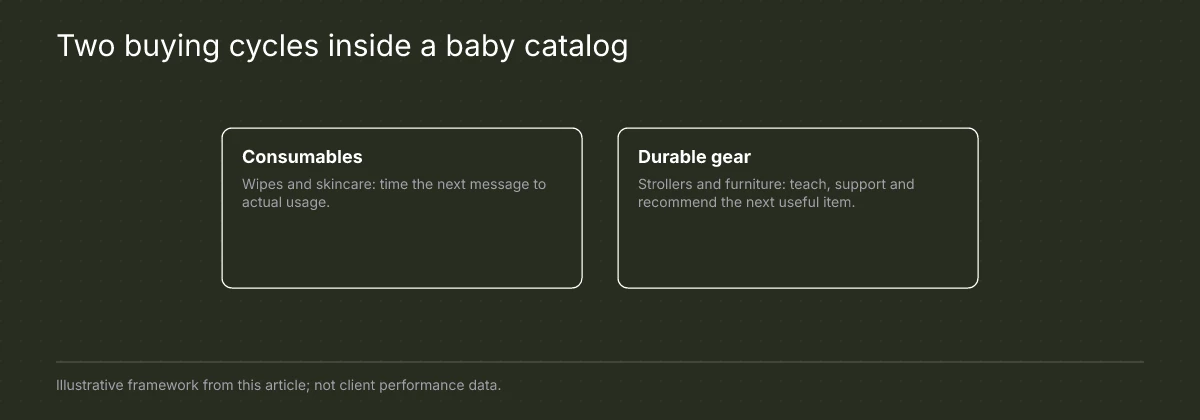
- A baby catalog usually contains two repurchase economies: high-frequency consumables and durable gear bought once per child. One playbook cannot serve both.
- The child outgrows the product, not the brand. Your email program has to track child age, not only customer recency.
- One well-placed question about due date, birth date, or stage becomes the segmentation anchor for every flow and campaign that follows.
- Win-back, replenishment, and next-stage prompts should be timed to the product’s real cycle, not a fixed 90-day rule.
- Measure repeat customer rate and lead-to-customer rate before open rate or revenue per recipient.
Two repurchase economies in one catalog
Look at how repeat purchase behavior varies by category. Eightx’s 2026 benchmarks, as cited in Retention Side’s own analysis, put the cross-vertical average repeat purchase rate at 28.2%. Consumable categories such as supplements, beauty, and food and beverage land around 45-55% on a 365-day view. Home and electronics sit closer to 20-25%.
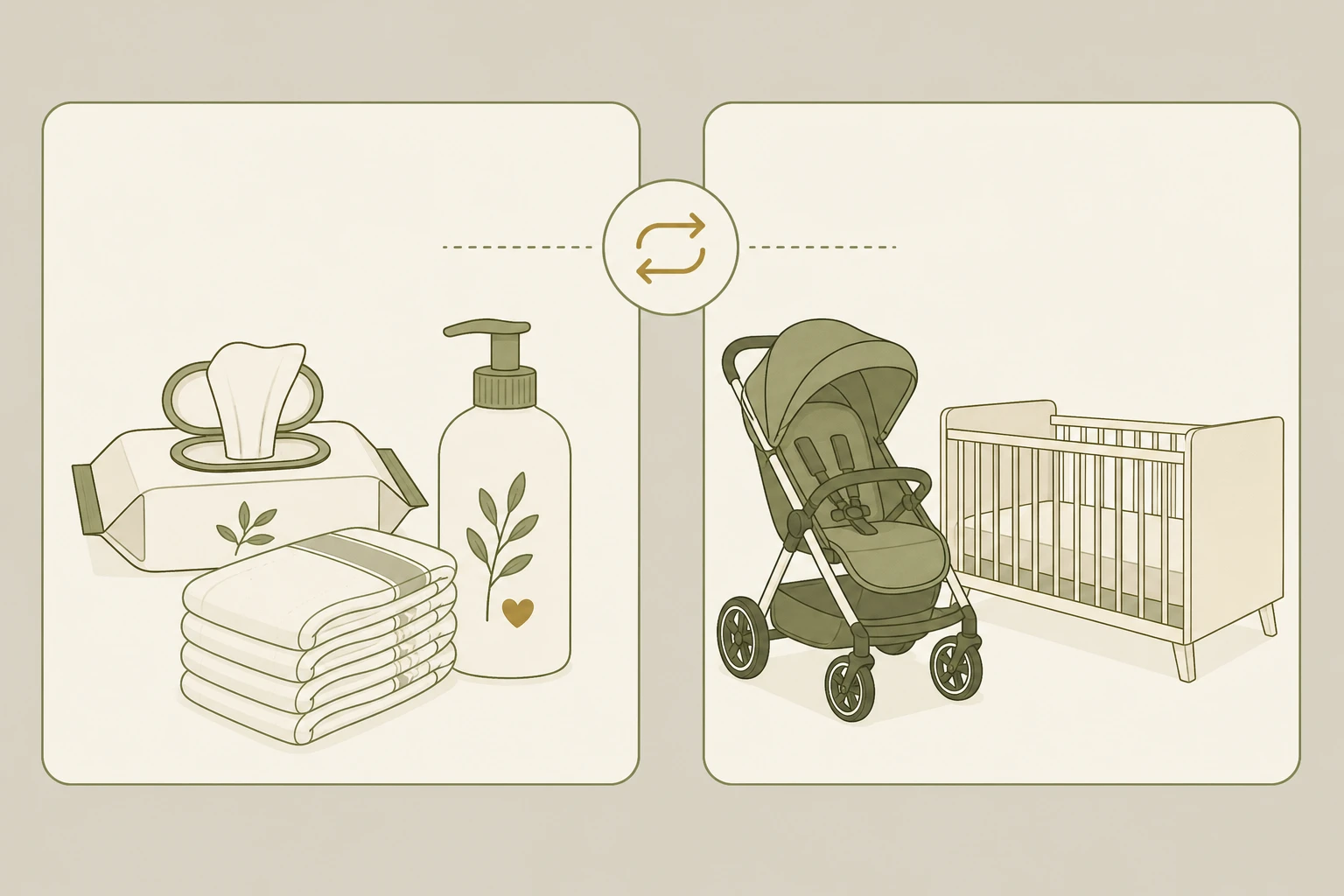
Baby brands straddle that divide. Wipes, bath products, and food behave like consumables. Strollers, cribs, and carriers behave like durables. In our view, a brand selling both should expect its catalog to split in the same way, and its email program has to split with it.
Timing matters as much as the rate. The same Eightx data shows food and beverage compressing 64% of annual repeat purchases into the first 30 days. When a product is used up on a schedule, replenishment timing has to follow the consumption cycle. A calendar promotion that lands two weeks early or late misses the moment.
For durable gear the logic flips. You will not sell a second crib to the same family on a schedule. What you can do is earn the next stage: the toddler bed, the booster seat, the next size of clothing, and the referral to the next expecting friend.
The child outgrows the product, not the brand
Generic lifecycle thinking asks how long it has been since the customer last bought. Baby asks a different question: how old is the child now?
A parent who bought newborn essentials eight months ago is not “lapsed” in the usual sense. Their need moved on. If your win-back flow fires a 90-day “we miss you” message featuring newborn products, it is accurate on recency and wrong on relevance. Relevance decays on a child-age timeline, and silent failure is the usual result: no complaint, just a parent who stops opening.
This is where standard flows underperform in the category. They are built around the customer’s last action. A baby program needs a second clock running beside it, the child’s stage, and it needs to be able to use both.
Build the data foundation first
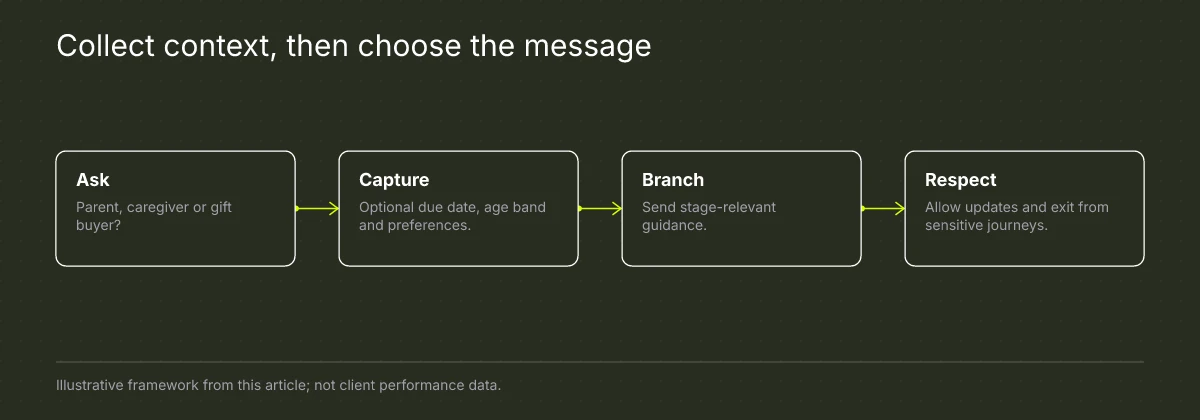
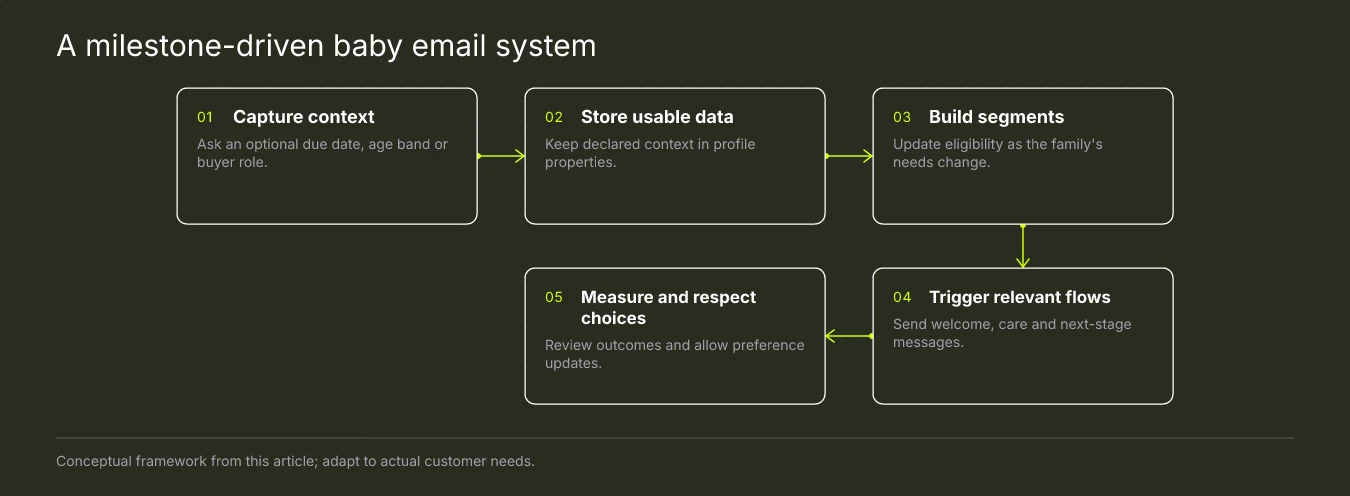
You cannot run a stage-based program without stage data. The cleanest way to get it is zero-party data: information the parent tells you directly. A single qualifying question in the signup form or the first welcome email, such as due date, child’s birth date, or current stage, can become a profile property in Klaviyo that anchors segmentation across every downstream flow and campaign. Retrofitting that property later is significantly more work than collecting it at the start.
Three practical rules:
- Ask one question at the moment attention is highest. The signup form is the best place. A long form damages conversion and the experience, so keep the ask short and let the welcome series collect the rest.
- Explain why you are asking. Salesforce research, cited through HubSpot, found that 71% of customers are more likely to share data with a brand that clearly explains how it will be used. A line like “so we only send what fits your baby’s stage” does real work.
- Make the field usable. A date is more valuable than a free-text answer, because a date lets you calculate age and trigger on it automatically.
Keep the lead-to-customer rate in view here. A longer form may reduce raw submissions and still raise the share of subscribers who buy. Form submission rate is not the goal.
Map flows to the baby lifecycle
Flows are behavior-based, time-sensitive automations, and baby is a category where timing carries more meaning than usual. Here is how the core flows change.
Welcome series that branches by declared stage
If the subscriber told you their stage at signup, serve relevant content from email 2 onward. Branching a welcome series on declared data tends to produce a consistent, meaningful conversion lift. An expecting parent needs preparation and checklists. A parent of a six-month-old needs weaning, sleep, or mobility. Same brand, entirely different first week.
Post-purchase education and handoff
The post-purchase window is the highest-engagement moment in the lifecycle. For baby, use it to teach: how to use, clean, and size the product, and what to expect next. Then hand off to cross-sell, replenishment, and loyalty flows. Treat these as starting points. Flows are never finished and should be tested and improved continuously.
The stakes are real. The probability of a second purchase is roughly 27% after the first order, about 54% after the second, and above 70% by the fourth, as cited in Retention Side’s post-purchase analysis. Getting parents to order two is the job of this flow.
Replenishment and next-stage prompts
For consumables, the most effective in-sequence recommendation is a replenishment prompt, with catalog expansion saved for later touchpoints. For apparel and gear, the equivalent is a size-up or next-stage prompt timed to the child’s growth. Bain & Company research, as cited by Retention Side, found repeat apparel customers spent 67% more in months 31-36 than in their first six months. Families who stay with a brand through several stages are worth substantially more than the first order suggests.
Browse abandonment for researchers and gift buyers
Baby brands get heavy research-driven browsing from expecting parents and gift buyers. Browse abandonment can only reach people you have captured, so on-site email capture determines how much of that product-page traffic your flow can ever touch.
Win-back timed to the product
Skip the fixed 90-day trigger. Segment by the expected repurchase window for the product type. A buyer of a monthly consumable who has been silent for 45 days is in a different position than a durable-goods buyer silent for 60 days. For baby, add the child-age check: if the child has moved past the product’s stage, the win-back should offer the next stage, not the last one.
Segment by child stage, household, and buyer type
Start with the six core DTC segments: new subscribers, active customers, VIPs, lapsed customers, unengaged subscribers, and non-purchasers. Then layer baby-specific logic on top.
- Child stage. Expecting, newborn, infant, toddler, and so on, calculated from the date you collected.
- Multi-child households. A parent of a toddler who has just had a second baby is in two stages at once. Let the profile hold more than one child where your data allows.
- Parents versus gift buyers. A gift buyer needs occasion-led, low-research messaging and should not receive a replenishment sequence for products they bought once for someone else.
- Registry and shower activity, if you capture it, which signals a burst of buying followed by a natural quiet period.
Dynamic segments matter more than static lists here, because a child’s stage changes every month without any action from the customer.
Campaigns: educate first, discount second
Campaigns are manual sends to selected segments, and in this category segmentation decides whether they work at all. A newborn-stage message sent to your full list is noise for half of it.
Balance matters too. If subscribers only hear from you during discounts, engagement and full-price purchasing decline over time. Parents of babies are especially open to useful content: sleep, feeding transitions, safe use, what to buy before the birth, what to expect at the next stage. Build a mix that includes educational and value-driven campaigns, milestone moments, and gifting occasions, with promotions placed deliberately rather than as the default.
Be careful with tone and claims. Parents are making decisions about their child’s safety and development. Keep claims accurate, avoid manufactured urgency around health or safety, and write as a knowledgeable peer rather than a pressure campaign. Trust is the asset, and a single clumsy message can cost more than a promotion earns.
Remember that a drop in performance does not always mean email is broken. Shifts in traffic quality, acquisition mix, or on-site conversion can show up in email metrics first.
Where other channels earn their place
Email usually comes first, but it should not carry everything. SMS fits time-sensitive moments: a restock reminder, a delivery-window update, a limited-time size-up window. In win-back, email carries the primary sequence and SMS plays a distinct supporting role after email fails, with a tighter message, a closer deadline, and a direct link. It should not echo the email.
Loyalty fits consumable frequency, where repeat orders are the point. Direct mail can suit gifting and milestone moments where a physical touch carries weight. The right mix depends on audience behavior, communication preferences, cost, and reach. For a wider view of how channels fit together, see Retention Side’s piece on what channels make a good eCom retention strategy.
What to measure
Start with repeat customer rate, the most important retention metric, and add lead-to-customer rate as the real list-growth KPI. Time between orders is especially revealing for baby, because it shows whether your timing matches real consumption and growth cycles.
Treat open rate carefully. After Apple Mail Privacy Protection it is distorted, and it is useful mainly as a deliverability red flag. Revenue per recipient will also mischaracterize educational sends, which exist to build trust and stage-appropriate relevance rather than to close the sale that day.
When performance slips, diagnose in order. Start with deliverability, then list health, then flow coverage and trigger reliability, then creative and offer quality. A spam complaint rate creeping toward 0.1% shows up in inbox placement within weeks, and Gmail and Yahoo bulk-sender requirements are hard thresholds. Delivery means the email was received. Deliverability means it landed somewhere useful. Baby lists age fast as children move past the stage, so engagement-based list hygiene is part of the infrastructure, not an afterthought.
How the system comes together
Retention Side works with baby and kids brands as one of the industries we serve, and the pattern we see is consistent: the failures are rarely in a single email. They are gaps between pieces. A good form with no stage question. A welcome series that ignores the answer. A win-back that fires on recency while the child has moved on.
Our approach anchors the program on four pillars: deliverability, list growth, automated flows, and campaigns. For a baby catalog, that means a clean sending foundation, a capture strategy built around stage data, flows mapped to consumption and growth cycles, and a campaign calendar that educates before it discounts. Then it extends into SMS, push notifications, direct mail, loyalty, WhatsApp, and Viber where behavior and cost justify them.
Here is how the pieces connect: a signup form with one stage question feeds a Klaviyo profile property. That property drives a branching welcome series, then post-purchase education, then replenishment or next-stage prompts by product type. Win-back runs on the product’s repurchase window, campaigns run across stages, and what you learn from campaign performance feeds back into segmentation. Segmentation is continuous, not a finished project.
This is why an email-only setup that treats the channel as a campaign engine tends to underperform here. The category rewards a system that knows who the child is today.
Retention is a race against the calendar
In baby, every customer has an expiry date on their current need and a start date on the next one. Your job is to be the brand that already knows the difference. Collect the stage, time to the cycle, teach before you sell, and keep the whole system, from inbox placement to loyalty, working toward the next order the family will actually need.