


Most ecommerce brands have Klaviyo installed. Far fewer have it actually built. The gap between those two states is where most of the platform’s revenue potential quietly disappears. A brand doing $400,000 a month might be using Klaviyo for little more than a welcome series and a monthly promo blast, while the same account has predictive churn scoring, RFM-based segmentation, and omnichannel flow logic sitting unused in the background.
This matters because Klaviyo is not a generic email tool with a bigger feature list. It is the only CRM built for B2C brands, and its architecture reflects that. The company now works with over 193,000 brands, according to its most recent official disclosure, and its data platform processes more than 2 billion events daily across 7 billion-plus customer profiles. That scale exists because the platform was designed around one idea: retention decisions should be made from behavior, not from static contact lists.
This article is not a tour of every button in the Klaviyo dashboard. It is a strategic inventory of the features that actually change revenue outcomes for operators running real ecommerce businesses, organized around how they connect to the bigger retention system rather than treated as a checklist.
What this article covers
Before getting into specifics, here is the shape of what follows: the data foundation that makes everything else possible, segmentation and RFM logic, the flow infrastructure that does the heavy lifting, omnichannel expansion into SMS and other channels, the AI and predictive layer, analytics and attribution, a short timeline of what has actually shipped in 2025 and 2026, and a direct comparison against Shopify Email for brands trying to decide whether Klaviyo is worth the move.
The data foundation: unified customer profiles and behavioral tracking
Every meaningful Klaviyo feature depends on the same underlying layer: a unified customer profile fed by real-time behavioral events. When a customer views a product, adds it to cart, starts checkout, completes a purchase, or returns to the site three days later, that event flows into Klaviyo and attaches to their profile almost instantly. This is the difference between sending emails to contact lists and sending emails in response to what individual customers actually do.
This tracking runs through Klaviyo’s own JavaScript on the storefront, which means it captures behavior from anonymous visitors, not just logged-in customers. That distinction sounds technical but has real revenue consequences. A platform limited to logged-in account data misses most of the behavior that actually predicts purchase intent, because most shoppers browse and abandon carts before ever creating an account.
The connective tissue behind this is Klaviyo’s library of 350+ pre-built integrations and open APIs, which pull data from Shopify, subscription platforms, loyalty systems, customer service tools, and reviews platforms into the same profile. For a brand doing meaningful volume, this matters more than it sounds. It means segmentation and flow triggers can be built on actual purchase behavior, product affinity, and lifecycle stage rather than blunt instruments like “has opened an email in the last 90 days.” The data foundation is not a feature you evaluate on its own. It is the infrastructure every other feature depends on.
Segmentation and RFM analysis
Segmentation in Klaviyo goes well past basic list splits. Segments can be built from hundreds of data points spanning purchase history, browsing behavior, email and SMS engagement, predictive scores, and custom properties pulled in through integrations. Segment AI extends this further by letting you describe a segment in natural language and have Klaviyo translate that into the underlying logic, which speeds up segment creation without sacrificing precision.
The more consequential addition is the RFM Action Center, released in early 2025. RFM stands for recency, frequency, and monetary value, and it is one of the oldest and most reliable frameworks for understanding customer value. Klaviyo’s version applies this logic automatically across your customer base and surfaces one-click, ready-to-use segments for high-value customers, customers showing early churn signals, and customers who have already lapsed, along with recommended actions for each group.
This is where segmentation stops being a data exercise and starts becoming a retention strategy. A brand that only segments by “purchased in last 30 days” versus “never purchased” is working with a fraction of the signal available. RFM-based logic lets you treat a customer who buys frequently but at low value differently from one who buys rarely but at high value, which is exactly the kind of distinction that should drive different messaging, different offers, and different flow timing. For a deeper breakdown of how to structure this for a Shopify store specifically, this connects directly into the mechanics covered in Retention Side’s segmentation strategy work.
Automated flows: the always-on revenue engine
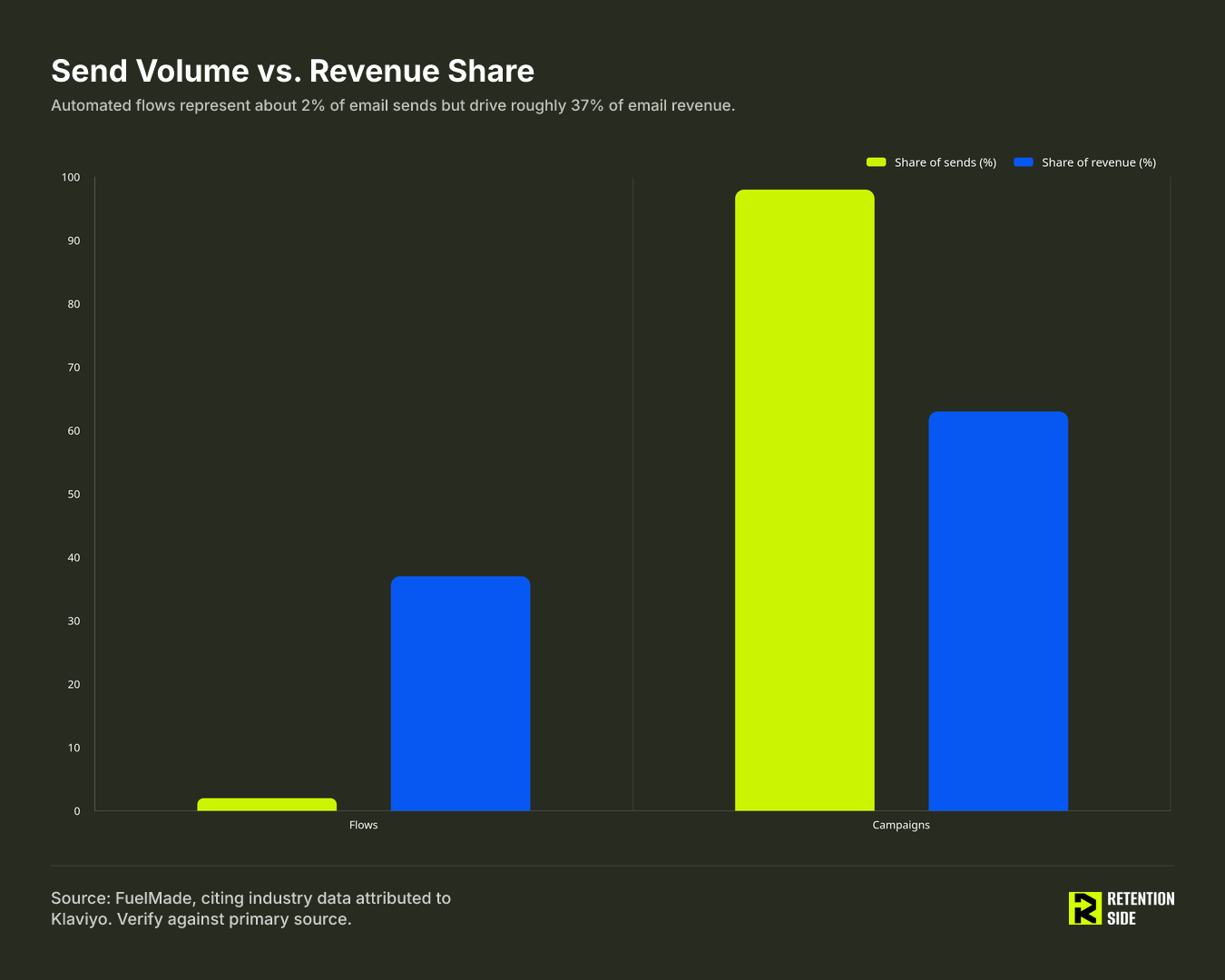
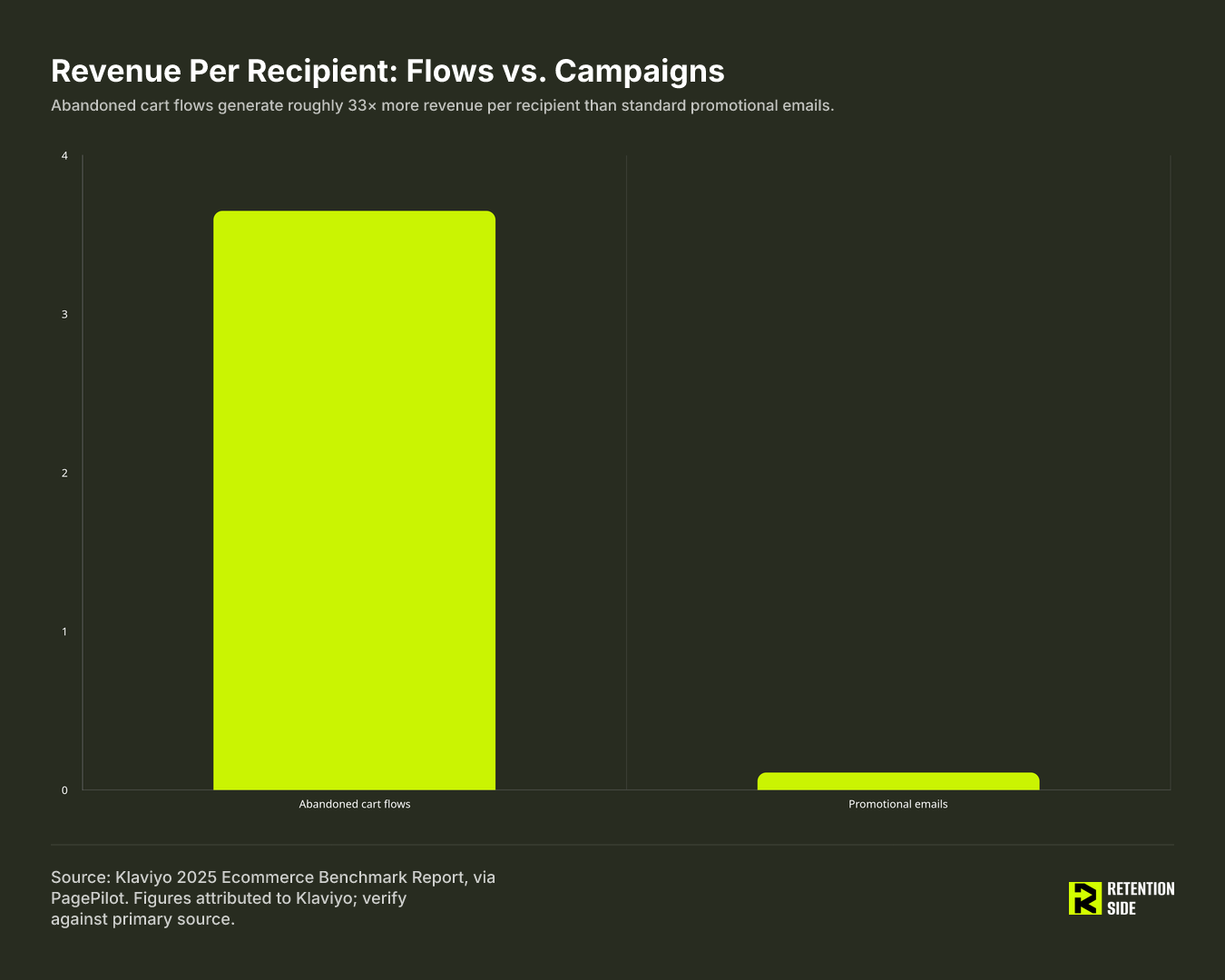
Flows are where most of Klaviyo’s revenue impact actually lives, and the data backs this up in a way that should reorient how operators think about where to spend their attention. Automated flows typically represent a small fraction of total email sends, yet they generate a disproportionate share of email revenue because they reach customers at the exact moment behavior indicates intent or risk. That imbalance is not a coincidence. A welcome flow triggers when someone is at peak interest. An abandoned cart flow triggers when someone has already shown purchase intent and simply stalled. A win-back flow triggers when a valuable customer’s behavior signals they are drifting away. None of that timing exists in a manual campaign sent to a static list.
Klaviyo ships with over 60 pre-built flow templates covering the core ecommerce lifecycle: welcome series, abandoned cart, browse abandonment, post-purchase, cross-sell and upsell, win-back, and sunset flows for disengaged subscribers. The drag-and-drop builder supports conditional splits and branching logic, so a single flow can route customers differently based on order value, product category, predicted CLV, or engagement history rather than sending everyone the same three emails regardless of context.
Two newer additions change how quickly this infrastructure gets built and maintained. Flows AI can generate a working flow structure from a brief description, which is useful for standing up a new flow fast, though it still needs a strategist’s eye to get the logic and timing right for a specific brand. Flows Analyst audits existing flows against benchmarks drawn from Klaviyo’s full brand base, which is a genuinely useful way to spot underperforming flows without guessing.
The strategic point worth internalizing here is that flows are never finished. A welcome flow that converts well in month one can decay as your audience mix changes or your offer structure shifts. Treating flows as a one-time build rather than an ongoing system is the single most common way brands leave revenue on the table. Retention Side’s post-purchase flow guide and flows-versus-campaigns breakdown both go deeper into how to structure and maintain this system over time.
Omnichannel: email, SMS, push, WhatsApp, and RCS
Klaviyo’s expansion beyond email is not a side feature anymore. It reflects a real shift in how the platform is positioned, and the June 2025 omnichannel release made that explicit with native WhatsApp and RCS support, an Omnichannel Campaign Builder, and Channel Affinity AI that learns which channel and send time each individual customer actually responds to.
The practical value here is not “more channels for the sake of more channels.” It is the ability to build a single flow that intelligently routes a message to whichever channel a specific customer is most likely to engage with, rather than forcing every customer through the same email-first sequence regardless of their actual behavior. A customer who never opens email but consistently clicks SMS should not keep receiving email as the default channel simply because that is how the flow was originally built.
Push notifications got a meaningful upgrade too, with silent pushes and dynamic app badges giving brands with a mobile app more subtle ways to re-engage without relying purely on promotional blasts. The Omnichannel Campaign Builder, which moved to general availability in the third quarter of 2025, lets a team plan a multi-day, multi-channel campaign from a single canvas rather than building separate campaigns in separate tools and trying to keep the messaging consistent by hand.
This is the point in the platform’s evolution where Klaviyo starts to resemble the broader retention system Retention Side has always argued brands should be building, one where email is the starting point but not the ceiling, and channel selection is based on actual audience behavior rather than default habit.
Klaviyo AI and predictive analytics
This is the layer that separates operators who use Klaviyo strategically from those who treat it as a glorified send tool. Predictive analytics surfaces a predicted next order date, a churn risk score, predicted lifetime value, and average time between orders directly on customer profiles. These are not decorative dashboard numbers. They become inputs for segmentation and flow logic, letting you trigger a win-back sequence before a customer actually churns rather than after, or route your highest predicted-LTV customers into a different post-purchase experience than one-time buyers.
There are real prerequisites here worth knowing before you expect these numbers to appear. Klaviyo requires at least 500 customers with non-cancelled, non-refunded orders, a connected ecommerce integration such as Shopify, at least 180 days of order history with recent order activity, and some customers with three or more orders. Brands below that threshold will not see predictive fields populate, which is a reasonable reason some smaller accounts underuse this feature; it simply is not available to them yet.
Personalized campaigns AI takes this further by testing and serving the best-performing message variant to each individual subscriber rather than picking one winner for the whole list. Early-access users reportedly saw open rate or SMS click rate lifts north of 26 percent, which is a meaningful improvement for a feature that runs largely in the background once configured.
The newest layer is Composer, an AI marketing agent that moved to public beta in mid-2026. Composer can generate a complete flow, segment, or push notification from a single plain-language prompt, with copy adapted per channel. Alongside it, Customer Agent has expanded into retail-specific skills like order tracking, returns and exchanges, subscription editing, and loyalty lookups, functioning as a 24/7 support layer that sits on the same customer data as your marketing. Auto Monitors AI rounds this out by flagging real-time performance dips in campaigns or flows before a small problem becomes a large one.
The honest framing for an operator evaluating these tools: they compress the time it takes to build and monitor a retention system, but they do not replace the strategic judgment of knowing which flows matter, which segments deserve different treatment, and which channels fit your specific customer base. AI tools built on top of a weak strategic foundation just produce more content faster, not better results.
Analytics, benchmarks, and attribution
The reporting layer is where a lot of brands underinvest their attention relative to how much decision-making value it holds. The Conversion Overview Dashboard, SMS Performance Dashboard, and Subscriber Growth Report give a consolidated view of what is actually driving revenue rather than forcing you to stitch together numbers from separate flow and campaign reports.
Benchmarks let you compare your account’s performance against peer brands, which is a genuinely useful reality check. A 22 percent open rate might look fine in isolation and look mediocre once you know what comparable brands in your category are actually achieving.
Multi-Touch Attribution, which reached general availability in mid-2025, moves attribution logic past last-click, giving a more accurate picture of how email, SMS, and other channels contribute across a longer customer journey rather than crediting whichever message happened to be sent right before a purchase. This matters more as brands add channels, because last-click attribution systematically undervalues earlier touchpoints in a multi-channel sequence.
Product analysis is a quieter but useful addition, surfacing frequently bundled items and repeat purchase trends. This feeds directly into merchandising decisions and post-purchase flow logic, since knowing what customers tend to buy next after a specific product is exactly the kind of signal that should shape a cross-sell sequence. Retention Side’s benchmarks article covers how to read these numbers in context rather than in isolation.
What’s new in Klaviyo: a 2025-2026 timeline
Klaviyo’s release pace has been fast enough that it is worth a straightforward timeline rather than trying to track every update individually.
January 2025 brought the RFM Action Center, product analysis, AI-powered per-subscriber campaign personalization, real-time form optimization, and the Conversion Overview, SMS Performance, and Subscriber Growth dashboards. A few weeks later, the Q1 2025 product release added spin-to-win sign-up forms, enhanced mobile push with silent pushes and dynamic badges, two-way automated SMS conversations, Auto Monitors AI, and review syndication across storefronts and the Shop app.
June 2025 was the omnichannel release: the Omnichannel Campaign Builder in beta, Channel Affinity AI at general availability, native WhatsApp and RCS support in beta, and Multi-Touch Attribution reaching general availability by the end of the month.
By March 2026, Klaviyo shipped its AI agents update, including Composer in private beta, an expanded Customer Agent with retail-specific skills, Agent Guidance for tone and escalation control, RCS reaching general availability, Instagram auto-replies, personalized onsite banners, and Flows Analyst for benchmarking flows against Klaviyo’s full brand base. Composer moved to public beta by June 2026 and by August 2026 had expanded to draft complete flows, segments, and push notifications from a single prompt with channel-specific copy.
The pattern across all of this is consistent: less manual configuration, more behavioral triggering, and a growing emphasis on omnichannel logic that treats email, SMS, push, and messaging apps as one coordinated system rather than separate tools that happen to share a login.
Klaviyo vs Shopify Email: what’s actually different
This comparison comes up constantly for Shopify merchants deciding whether to move off Shopify Email, and the differences are bigger than a feature checklist suggests.
Shopify Email offers roughly nine basic automations, most of them single-message sends without meaningful branching logic. Klaviyo offers over 60 pre-built flows with multi-step conditional logic, meaning a single flow can route customers differently based on their behavior rather than sending the same message to everyone who triggers it.
The data depth is the more fundamental difference. Shopify Email works from logged-in customer account data. Klaviyo captures behavioral data from anonymous visitors through its own tracking script, tying product views, add-to-cart events, and purchase history to unified profiles regardless of login status. This is not a minor technical detail. Brands moving from Shopify Email to Klaviyo often see the eligible recipient pool for abandonment flows increase three to five times over, simply because Klaviyo can see and act on behavior that Shopify Email never captures in the first place.
Channel coverage is another clear split. Klaviyo includes native SMS, push, WhatsApp, and RCS. Shopify Email’s SMS capability has remained in beta. Klaviyo also includes built-in A/B testing, RFM analysis, and predictive analytics as core features. Shopify Email does not offer equivalents to any of these.
Pricing models differ too, and this is worth being clear-eyed about rather than treating Klaviyo as automatically the right call regardless of size. Shopify Email includes 10,000 free sends per month, which can genuinely cover a very small store’s early volume. Klaviyo’s free tier covers 250 active profiles and 500 emails per month, a much lower ceiling that reflects its focus on paid usage as a list grows. For a brand doing under six figures a month with minimal behavioral complexity, Shopify Email’s simplicity might be defensible for a short period. For a brand doing $300,000 or more a month, the revenue difference from deeper behavioral targeting and flow complexity almost always outweighs the cost difference, particularly once you consider that automated flows have historically driven a wildly disproportionate share of total email revenue relative to their share of sends.
It is also worth noting that this is not really a competitive rivalry. Shopify invested $100 million in Klaviyo in 2022 and made it the recommended email solution for Shopify Plus merchants, which is a strong signal about where Shopify itself sees the ceiling of its own native tool. Retention Side’s Shopify welcome flow guide covers more of the practical setup differences for merchants making this move.
FAQ: Klaviyo, ecommerce, and website features
What are some good features for an e-commerce website?
A strong ecommerce website needs a well-organized product catalog with clear categorization, a shopping cart that supports guest checkout alongside account-based purchasing, and a secure checkout with multiple payment options including credit cards, digital wallets, and buy-now-pay-later. Real-time shipping rate calculation and automated tax handling reduce cart abandonment caused by surprise costs at checkout. Search functionality with filtering and sorting matters more than most brands realize, since customers who cannot find a product quickly tend to leave rather than dig. Mobile optimization is not optional given how much ecommerce traffic arrives on phones, and security measures including PCI compliance and encryption protect both the business and the customer. Customer accounts with order history and wishlists, visible reviews and social proof, and integrated marketing tools for email and abandoned cart recovery round out what a modern storefront needs to convert and retain traffic effectively.
What are the key features of e-commerce?
At a category level, ecommerce depends on product and inventory management, a functioning cart and checkout system, secure payment processing, shipping and tax logic, customer account infrastructure, search and navigation, mobile responsiveness, and security compliance. Beyond the storefront itself, marketing and retention tools including email automation, SMS, and analytics reporting are what actually turn a functional store into a growing one. The storefront gets someone to the point of purchase. The retention layer, built on the behavioral data that storefront generates, is what determines whether that customer buys once or becomes a repeat customer worth real lifetime value.
What are the key differences between Klaviyo and Shopify?
Shopify is an ecommerce platform that runs your storefront, checkout, and order management. Klaviyo is a marketing and retention platform that connects to Shopify and uses its behavioral and order data to power segmentation, flows, and campaigns. They are not direct competitors, though Shopify does have its own basic email tool, Shopify Email, built into the platform. The meaningful comparison is between Klaviyo and Shopify Email specifically: Klaviyo offers deeper behavioral tracking including anonymous visitor data, over 60 flow templates with conditional branching versus roughly nine basic automations, native SMS, push, WhatsApp, and RCS support, and built-in predictive analytics and RFM segmentation. Shopify Email is simpler, included in Shopify’s core plans, and reasonable for very early-stage stores, but it lacks the behavioral depth and automation complexity that brands need once they are running a real retention system rather than sending occasional newsletters.
What are the new features in Klaviyo?
The most significant recent additions include the RFM Action Center and predictive campaign personalization from early 2025, an omnichannel expansion in mid-2025 bringing native WhatsApp and RCS support along with Channel Affinity AI and Multi-Touch Attribution, and an AI agents release in 2026 centered on Composer, an AI agent that builds complete flows, segments, and push notifications from a single prompt, alongside an expanded Customer Agent handling retail-specific support tasks like order tracking and returns. Flows Analyst, which benchmarks a brand’s flows against Klaviyo’s full customer base, and Auto Monitors AI, which flags performance dips in real time, are two of the more practically useful additions for operators who want ongoing visibility without manually checking every flow’s performance each week.
The takeaway
The right question is never which Klaviyo features exist. It is which of those features are actually connected to your customer behavior and wired into a system that acts on it. A brand with predictive analytics enabled but no flow logic built around churn risk scores has a feature installed, not a system built. The same is true of RFM segments sitting unused, or omnichannel channels added without any logic for when a customer should actually receive a WhatsApp message instead of an email.
Getting the foundation right, meaning clean data flow, well-structured flows, and segmentation that reflects real customer value, matters more than adopting every new AI feature Klaviyo ships. Once that foundation is solid, the newer capabilities compound rather than distract. That sequencing, building the system before expanding it, is the difference between a brand that has Klaviyo and a brand that actually runs on it.